Standing up for credit unions: Why Warren’s overdraft critique misses the mark.

Senator Elizabeth Warren’s recent broadside against credit unions – calling their overdraft practices “predatory” amid Americans’ economic struggles – is well-intentioned but misguided.
Her December 2 letter, co-signed by Senators Cory Booker and Richard Blumenthal, paints all credit unions with the same brush as profit-driven big banks. In reality, credit unions operate on a fundamentally different model – one that prioritizes members over profits – and their overdraft programs provide a voluntary safety net that many working families need.
Credit unions are not-for-profit, member-owned cooperatives. This means any earnings are returned to members in the form of lower fees, better rates, and community services – not siphoned off to enrich shareholders. As I have previously written, “We are not-for-profit, member-owned, and dedicated to returning any surplus to our members – with lower fees, better savings rates, and services that millions of working families and military households rely on.”In short, credit unions are the original consumer protectors, founded to safeguard the financial well-being of American families.
This member-first mission directly shapes how credit unions handle fees. Far from gouging consumers, credit unions tend to charge lower overdraft fees than banks. The country’s largest credit unions historically charged about $26 per overdraft$10 less than the ~$35 fee typical at big banks. Some credit unions have fees even below that – one military credit union’s overdraft fee is $20 per occurrence, well below industry averages. These differences are often glossed over in political rhetoric. Yes, credit unions do collect overdraft fees (as any institution must when covering shortfalls), but context matters: their fees are generally lower, and any revenue ultimately benefits their member-owners. It’s simply inaccurate to portray member-owned credit unions as predatory profiteers when they exist to serve the very communities that critics say need protection.
Overdraft Protection as a Voluntary Safety Net
Perhaps the most important fact missing from Senator Warren’s critique is that overdraft protection is a completely voluntary service, one that millions of consumers actively choose because they find it valuable.
Federal rules require that consumers opt in to overdraft programs for debit card transactions, ensuring no one is involuntarily enrolled. Those who do opt in are often grateful for the safety net. According to national surveys, roughly 7 in 10 consumers value having overdraft protection available when they need it. This includes modest-income families who occasionally run short between paychecks and military households facing unique financial strains from deployments or relocations.
For these members, an overdraft program can be “often lifesaving,” I’ve said it before, “help[ing] members who live paycheck to paycheck bridge a short-term gap – not to trap them in debt.” In other words, overdraft coverage is intended as a bridging tool, not a debt trap. When an emergency expense or timing mismatch arises,say, the rent check clears one day before payday, a credit union’s overdraft coverage can ensure that essential payment is made instead of bounced. The member incurs a fee, yes, but avoids far worse consequences like a landlord’s bounced-check penalty, a utility shutoff, or a hit to their credit. DCUC has stressed to regulators, “overdraft protection is a valuable, voluntary service that many members use responsibly to manage short-term cash flow gaps and avoid costlier penalties such as bounced checks, late fees, or utility disconnections.” Without the option to occasionally overdraft, consumers could face cascade effects: one small shortfall can trigger snowballing fees from merchants or late bills – a far heavier burden than a one-time credit union charge.
Crucially, credit union overdraft programs are designed with transparency and responsibility. Members are educated about the fees and alternatives, and many credit unions offer forgiveness policies (such as waiving the first overdraft fee per year) or linked savings transfers to minimize costs. Their goal is to help members cover necessities without pushing them toward truly predatory alternatives. This point is critical: if overdraft protection is overly restricted or eliminated, many cash-strapped people will be left with few good options. They may be forced to turn to payday lenders charging 300%+ APR, borrow from dubious sources, or simply default on obligations. In that sense, overdraft fees, particularly the lower, more restrained fees at credit unions, can prevent greater financial harm.
Senator Warren’s letter chastises credit unions for charging “excessive” fees and applauds a now-rescinded CFPB rule that would have capped most overdraft fees at $5.
It’s true that the CFPB estimated such a cap could save consumers billions. But this blunt approach ignores practical realities and would likely backfire, especially on community institutions and their customers. In fact, DCUC warned that the CFPB’s $5 cap <“disregards both the cost to provide this service and the preferences of consumers who choose to opt in for the flexibility it offers.”
Imposing an artificially low price or treating every overdraft as a regulated loan under Truth in Lending would force many institutions, “especially community-focused credit unions, to reduce or eliminate overdraft protection altogether.” When faced with untenable economics or draconian compliance requirements, a credit union might simply have to stop offering the service. That outcome doesn’t empower consumers – it leaves them high and dry
Story continued below…
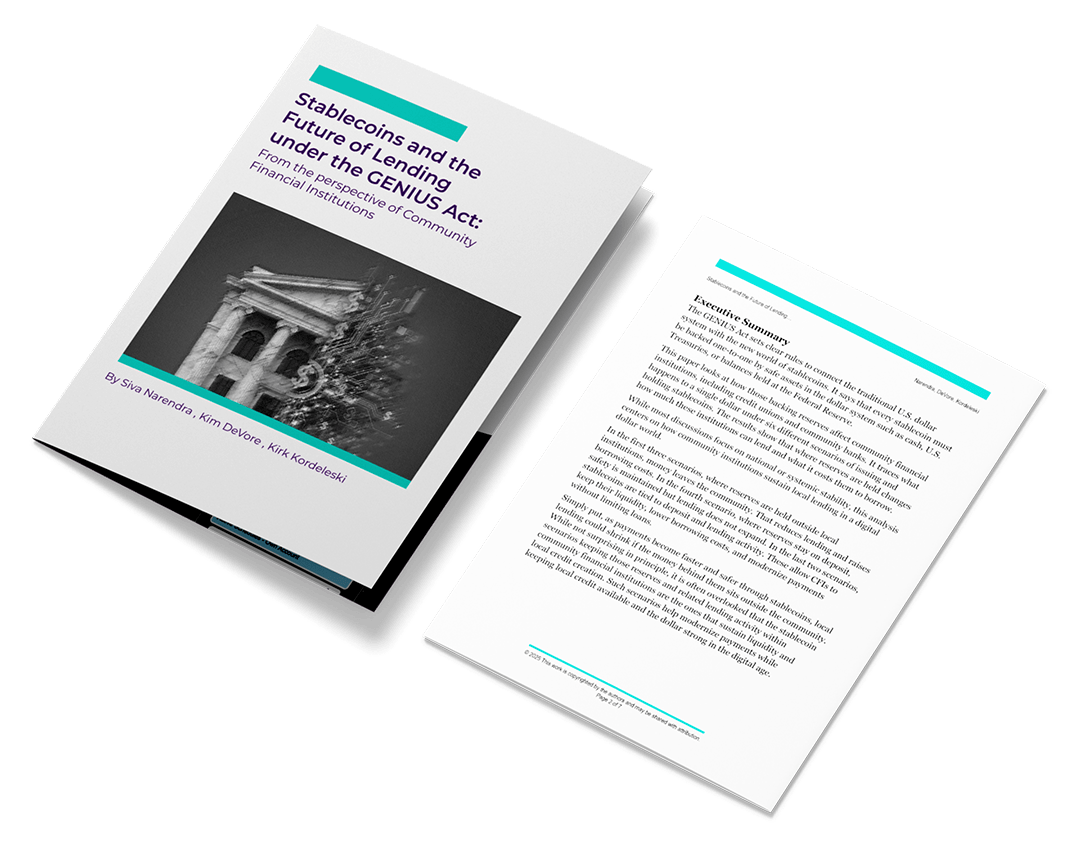
FREE PAMPHLET
Stablecoins threaten small financial institutions — but there’s a fix.
If you lead a community bank or credit union, you’ve likely heard the buzz: issue a stablecoin, tokenize your deposits, or risk being left behind. Yet amid the noise, one question stands out—how can local institutions modernize without draining liquidity or sacrificing their core mission of lending to Main Street?
Consider the consequences: “If regulators or lawmakers heed this letter and broadly eliminate or restrict overdraft options across the board, the real casualties will be everyday Americans – active duty service members, veterans, working parents – who will lose access to a trusted safety net just when they need it,” I cautioned earlier on this issue. Those families living on the financial edge would be hit hardest. They’d have no choice but to turn to payday lenders or face bounced checks, late fees, or even eviction when timing mismatches occur. In other words, a one-size-fits-all crackdown could inadvertently drive the very harm it seeks to prevent.
Moreover, heavy-handed rules ignore the diversity among institutions and consumers. The narrative that “overdraft = bad” fails to distinguish between a community-focused credit union charging a reasonable fee to cover a member’s shortfall versus a big bank racking up $35 fees six times in a day. The data show that large Wall Street banks have historically been far more reliant on punishing overdraft/NSF charges (to the tune of $15+ billion a year), whereas small institutions tend to charge lower fees and often limit their use. It’s telling that just three mega-banks (Chase, Wells Fargo, BofA) brought in nearly 44% of all overdraft/NSF fees in a recent year. Many of those giants have belatedly reformed their policies under public pressure – a move we applaud – but credit unions were never the chief culprits to begin with. As we wrote to the CFPB on this issue, “if the intent is to protect consumers, [regulators] should focus…on the minority of financial institutions that abuse their members through excessive overdraft fees, rather than penalizing the entire financial sector. Credit unions…are not the problem and should not be treated as such.” Blanket restrictions would punish the good actors along with the bad.
It’s also worth noting that credit unions must cover costs to remain safe and sound. Overdraft programs involve real expenses – handling negative balances, customer notifications, loss risk on unpaid overdrafts, etc. A $5 cap, as proposed, is often below the cost of providing the service. That would turn every covered overdraft into a loss for the institution, an unsustainable model. Large banks might absorb that by cross-subsidizing with other profit streams, but community institutions would feel the squeeze. The result? Tighter account requirements (like higher minimum balances or monthly fees) that could price out low-income members – the opposite of inclusion. Credit unions have already expressed that the CFPB’s rule was “significant regulatory overreach that will weaken financial institutions… including those committed to serving the most financially vulnerable”. When well-meaning regulation overshoots, the unintended consequences fall on consumers in the form of reduced access and flexibility.
Rather than vilifying credit unions or handcuffing them with oversimplified rules, policymakers should work with these member-owned institutions to continue refining overdraft practices in a way that truly benefits consumers. Credit unions aren’t complacent; they constantly balance member needs with financial responsibility.
In recent years, many credit unions voluntarily improved their overdraft programs – introducing grace periods, lowering fees, eliminating NSF charges, or, in a few cases, doing away with overdraft fees entirely. Alliant Credit Union, one of the nation’s largest, eliminated its overdraft fees and still achieved a record $439 million in dividends paid back to members in 2023. That speaks volumes about the cooperative model – when fees aren’t needed, credit unions gladly give value back to members. Other credit unions have taken different approaches, like Washington’s BECU capping overdraft fees at $10, or Navy Federal Credit Union (the largest in the U.S.) holding its fee to $20, well under big-bank levels. The point is, credit unions are adapting and competing to serve consumers well, all within a framework of member ownership and choice.
Senator Warren is absolutely right about one thing: too many Americans are living on the financial brink, with almost 40% unable to cover a $400 emergency. That’s a serious problem we all must address.
Credit unions are part of the solution, not the problem. They provide affordable loans, financial education, and yes, responsible overdraft protection, to help families weather those financial storms. Instead of demonizing these community institutions, let’s recognize their unique role. As I’ve stressed, “Rather than penalizing community-based credit unions that put people first, policymakers should focus their attention on the big banks that have built their business model around maximizing fee-driven profits…Credit unions do not deserve to be tarred with the same brush.” If consumer protection is truly the goal, we should oppose sweeping restrictions that would hurt the very people we’re trying to help. Preserving responsible overdraft services at credit unions – services that help, not hurt – is ultimately in the best interest of working families.
Bottom line
Let credit unions manage their institutions in line with their member-centric mission. By all means, shine a light on any abusive outliers – but don’t overlook the evidence that most credit unions run fair, transparent overdraft programs that members both value and rely on.
These not-for-profit cooperatives have earned the trust of nearly 145 million Americans. We should trust them to continue putting people over profits, as they have for decades, rather than burdening them (and their members) with politically charged constraints. In the effort to protect consumers, let’s not throw out the lifeline that credit union overdraft protection represents for so many households. Let’s strengthen it wisely – and keep the focus where it belongs: on truly predatory practices, not on member-owned credit unions that are on the consumer’s side.
The Defense Credit Union Council bills itself as the trusted resource for credit unions on all military and veteran matters.
Disclaimer
The views, opinions, and perspectives expressed in articles and other content published on this website are those of the respective authors and do NOT necessarily reflect the views or official policies of Tyfone and affiliates. While we strive to provide a platform for open dialogue and a range of perspectives, we do NOT endorse or subscribe to any specific viewpoints presented by individual contributors. Readers are encouraged to consider these viewpoints as personal opinions and conduct their own research when forming conclusions. We welcome a rich exchange of ideas and invite op-ed contributions that foster thoughtful discussion.