FINTECH NEWS
Credit unions bet on digital experience as the new measure of financial health.
Institutions from Connecticut to Idaho say logins are not enough and that long-term trust, data and outcomes now define success.
Credit unions for years have competed on rates, service at the teller window and proximity to a branch.
Now, as digital banking becomes the primary gateway for members, leaders say the stakes are no longer convenience alone, but whether technology meaningfully improves financial well-being.
At Nutmeg State Financial Credit Union in Rocky Hill, Connecticut, an $889 million institution serving 66,000 members, that shift has required rethinking how success is defined.
“We don’t view member experience as competing with cost, speed, or compliance,” John Holt, president and chief executive, told Tyfone. “Instead, we ask whether a decision reduces confusion, builds long-term trust, and improves financial clarity for members.”
Compliance, he said, is “nonnegotiable,” but the credit union seeks to design controls that are risk-based rather than “one size fits all.” If a solution meets regulatory requirements but creates unnecessary friction, particularly for low-risk, established members, the design is revisited to better align with regulatory intent while minimizing disruption.
Holt said the credit union prioritizes initiatives that align with its long-term digital strategy and can scale over time. Seamless onboarding, stronger self-service capabilities and secure real-time payments take precedence over short-term fixes that do not advance the broader ecosystem.
Data and feedback, he said, ultimately determine where to invest. Member surveys, frontline insights and performance metrics help validate whether a change delivers real value. “When the data shows that friction is undermining trust, adoption, or financial outcomes, that becomes a strong signal to prioritize experience — even when it requires more time or investment,” he said.
While engagement metrics such as logins and app downloads matter, Holt said they are not the goal. Nutmeg tracks credit score migration, total relationship growth, deposit growth and checking account penetration to determine whether members are using products with purpose. Experience indicators such as Net Promoter Score and customer satisfaction are paired with behavioral data to assess whether digital interactions are translating into stronger trust and improved financial stability.
Story continued below…
FREE CASE STUDY
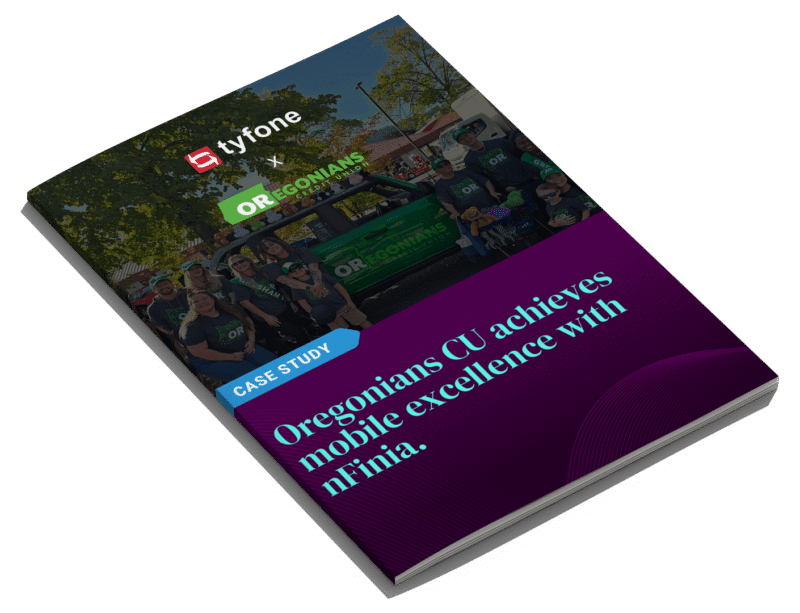
Oregonians Credit Union achieved mobile excellence with nFinia.
With nFinia as their platform and empathy as their foundation, Oregonians CU has built a model where innovation and human care work hand in hand. It’s not a choice between high tech and high touch. Done right, you can have both.
Read our exclusive case study and learn how they elevated their digital banking and mobile experience.
In Mountain Home, Idaho, Pioneer Federal Credit Union has taken a similar approach. The $746 million credit union, which serves 50,000 members, migrated in 2021 from a legacy system to Tyfone’s nFinia retail digital banking platform in search of a more adaptable and personalized experience.
The shift enabled what executives describe as a hyper-personalized digital journey supported by open banking and third-party integrations. Integrated video banking, real-time payments, an A.I.-powered financial concierge, Quick Pay, Skip-a-Pay and advanced card management are among the features introduced.
Tracey Miller, senior vice president and vice president of operations, said Pioneer pilots new features for 90 to 120 days with friends and family before broader release, supported by a dedicated testing team. “No one wants to market a new product and have it fail,” she said.
At University of Kentucky Federal Credit Union in Lexington, with $1.6 billion in assets and 112,000 members, digital expectations are shaped less by local competitors than by technology giants.
“In my opinion, the greatest friction point we are fighting is the consumer expectation,” said Ryan Ross, president and chief executive, in an interview with Tyfone. “The quote ‘My best experience is now my new expectation.’ Seems to be the norm with consumers across our markets.”
Ross said the credit union is working to create a seamless, tailored and data-driven experience akin to what mega-brands have set in e-commerce. That effort includes finding partners to help manage first-party data and generate insights that can deliver relevant solutions to existing members.
“Regulatory complexity is irrelevant as we are committed to ensuring we are not only meeting the requirements of our regulators, but also the recommended best practices,” Ross said. “Outside of regulatory constraints, the member experience is our true north.”
To measure whether digital tools are improving members’ lives, the Kentucky institution tracks savings rate growth, reductions in revolving credit card balances, decreases in overdraft frequency, increases in credit scores across segments and improvements in debt-to-income ratios.
Across these institutions, a common philosophy is emerging: digital banking is not an end in itself, nor is engagement defined by screen taps alone. Instead, the measure of success is whether technology deepens trust, strengthens relationships and helps members build more stable financial futures.
As competition intensifies and consumer expectations continue to rise, credit unions are wagering that disciplined investment in digital experience — grounded in data and guided by mission — will determine who remains relevant in the next era of community finance.