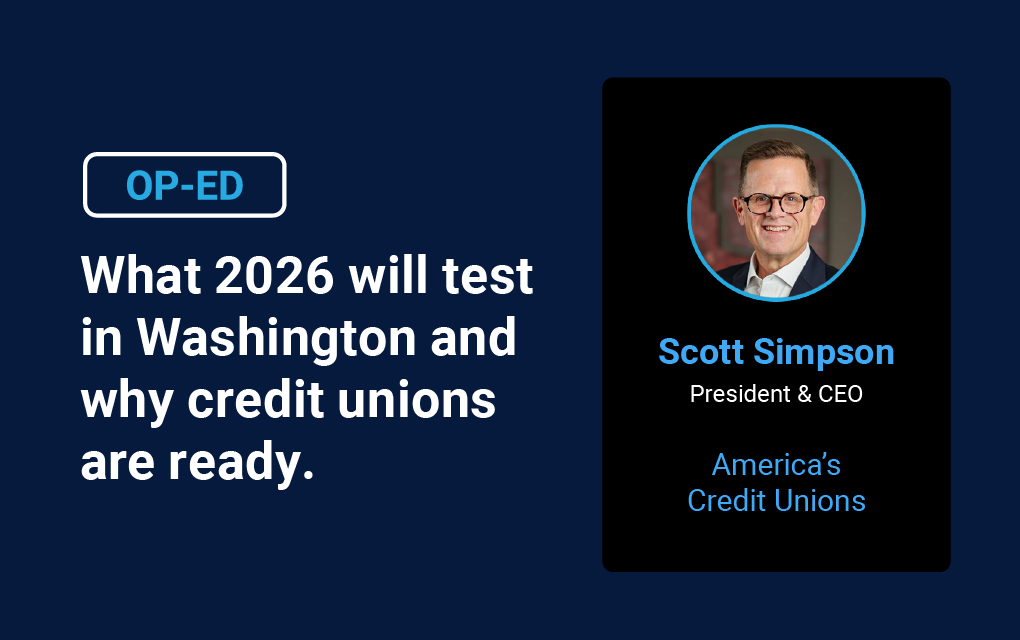

What 2026 will test in Washington and why credit unions are ready.

After enough years of observing Washington work, you start to recognize the seasons.
Midterm years have a different energy to them. Action slows down. The noise gets louder. And members of Congress begin listening a little more closely to what they are hearing back home than to what is being said inside the Beltway.
As we look toward 2026, here is how I see the year ahead shaping up.
First, Congress’s attention will narrow. That happens every midterm cycle. Sweeping legislative ambitions give way to positioning and messaging, often with proposed policies that will have a big impact on people back home. Hearings multiply. Investigations gain traction. And economic concerns move from background noise to the main conversation.
For financial services, that means affordability, access to credit, and trust will be front and center. Not as abstract policy debates, but as real questions families and small businesses are asking around their own kitchen tables. We’re already seeing this in action from the president and lawmakers on issues around credit cards.
Second, lawmakers will gravitate toward community institutions. When reelection is on the line, theory matters less than proof. Members of Congress want examples they can explain to constituents, not white papers they have to defend. Institutions that are locally rooted, trusted, and accountable tend to stand out in that environment.
Credit unions fit that description. They are embedded in communities, owned by the people they serve, and focused on building long-term relationships to understand and support people’s financial well-being. As the 2026 midterms approach, I expect more lawmakers to seek insights from these local institutions, because they reflect what voters are truly feeling.
Story continued below…

FREE PAMPHLET
A year of transforming digital banking.
2025 was a milestone year for Tyfone’s digital banking platform. With major product launches, expanded integrations and strategic partnerships, we introduced updates that make banking easier and more seamless.
Download our pamphlet to explore the breakthroughs that shaped the year and set the stage for what’s coming next.
A workable parallel is perhaps the U.S. CUSO model, with an important caveat. The federation isn’t viewed as an add-on; but rather, core infrastructure allowing credit unions to operate at scale.
Using simple averages from the numbers above, the typical U.S. credit union is around $520 million in assets, while the typical Canadian credit union is closer to $1.7 billion CAD.
Simple averages perhaps skew the numbers in a system with over 4,400 credit unions, as we know U.S. credit unions range from thousands in assets to hundred-plus billions.
But the numbers also drive the point that the U.S. system is wide and fragmented, with thousands of institutions spread across a long size spectrum. The Canadian system is far more concentrated, with fewer institutions operating at a larger average scale.
Consolidation
Another similarity, and perhaps not surprising, is that both systems are experiencing material consolidation. The U.S system has experienced a roughly 60% decline in the number of credit unions over the last 30 years, and a roughly 40% decline over the last 15 years.
The Canadian system has experienced slightly higher consolidation at around 70% over the last 30 years. If we roll up the individual credit unions to the federation level, the consolidation is even greater.
When we realize that technology requirements, member expectations, and regulatory burden are similar, the consolidation trends should not be surprising. In other words, the demands and pressure are not materially different.
Outlook
When doing a high-level comparison on the systems, there are two lenses we can look through. The first lens sees similar challenges, and gets discouraged. Doom and gloom. And perhaps starts to contemplate if the cooperative model has failed.
The second lens sees similar challenges and sees opportunity. I choose the second lens. The concept of a credit union has not failed. Instead, in a system that’s built on a cooperative model, perhaps there’s opportunity for collaboration between the systems. Shared lessons on successes and failures.
As an industry, the second lens is who we are.
While there are differences, the mission is still the same in both countries.
America’s Credit Unions is a national trade association that gives a unified voice to credit unions across the country.
Disclaimer
The views, opinions, and perspectives expressed in articles and other content published on this website are those of the respective authors and do NOT necessarily reflect the views or official policies of Tyfone and affiliates. While we strive to provide a platform for open dialogue and a range of perspectives, we do NOT endorse or subscribe to any specific viewpoints presented by individual contributors. Readers are encouraged to consider these viewpoints as personal opinions and conduct their own research when forming conclusions. We welcome a rich exchange of ideas and invite op-ed contributions that foster thoughtful discussion.