FINTECH NEWS
SDK: Still doesn’t know – why modern digital banking outgrew it.
Once upon a time, shipping an SDK made you sound innovative. Apps lived in silos, updates were annual, and integration meant one-off partnerships. But the world has changed. Financial technology today runs on ecosystems, not walled gardens.
SDKs Give Control but Take Freedom
SDKs give the feeling of control. You download the kit, build your own version, and shape it exactly how you want. It’s like setting up your own private island.
You can do a lot inside your world, but every upgrade, fix, or integration depends entirely on you. When compliance rules change or mobile operating systems update, everyone scrambles independently. Multiply that across banks, credit unions, and fintech partners, and you’ve created a labyrinth of maintenance. While on paper this may seem like freedom, in reality it’s more isolating.
SDKs also multiply complexity. Each deployment becomes a mini-product that must be maintained separately. What feels like flexibility can quickly become a heavy cost, slowing innovation and increasing risk.
Ecosystems Thrive on APIs
SDKs are like AOL in the early Internet era. Inside AOL, everything felt connected, such as news, email, and chat, but only within its walls. It worked until you needed to reach outside. You could not just connect to the broader Internet without building and maintaining your own bridge.
APIs are the Internet in this analogy. Basically they changed the game. They connect everyone to a shared ecosystem, open, collaborative, and constantly improving. When a platform upgrades an API, all connected institutions benefit instantly.
Instead of carrying the entire maintenance burden, financial institutions can focus on creating value rather than rebuilding what has already been solved elsewhere.
This ecosystem-driven approach accelerates collaboration between banks, credit unions, and fintech partners. New features, security patches, or integrations propagate automatically.
Rather than hundreds of teams solving the same problem, one ecosystem evolves together. APIs create network effects where one improvement benefits all participants. There is little or no client-side work required, because the API handles change through a shared and standardized interface.
Story continued below…
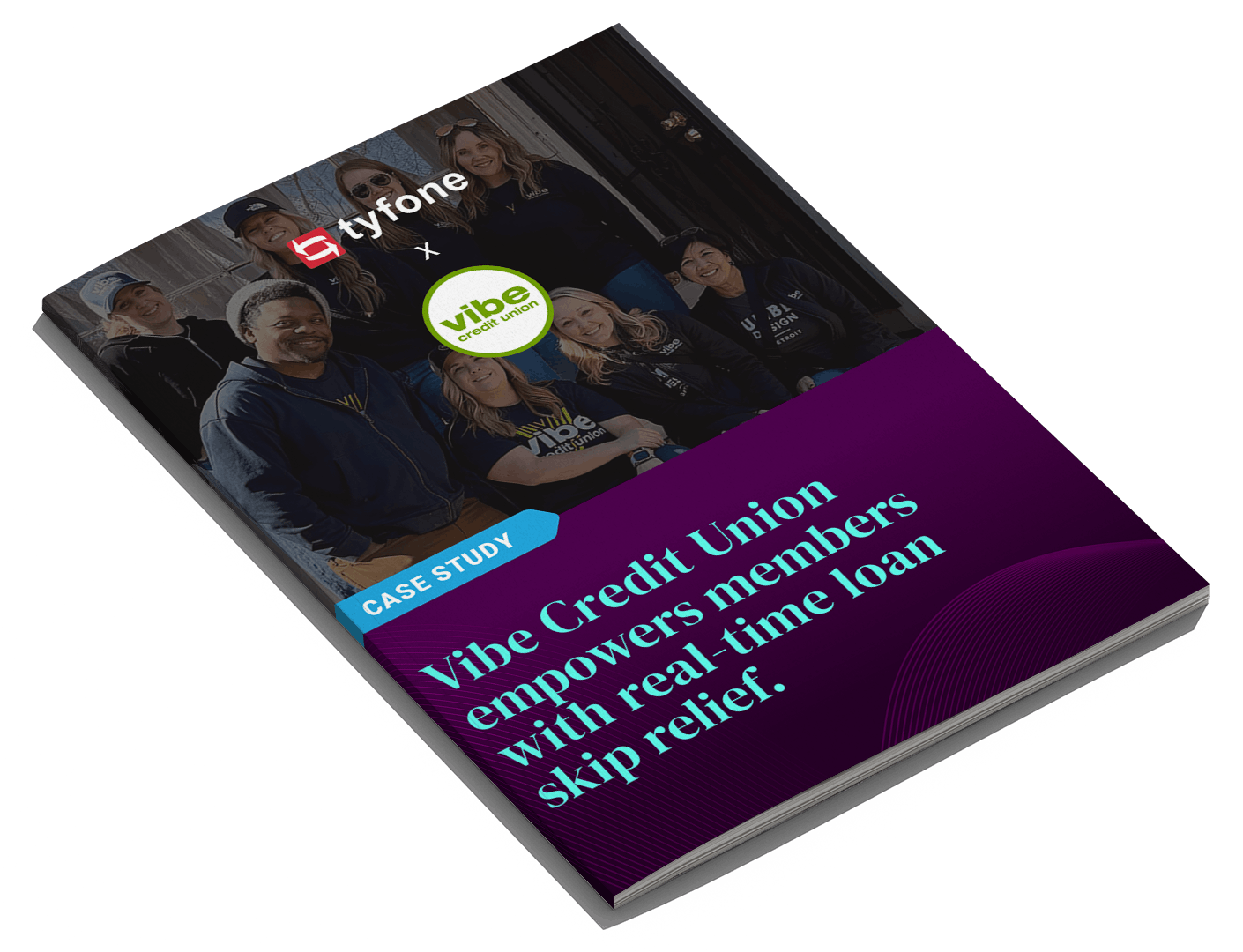
FREE CASE STUDY
Vibe Credit Union empowers members with real-time loan skip relief.
To meet growing demand for faster, more convenient digital options, Vibe partnered with Tyfone to implement a Skip-A-Pay solution. Members can skip eligible loans online, while staff can assist those who prefer to call or visit branches using the same system. The result is a self-service loan skip program that supports members year-round, improves internal efficiency, and has generated over $100,000 in annual revenue without impacting credit scores.
Read our exclusive case study and learn how they elevated their digital banking and loan servicing experience.
AI and APIs Power Real-Time Banking
As digital banking shifts toward AI-assisted and instant-payment experiences, SDKs can’t keep up. Sitting on the client side, they require redeployment for every change and cannot adapt dynamically. APIs, in contrast, are server-based, intelligent, and scalable.
They integrate seamlessly with machine learning models, vector databases, and instant-payment networks, all without touching the end user’s app. In a world moving at the speed of AI and real-time payments, falling behind isn’t gradual, it happens before you even realize it.
An API-first design separates function from delivery. Every capability such as payments, authentication and AI-based insights is exposed through consistent, reusable endpoints. This allows digital banking platforms and fintechs to innovate faster, without rewriting systems for every new feature.
For instant payments, APIs connect directly to networks like FedNow or RTP through standardized interfaces. When a payment rail updates or adds new functionality, the platform updates the API once, and all connected institutions benefit immediately. Features like request-for-payment or real-time settlement can be deployed in days rather than months.
APIs also power AI-assisted experiences. With the Model Context Protocol (MCP), agentic AI systems can securely query data, perform calculations, or even initiate transactions while maintaining full governance and auditability.
The power of this approach is amplified by exponential growth in computing and network infrastructure. Moore’s Law made digital banking possible by powering affordable, fast, and scalable computing; Huang’s Law shows GPU and AI compute performance now doubles roughly every five to six months, while Nielsen’s Law tracks network bandwidth growth at 50 percent per year.
Keeping pace with these forces requires open, interoperable design. APIs are the foundation for this agility, enabling financial institutions to integrate new payment rails, fraud-detection services, or AI tools in weeks rather than months.
Without open APIs, institutions are forced to rebuild systems whenever technology advances. With them, banks and credit unions can move at the speed of modern computing, combining AI intelligence with the reliability and control of core banking systems. APIs aren’t just tools, they are the architecture that makes speed, adaptability, and real-time innovation possible in today’s digital banking landscape.
Leave SDK Islands Behind and Join the API Era
For organizations still relying on SDKs, the path forward is clear: adopt open, standardized APIs built for interoperability. Platforms following ISO 20022 for data semantics, FDX for secure data sharing, and OAuth 2.0 for authorization ensure integrations are consistent, auditable, and scalable.
SDKs are static; APIs are intelligent. SDKs isolate you; APIs connect you. SDKs multiply maintenance burdens; APIs accelerate innovation. The future of digital banking belongs to those who leave SDK islands behind and embrace open API ecosystems.