
Why sequential strategy is failing credit unions.
For much of their history, America’s credit unions have thrived through steady, deliberate decision-making. Prudence, patience, and incremental progress are virtues in a cooperative financial system built on trust. But in today’s economic and geopolitical environment, a dangerous habit has taken root in many institutions: linear thinking.
Linear thinking assumes that problems should be addressed one at a time. A credit union identifies an issue and begins solving it. Only after that initiative is complete does it move to the next challenge. In calmer times, this step-by-step approach may have been workable. Today, it is simply untenable.
The modern operating environment does not present problems sequentially. It presents them simultaneously.
For example, interest rates remain volatile after one of the most aggressive tightening cycles in modern history. Liquidity dynamics are shifting as depositors move funds more quickly and with greater price sensitivity. Technology is evolving at breakneck speed, while fintech competitors introduce new services in months rather than years. At the same time, geopolitical tensions, wars and trade frictions continue to influence inflation, supply chains, and financial markets. These forces swing wildly and do not politely wait their turn.
Yet many credit unions still approach strategy as though they do.
Too often we hear conversations that sound like this: First we will address lending growth. Then we will modernize our technology. After that we will revisit our member acquisition strategy. The result is that by the time one issue is “solved,” the others have grown more urgent. And the original problem has often changed shape. “We’d love to incorporate self-directed brokerage but cannot get it on the list until early 2028” just does not cut it in today’s hyper-competitive environment.
Business history offers ample warning against this kind of sequential thinking.
Andy Grove, the legendary CEO of Intel, famously observed that “[o]nly the paranoid survive.” Grove’s point was not about fear, but about vigilance. He highlighted the need to constantly scan the environment and respond to multiple threats and opportunities at once. Intel succeeded not by solving one strategic challenge at a time, but by simultaneously investing in technology, manufacturing scale, and new markets.
Similarly, Amazon’s Jeff Bezos has long emphasized parallel execution. Amazon built logistics infrastructure, cloud computing, consumer devices, and digital marketplaces all at the same time. For Bezos, “leaning into the future” requires moving on many fronts simultaneously, not waiting for one initiative to conclude before launching another.
Story continued below…
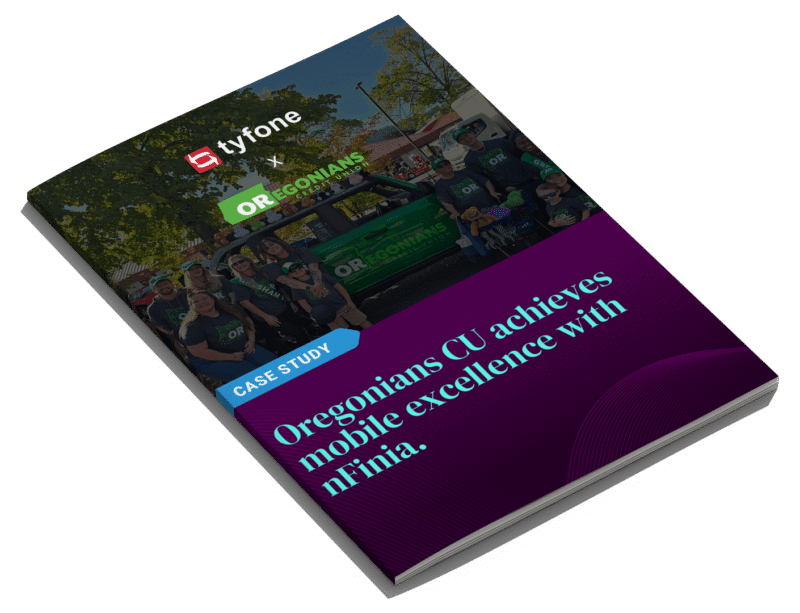
FREE CASE STUDY
Oregonians Credit Union achieved mobile excellence with nFinia.
With nFinia as their platform and empathy as their foundation, Oregonians CU has built a model where innovation and human care work hand in hand. It’s not a choice between high tech and high touch. Done right, you can have both.
Read our exclusive case study and learn how they elevated their digital banking and mobile experience.
For credit unions, the lesson is clear: strategy must become multidimensional.
Deposit strategy cannot be separated from lending strategy. Technology investment cannot be postponed until after balance sheet issues are addressed. Waiting for the low-income designation before beginning the subordinated debt plan does not cut it. Member growth, digital engagement, operational efficiency, and capital planning are interdependent systems, not isolated tasks.
Consider the simple example of loan growth. Many credit unions focus on increasing originations without simultaneously addressing funding, pricing analytics, and member acquisition. The result can be predictable: strong lending pipelines but insufficient deposits to fund them, forcing reliance on wholesale funding at unfavorable rates. What appeared to be progress on one front becomes a new risk on another.
The better approach is systems thinking, where loan growth initiatives are designed alongside deposit strategy, digital channel development, marketing, and risk management. Each lever affects the others.
Peter Drucker, widely regarded as the father of modern management, captured this dynamic succinctly: “The greatest danger in times of turbulence is not the turbulence—it is to act with yesterday’s logic.”
Linear thinking is yesterday’s logic.
Today’s environment demands leadership teams that can hold multiple strategic questions in view at once: How do we compete for deposits while maintaining margin? How do we modernize technology while controlling operating costs? How do we grow membership while deepening relationships with existing members? These are not sequential decisions. They are concurrent ones.
Credit unions have long demonstrated resilience and ingenuity. But resilience in the coming decade will require a shift in mindset. Solving problems one step at a time must give way to orchestrating progress across many dimensions simultaneously.
In a world moving this quickly, strategy can no longer be a straight line. It must be a network.
Olden Lane is a boutique financial services firm dedicated to the credit union industry.
Disclaimer
The views, opinions, and perspectives expressed in articles and other content published on this website are those of the respective authors and do NOT necessarily reflect the views or official policies of Tyfone and affiliates. While we strive to provide a platform for open dialogue and a range of perspectives, we do NOT endorse or subscribe to any specific viewpoints presented by individual contributors. Readers are encouraged to consider these viewpoints as personal opinions and conduct their own research when forming conclusions. We welcome a rich exchange of ideas and invite op-ed contributions that foster thoughtful discussion.