
Echoes of a bubble: Why today’s economy feels like 2006 all over again.

Just 25 years into the 21st Century, we have endured the terrorist attacks of 9/11, the “Great Recession” and the Global Pandemic. Each of these events had us “feeling the earth move under our feet”. Someday in the future, we may look back at today’s current events and feel the first 25 years pale in comparison .
Let’s hope not.
In the two years leading into the “Great Recession” and prior to the collapse of the stock market and housing market, I wrote a couple of articles for Credit Union Executive Society’s (CUES) monthly newsletter focused on the U.S. economy, more specifically the credit bubble brought on by 5 years of low rates. The articles were titled, “How Consumer’s Debt Affects Credit Unions” and a year later “We’ve Built a House of Cards”. The last line of the “…House of Cards” article went like this…”…When this bubble pops, we are going to need more than low rates to bail us out of the next recession”.…and we did as the US Federal Reserve not only took the fed funds rate to zero, they also purchased assets from the system to sustain low rates.
Since we are currently in a low-rate environment roughly 3x longer than the prelude to the Great Recession, a comparison of then and now is warranted.
Back to the Future?
Today, with so much unknown risk stemming from political dysfunction, geopolitical crisis, inflation, AI’s impact on employment, it is sometimes hard to imagine a landing from all this, let alone a “soft” one!
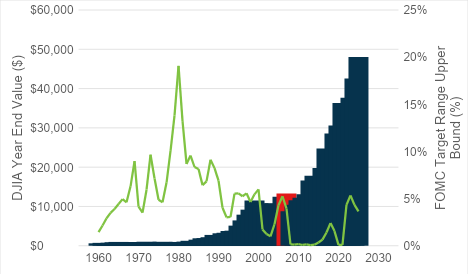
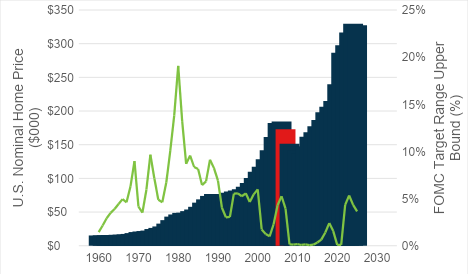
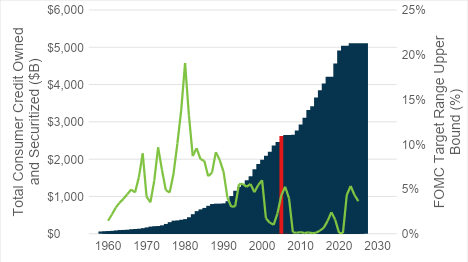
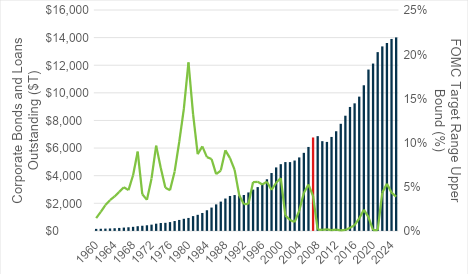
The metrics shared in the articles looked at the Dow Jones Industrials, Nominal Home Prices and Consumer Credit from 1961 to 2006. The graphs below include that time and are extended through 2025.
Note the levels on each metric at their peak before the bubble popped in 2008 (highlighted in red).
The pictures speak for themselves, but in case you’re wondering, as the table shows, they’re double their 2006 highs except the DJIA which is up nearly 6x!
Appropriately, regulators are sharpening focus on credit quality and liquidity.
Story continued below…

FREE CASE STUDY
Oregonians Credit Union achieved mobile excellence with nFinia.
With nFinia as their platform and empathy as their foundation, Oregonians CU has built a model where innovation and human care work hand in hand. It’s not a choice between high tech and high touch. Done right, you can have both.
Read our exclusive case study and learn how they elevated their digital banking and mobile experience.
NCUA’s 2026 Supervisory Priorities
“The overall delinquency rate and rolling 12-month loss rate within federally insured credit union loan portfolios is at its highest point in over a decade. Asset quality deterioration and elevated loan losses remain material contributors to balance sheet stress, especially where higher-cost funding such as share certificates and borrowings limit margin recovery.
Specific review areas will focus on institution-specific risks and may include the sufficiency of credit administration, including loan underwriting, loss mitigation programs (including loan modifications and workouts), Allowance for Credit Loss reserves and methodologies, and charge-off practices. NCUA examiners will review portfolio monitoring, including the management of any material credit risk concentrations.
Recent liquidity challenges have reinforced the importance of diversified funding strategies and robust liquidity risk management. Accordingly, credit unions should expect continued supervisory focus on these areas to ensure institutions can withstand a range of interest rate and funding stress conditions.”
NCUA’s guidance here makes sense given that, historically, the common elements of a credit crisis start with concentration risk of bad loans combined with too little liquidity. History has shown that a well-capitalized FI can become insolvent in near “overnight” fashion when a credit cycle turns (and the cycle always turns) because so many loans written in good times do not hold up in bad times. When non performing loans in quantity combined with too little liquidity and the FI must sell assets at distressed prices, “well” goes to “under” capitalized quickly.
Credit unions (on average using 2025 numbers) are better prepared for a downturn with loss reserves at 1.15% of Total Loans as compared to 0.69% in 2007. However, the average size of each loan at a credit union is up 174% over that same period, so each underwriting mistake is potentially twice as costly.
Along with timely NCUA guidance above, we are also reminded that a turn in the credit cycle also creates opportunities for healthy institutions with scale to increase investment in consumer pleasing products and services that lead to higher market shares on the organic front (while other Fi’s struggle to overcome credit problems).
On the merger front, activity typically accelerates (after a lull to determine the true credit quality of loan portfolios) as institutions become available for merger/acquisition. There are many reasons for this, not just loan portfolio trauma. The operating environment today is universally considered by FI’s to be difficult without the challenges brought on by recession. With an economic recession, business becomes even more difficult as institutions fall behind on investment in products and services demanded by consumers who won’t wait long before deciding to bank elsewhere..
FIs currently considering merger opportunities will be wise to prudently consider the performance and underwriting of the potential partner’s loan portfolio and in the context of the pro forma combined institution. Every reader knows this from past experience. The metrics provided indicate that extra caution may be justified.
As a merger advisor, we always think about this simple phrase, “when in doubt, do without”.
Note: The consumer debt is trillions not billions
| 2008 | 2025 | |
|---|---|---|
| DJIA | $8,776 | $48,063 |
| Home Prices | $151,506 | $327,455 |
| Consumer Debt | $2,647T | $5,106T |
| Corporate Debt | $6,863B | $14,014B |
For decades, Peter Duffy has advised credit unions on their M&A strategies. He is a frequent speaker at credit union conferences and board meetings.
Disclaimer
The views, opinions, and perspectives expressed in articles and other content published on this website are those of the respective authors and do NOT necessarily reflect the views or official policies of Tyfone and affiliates. While we strive to provide a platform for open dialogue and a range of perspectives, we do NOT endorse or subscribe to any specific viewpoints presented by individual contributors. Readers are encouraged to consider these viewpoints as personal opinions and conduct their own research when forming conclusions. We welcome a rich exchange of ideas and invite op-ed contributions that foster thoughtful discussion.