
Banking in 2040: What a former NCUA examiner sees coming.

When I worked as an NCUA examiner, the rhythm of the job was set by paper and email. I would send an items-needed list ahead of the visit, and we would walk into the credit union to find the requested files stacked on a table waiting for us. Eventually that moved to a secure portal. Modern-ish, by the standards of the work. Risk-focused exam scoping was, in the end, an experienced examiner reading a quarterly call report alongside notes from the prior cycle and forming a hypothesis about where to look. The hypothesis was usually right. The volume was usually overwhelming.
That isn’t how this is going to work for much longer.
If I had to write down what I actually believe banking, and credit unions specifically, will look like in 2040, the headline isn’t “AI replaces the front line.” That’s the consumer version of the question, and the trade press has been beating on it for two years. The version that’s harder to see, and probably more important, is what happens when most of the operational and supervisory work of running a regulated financial institution stops being done by people typing.
I’d be cautious about the fourteen-year prediction game. But there are a few things that look directionally inevitable enough to take seriously.
A lighter exam, AI to AI
This is the change I’m most confident about, partly because the trajectory is already visible and partly because no one outside the supervision world is paying attention to it.
The current exam cycle is fundamentally an event with very high friction. The institution prepares for weeks. The examiners arrive. Findings are issued. The institution remediates. Twelve to eighteen months later, the cycle repeats. Most of the work, on both sides, is the labor of moving information back and forth across the gap between a continuously operating institution and a periodically attentive supervisor.
The trajectory got a quiet push in 2025, when the NCUA reduced its staff by 23% through a voluntary separation program. That brought the agency to its lowest headcount since 2003. The cuts hit Central Office harder than the examiner ranks, but the exam cycle was extended for apparently stable credit unions, and the direction of travel is unmistakable. Whatever the supervision model looks like in 2040, it is not going to be the staff-intensive, on-site rotation that defined the work for the past fifty years.
By 2040, the picture is straightforward. The credit union runs full AI infrastructure on its own systems. Every applicable regulation, every piece of NCUA guidance, every internal policy, and every relevant best practice executes as continuous logic against the institution’s own data. Most of it is agent driven. The institution catches and corrects exceptions in real time. It self-heals.
The NCUA runs full AI infrastructure on its side as well. AI agents conduct the exam, exchanging files and structured information with the institution’s systems on a point-in-time basis still controlled by the credit union. The credit union chooses what to share at exam time, the same way it does today. The difference is that what gets exchanged is processed by AI systems trained for the work, not by humans manually moving documents back and forth.
The result is the exam itself: faster, lighter, more secure, and much less human-intensive on both sides. Findings concentrate on the things the AI agents cannot resolve on their own, the questions that genuinely need a human examiner and a human compliance officer in the same room.
I’d hedge the timing in three layers. An individual credit union with the right vendors and commitment can get most of the way to this state today. The industry as a whole will take roughly a decade to follow. The government side, including the NCUA’s own AI infrastructure for conducting the exam, will take longer still. 2040 captures the year all three are in place at once. The credit unions that don’t wait for the third layer will be internally operating this way years before.
The CFOs reading this are doing math in their heads about exam preparation costs. Those costs largely go away. The exam itself doesn’t disappear, but the document scrambles, the after-the-fact reconciliations, and the retrofit remediation projects do. What’s left is the cost of running a self-healing operation in real time, which is roughly what the institution should have been doing all along.
Story continued below…
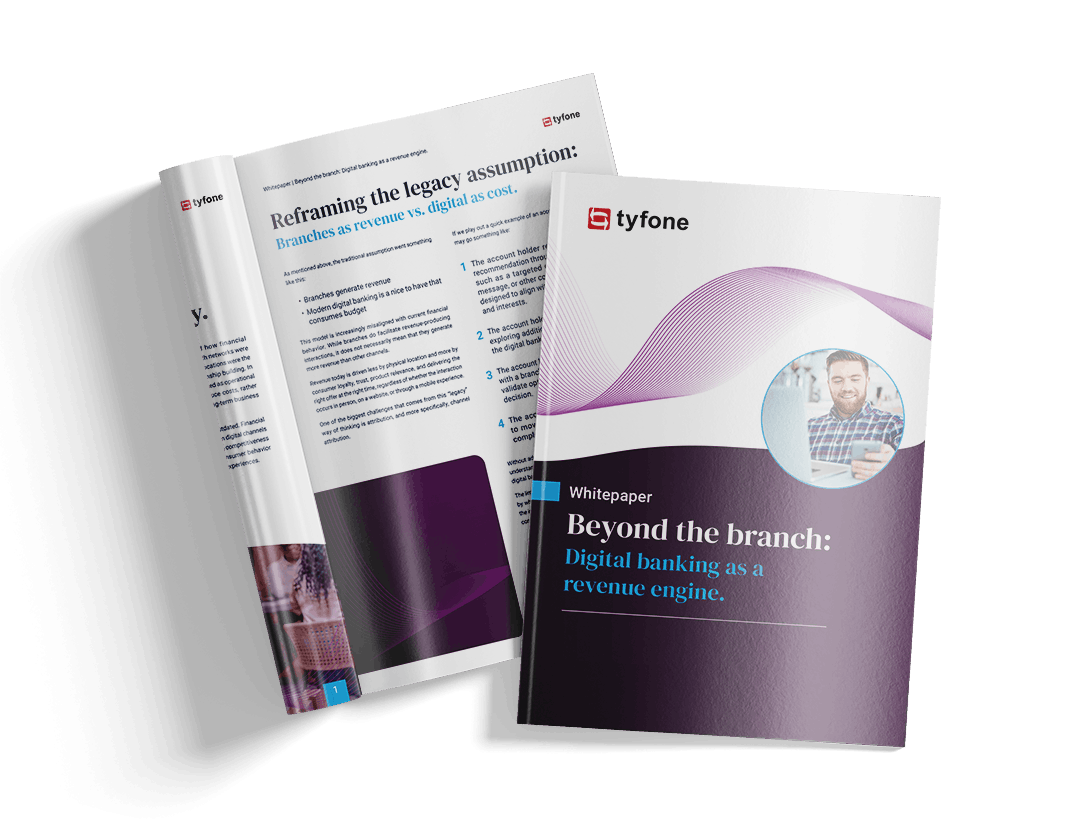
FREE WHITEPAPER
Beyond the branch: Digital banking as a revenue engine.
For decades, financial institutions have treated digital banking as a cost center while branches were seen as the primary drivers of revenue. But with consumer behavior shifting toward digital-first interactions, this traditional mindset is no longer enough.
Read our exclusive whitepaper and explore how modern digital banking platforms can become strategic engines for growth, engagement, and measurable revenue.
Compliance becomes structurally different, not perfect
I want to be careful with this one because the easy prediction is that compliance becomes near perfect. That isn’t right.
What does happen is that the compliance failures of 2026 mostly disappear. Manual reconciliation errors. Late filings. Calculation drift between systems. Inconsistent member disclosures. Data quality issues in call reports. Those are exactly the kinds of failures a self-healing system catches. The system sees the discrepancy, flags it, routes a fix. Done.
What replaces them is a different set of risks. AI systems making bad decisions because the models or the data feeding them are off. A flaw in one vendor’s system rippling through every credit union running it. Bad actors finding ways to game the agents. Decisions getting made by software faster than any human can audit them.
Agents will catch a lot of this. They monitor each other for drift, flag vendor anomalies, detect adversarial patterns. A well-designed institution layers local kill switches and circuit breakers on top, so if a vendor goes wrong or a model drifts, it can isolate itself rather than ride the failure down. The residual isn’t capability. It’s accountability. Leadership owns the architecture choices that make those safeguards work, and leadership owns the outcomes when they fail. Examiners can’t hold a model responsible. The credit unions that build agent governance around design and accountability, rather than waiting for examiners to write the playbook, will be in a meaningfully better position than the ones that don’t.
Compliance in 2040 is materially easier. It’s structurally different. Agents handle more than they used to. Leadership still owns the architecture and the accountability.
The cooperative question doesn’t go away
All of the efficiency this future creates is real, but the destination of that efficiency isn’t predetermined. A bank captures the efficiency for the shareholders. A credit union has the option, at every level, of returning it to its members. Lower fees. Better rates. Expanded access for thin-file borrowers. Programs for member segments the institution couldn’t afford to serve before.
There’s also the member side of this. By 2040, members aren’t shopping for financial services the way they do today. They have their own AI agents acting on their behalf, comparing terms across institutions, surfacing fee differences, recommending switches. By that point, open banking is the connective tissue between member-side agents and institution-side systems. Those agents are not emotionally loyal to anyone. They optimize.
This is where the cooperative dividend gets tested. A credit union that genuinely returns efficiency to its members in measurable terms wins more in this world than it does today, because the AI making the comparison has no sentiment to override. A credit union that markets the cooperative model but operates like a regional bank loses faster than ever, because the same AI sees through the marketing and routes the member elsewhere.
Whether the credit unions of 2040 actually do that, or whether the cooperative dividend gets quietly absorbed into operational margins and bigger headquarters, is the question this whole technology arc turns on.
Outlook
The exam gets shorter, lighter, and runs AI to AI. Members increasingly interact with credit unions agent to agent. Today’s compliance failures self-heal, and a new set takes their place. None of that is the headline, even if it’s what most of the sector will spend the next decade and a half building.
The headline is the same one credit unions have always had to answer. The institutions that exist in 2040 will be vastly more efficient than the institutions of 2026. What they choose to do with that efficiency will determine whether the cooperative model still means anything, or whether the credit union industry has quietly become a tax-advantaged subset of community banking running on the same agent stack as everyone else.
The technology won’t decide that. The leaders will.
Josh Herman is a former NCUA Principal Examiner and VP of Strategy at a billion-dollar credit union. He is the Founder and CEO of CU WealthNext, a credit union wealthtech holding company, and the Founder of The Credit Union Wire, a global credit union media platform.
Disclaimer
The views, opinions, and perspectives expressed in articles and other content published on this website are those of the respective authors and do NOT necessarily reflect the views or official policies of Tyfone and affiliates. While we strive to provide a platform for open dialogue and a range of perspectives, we do NOT endorse or subscribe to any specific viewpoints presented by individual contributors. Readers are encouraged to consider these viewpoints as personal opinions and conduct their own research when forming conclusions. We welcome a rich exchange of ideas and invite op-ed contributions that foster thoughtful discussion.