
There’s no prompt for presence: In the age of AI, leadership still has to earn the room.

“Knees weak, palms sweaty, nervous. On the surface, though, he looks calm and ready…”
Alright, maybe not quite 8 Mile intense, but if you have ever sat outside a boardroom waiting to be called in, you know the feeling.
Your heart starts thumping so loudly it feels like it is echoing in your ears. Each swallow gets harder as your throat turns to sand. The room feels unrealistically bright and far too quiet. You glance down as a bead of sweat falls from your forehead onto your business card, paperclipped neatly to the presentation you put together early that morning, triple checked, of course.
Across from you sits the competition, a small waiting room full of bankers. You are all trying to play it cool, sneaking glances back and forth, wondering if slide 7, your zinger slide, is enough to win the day, or if they have one too, maybe better than yours. No! Positive thoughts only. You glance down at your watch. The first banker has been in there five minutes longer than expected. What if they already won the business before you even get a shot? You remember one last competitive angle and quickly scribble a note on the inside of your hand. You are up next, but for now, you wait.
In that room, in that moment, you have a group of professionals, different levels of experience, same nerves, quietly running through their scripts, each competing for the same client. Only one of you will walk out with the business. The room is filled with ambition and pressure… sweat equity. Some look more put together than others, but everyone there has paid their dues to earn a seat at that table.
And what you do not see in that room is a banker in a bright orange tuxedo and white bowtie named Claude.
Because Claude did not exist then.Back then, you had to rely on your preparation and your team. Your ability to read the room, build trust, and win the day.
Presence Over Prompts
AI can do incredible things to accelerate the moments that matter for our current and future clients. But it cannot replace the sweat equity and earned credibility that make human connection the foundation of great strategy and authentic leadership.
In that boardroom, there is no prompt for presence. No shortcut to trust. No model that can replicate what it feels like to read the room, adjust in real time, and carry the weight of winning or losing the business.
Credit unions and community banks that understand that balance will build something today that still matters ten years from now. Those who outsource their strategy to AI and leave human connection in the rearview mirror may move faster in the short term, but they will pay for it later. Likely forced to circle back and rebuild a foundation that should have been there from the start.
3 Leadership Gaps AI Is Exposing Right Now
A.I. Imposter Syndrome:
I recently worked with a credit union ambitious to rebuild its commercial program into a true community focused business banking platform. They had the right leader in place, someone who had done it before, built the playbook, won with it, and brought forward a clear, credible plan that was already approved and ready to go.
Then, at the eleventh hour, an executive with debatable experience in business banking discovered Claude. They turned to AI for the “best” go to market strategy and backed that over the one built by someone who had actually lived it. According to SAP’s 2025 survey, 44 percent of U.S. C suite executives would reverse a decision after seeing AI input, and 38 percent would trust AI to make business decisions on their behalf. In this case, the result was not innovation. Instead the organization drifted into a holding pattern, stuck between direction and doubt.
Eventually, morale dropped, the proven leader walked, and money was spent on outside help that lacked both credit union and business banking depth. Two quarters slipped by, and the team found themselves rebuilding a watered-down version of what they could have had.
Access to answers is not the same as ownership of outcomes. The better approach would have been to use AI to pressure test and refine strategy, not replace the people who have earned the right to build it. It is simple. Let practitioners lead. Leverage AI to make them sharper. A prompt can give you a plan. Experience is what gives you the conviction to stand behind it.
Story continued below…
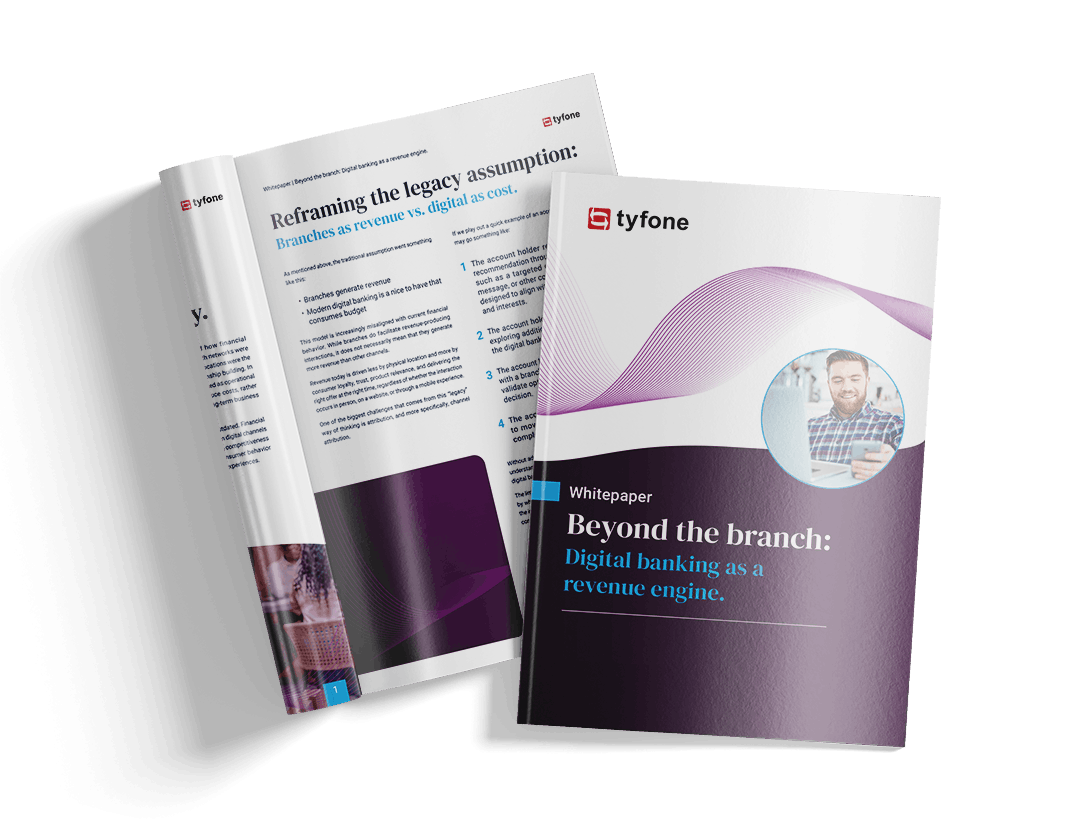
FREE WHITEPAPER
Beyond the branch: Digital banking as a revenue engine.
For decades, financial institutions have treated digital banking as a cost center while branches were seen as the primary drivers of revenue. But with consumer behavior shifting toward digital-first interactions, this traditional mindset is no longer enough.
Read our exclusive whitepaper and explore how modern digital banking platforms can become strategic engines for growth, engagement, and measurable revenue.
Artificial Intelligence vs. Authentic Instinct:
A former mentor of mine had a simple mantra: don’t walk past it. Whether it was a Snickers wrapper blowing across the branch entrance or a system issue quietly frustrating clients, the expectation was the same. If you saw it, you owned it. It got documented, surfaced, and worked through until it was fixed.
That same reality shows up on the frontline every day in different ways. Staying late to fix a problem that should not have happened. Realizing mid conversation, the system will not deliver and finding a workaround on the fly. Saying yes to win the relationship, then carrying the weight of figuring out how to back it up. Those hard moments build instinct and judgment that no prompt can replicate.
AI should strengthen the handshake, not replace it.
The mistake is thinking AI replaces that. It does not. According to Deloitte’s 2026 Global Human Capital Trends survey, 60% of executives now regularly use AI to support their decisions, underscoring how quickly it is becoming part of the process, but not a substitute for human judgment. Winning is not about adding another layer of technology on top of a cracked foundation. It is about fixing the friction your people have been managing for years.
The better approach is to take what your frontline already knows and actually do something with it using AI. Catch breakdowns before the client feels them and get rid of the workarounds that slow everything down. Help your team see what needs to happen next while they are still in the conversation and close the gap between what you sell and what you can actually deliver. The foundation is human. The acceleration is AI.
Artificial Leadership:
Stop reading this for a minute. Open LinkedIn. Scroll your feed like it is a modern version of Where’s Waldo. (Seriously, give it a shot.)
You will start to notice a pattern. Overnight, everyone became a leadership expert.
The posts feel oddly familiar, overly polished, and a little too reliant on contractions. They are thoughtful in all the right ways, or should I say, they’re thoughtful in all the right ways, but somehow disconnected from anything that feels lived in. You can feel it. It is not how people actually talk, and it is definitely not how they lead.
It might earn you a few likes, but the people who actually know the work can feel the difference, and that is where it starts to cost you. It matters inside your organization, too. If your team reads something that does not sound like you, they notice, and it stays with them. It shows up in how they hear you in meetings and how they trust your decisions, especially in rooms you have not earned your way into. AI does not make you qualified. It just makes it easier to sound like you are. Kind of…
Credibility is hard to earn and easy to lose. AI just speeds that up.
The better approach is simple. Use AI as an assistant, not as your voice. Start with what you have actually done, then let AI sharpen it. If you are learning something new, say that. Share the reps, the misses, and the progress. That is what people trust. Write like you speak so your team recognizes you. Like anything new, earn the right to teach by showing the work first. Do not use AI to sound like a leader. Use it to become one, then speak for yourself.
In closing, I leave you with one question to sit with: as AI continues to expand, does human connection become a luxury?
Philip Sutliff is the founder of Main Street & Co., a boutique consulting firm serving community banks and credit unions. After building his career inside large national banks, he developed a playbook for building and rebuilding business banking divisions that has gained national recognition. He works with executive teams and boards to turn overlooked groups into scalable growth engines that drive real deposit and loan growth. Sutliff is an adjunct professor of economics and is widely recognized as a thought leader and disrupter in the industry.
Disclaimer
The views, opinions, and perspectives expressed in articles and other content published on this website are those of the respective authors and do NOT necessarily reflect the views or official policies of Tyfone and affiliates. While we strive to provide a platform for open dialogue and a range of perspectives, we do NOT endorse or subscribe to any specific viewpoints presented by individual contributors. Readers are encouraged to consider these viewpoints as personal opinions and conduct their own research when forming conclusions. We welcome a rich exchange of ideas and invite op-ed contributions that foster thoughtful discussion.