FINTECH NEWS
At Members 1st, digital banking is no longer treated as a cost center.
The Pennsylvania credit union is expanding both its branch network and its in-house digital platform as executives argue that the old divide between physical and digital banking no longer reflects how consumers actually manage money.
For decades, the economics of retail banking rested on a fairly simple assumption: branches generated revenue, while digital banking reduced costs.
Loans were closed across desks. Financial advice happened face to face. New accounts were opened in lobbies beneath fluorescent lights and promotional banners. Mobile apps and online banking, by contrast, were largely viewed as operational tools — useful for efficiency, but secondary to the business of growth.
That distinction is beginning to break down.
Consumers now move fluidly between mobile apps, call centers and branches, often beginning a financial interaction in one channel and finishing it in another. For banks and credit unions, the challenge is no longer simply maintaining digital access. It is figuring out how to measure where business actually originates — and whether traditional assumptions about growth still hold.
At Members 1st Federal Credit Union, executives concluded years ago that digital banking was not merely a support function. It was becoming central to the institution’s strategy.
“We’ve always viewed digital banking as a driver,” Mike Wilson, the credit union’s president and chief executive, said in an interview with Tyfone.
Members 1st, based in Enola, Pa., manages $8.6 billion in assets and serves roughly 630,000 members. The credit union earned $48.1 million in the first quarter of 2026, up from $40.1 million a year earlier.
Story continued below…
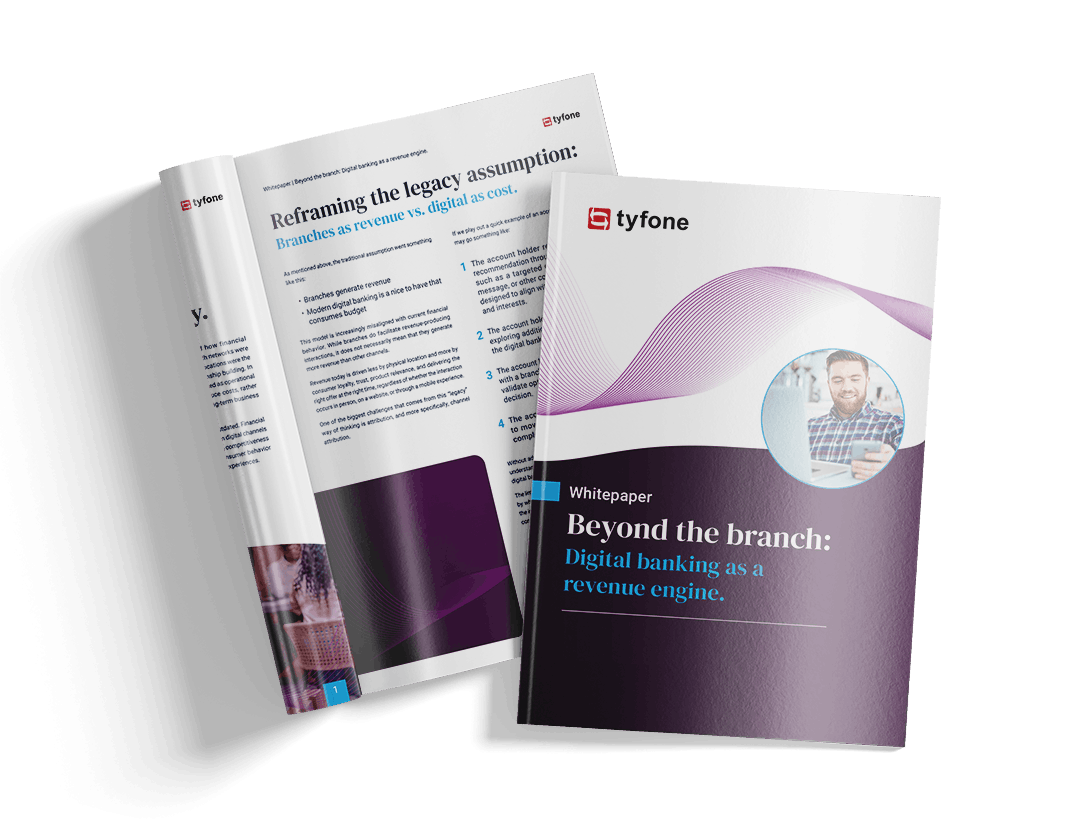
FREE WHITEPAPER
Beyond the branch: Digital banking as a revenue engine.
For decades, financial institutions have treated digital banking as a cost center while branches were seen as the primary drivers of revenue. But with consumer behavior shifting toward digital-first interactions, this traditional mindset is no longer enough.
Read our exclusive whitepaper and explore how modern digital banking platforms can become strategic engines for growth, engagement, and measurable revenue.
More than a decade ago, the institution made an unusual decision for a credit union of its size: rather than relying entirely on outside vendors for digital banking, it began building and maintaining its own online and mobile banking platform internally.
Wilson said only a small number of credit unions nationwide take that approach.
“We were probably a little more pioneers at that time,” he said.
The strategy was not without risk. Maintaining an internal development team requires significant investment and technical expertise, particularly as consumer expectations increasingly mirror those shaped by national banks and financial technology firms.
But Members 1st revisited the question several years ago, around the time Wilson became chief executive, and ultimately decided not only to continue managing its own platform but to “double down” on it.
Executives believed the model gave the credit union more control over product development, member data and personalization.
“We view it as a differentiator,” Wilson said. “We can be nimble, we can add features and functionality that are a little unique.”
That flexibility matters increasingly in a financial marketplace where institutions are competing less on branch proximity and more on relevance, speed and personalization.
The traditional branch-centric model of banking has become harder to quantify. A customer may see a loan offer inside a mobile app, research products online, speak with a call center employee and ultimately sign paperwork at a branch. Historically, however, the revenue from that transaction was often credited to the branch alone.
Wilson said Members 1st spent heavily to create what it calls a “single source of truth” for its data — a centralized system designed to track where interactions begin and how they move across channels.
“In the past, things would get falsely attributed to a branch that maybe had absolutely nothing to do with a branch,” Wilson said.
The credit union now attempts to follow the full consumer journey across its 61 branches, digital channels and call centers to better understand where engagement actually drives growth.
That shift reflects a broader trend within banking. Financial institutions increasingly rely on behavioral data to understand not just completed transactions, but also the sequence of interactions that lead to them.
At Members 1st, Wilson said the organization has invested heavily in what it calls “journey mapping,” assigning employees to study processes entirely from the member’s perspective.
Those reviews can include anything from opening an account online to navigating internal department transfers.
“We’re constantly striving for frictionless improvements,” Wilson said.
The emphasis on digital investment has not diminished the institution’s appetite for physical expansion. In fact, Wilson said Members 1st is preparing for a significant branch growth push even as digital usage climbs sharply.
On a typical day, he said, roughly half a million members use the credit union’s mobile app.
At the same time, branch traffic remains meaningful — though increasingly for different reasons.
“What we’re seeing is if they want quick, don’t-need-to-talk-to-anyone transactions, they’re going to use that mobile platform,” Wilson said. “But if they have more consultative questions, advice, or guidance, they’re doing that at one of our branches.”
That evolution is reshaping how many financial institutions think about branches themselves. Rather than functioning primarily as transaction centers, branches are increasingly being redesigned around advisory conversations, lending discussions and relationship-building.
Wilson suggested that traditional teller lines and routine transactions may eventually fade further into the background.
“The days of someone going to wait in line behind the stanchions to deposit a check at the teller station — all that stuff’s going to change,” he said.
Even so, he argued that physical branches still matter deeply in the markets Members 1st serves.
“There’s a lot of data that supports what we’re doing in the marketplace that we’re in,” Wilson said. “And we just see nothing but opportunity.”
The balancing act between digital modernization and legacy infrastructure remains one of the industry’s central challenges.
Members 1st operates on the Symitar core processing system from Jack Henry, a widely used platform among credit unions. Wilson said the institution maintains close ties with the company while relying on internal software developers to build application programming interface connections between its homegrown digital platform and the core system.
That arrangement allows the credit union to customize its digital experience while continuing to operate on a traditional banking backbone.
The strategy reflects a broader reality across financial services: even institutions investing aggressively in digital channels are often still layered atop decades-old infrastructure.
What has changed, executives increasingly argue, is the assumption that digital banking exists mainly to cut expenses.
The more important question now may be whether institutions can afford to treat it as anything less than a growth engine.