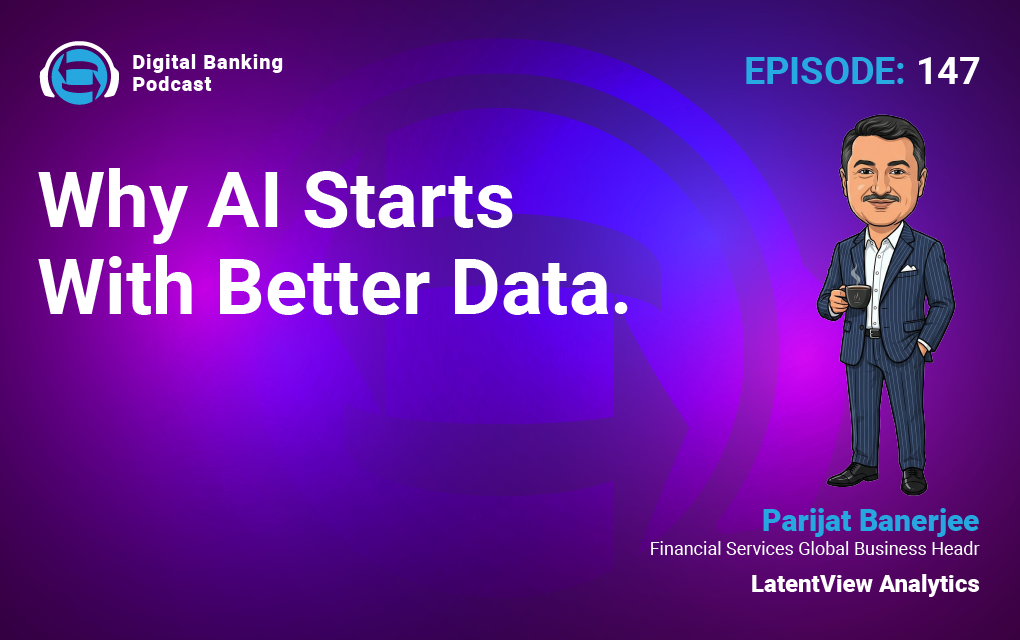
Why AI Starts With Better Data, with Parijat Banerjee.
“Data tells the truth even when opinions don’t.”
EPISODE:
147
with guest:

Parijat Banerjee
Financial Services Global Business Head
LatentView Analytics
Episode Summary
In the latest episode of Digital Banking Podcast, host Josh DeTar of Tyfone welcomed Parijat Banerjee, Financial Services Global Business Head at LatentView Analytics. The episode centered around how AI depended on strong data, clear process design, and a human-first purpose.
Josh and Parijat started with a simple idea: good technology should help people pay better attention. Parijat argued that listening remained the most useful human skill, and he framed AI as a tool that could remove busy work and make space for real focus. From there, he traced the rise of AI back to falling storage costs, wider access to data, and the shift from rules-based systems to models that learned patterns at scale.
The conversation then moved to what financial institutions had to get right. Parijat explained that poor data still led to poor outcomes, while unified data created a single source of truth and faster decisions. He also noted that banks and credit unions faced tighter limits because they needed accuracy, lineage, and explainable AI. Josh and Parijat closed on a practical point: community institutions could use AI well if they built on trust, local relevance, and clear customer needs.
Key Insights
⚡ AI gets better when data gets better
Strong AI starts with strong data. That sounds obvious, but many teams still skip the hard part and rush to the model. The result is weak answers, bad assumptions, and low trust. A better path starts with clean inputs, shared definitions, and one source of truth across the business. When data sits in silos, leaders end up with too many dashboards and not enough clarity. When teams unify that data, they can ask better questions and move faster on real decisions. That shift matters in banking, where a missing field or bad assumption can change the outcome. Before adding another tool, review the data underneath it. Check quality, lineage, and access. Make sure people trust the source. AI does not fix messy operations on its own. It tends to expose them. Clean data still does the heavy lifting.
⚡ Not every AI use case needs the same risk standard
Financial institutions do not need to treat every AI project the same way. Some use cases carry low risk and can move fast. Meeting notes, internal search, knowledge tools, and early marketing tasks fit that category. Other use cases sit much closer to compliance, fraud, underwriting, or risk modeling. Those demand a slower pace, tighter controls, and clear explainability. The key is to separate them instead of holding every project to the highest possible threshold. When teams apply an all-or-nothing standard, they often stall useful work that could deliver gains today. A better approach is to rank use cases by risk, customer impact, and regulatory exposure. Then match the governance to the task. That gives teams room to learn where AI is safe and useful, while protecting the areas where mistakes carry serious cost. Speed matters, but fit matters more.
⚡ The best use of AI may be more human attention
AI has real value when it gives people more room to listen, think, and respond with care. That is easy to miss in a market focused on speed and scale. Many of the best use cases are simple. Automated note-taking, background research, and first-draft summaries can remove busy work from meetings and service interactions. That frees people to stay present instead of splitting their attention between the conversation and the task list. For community financial institutions, that matters even more. Their advantage often comes from trust, local context, and real relationships. AI should support those strengths, not replace them. The same idea applies to generative engine optimization. Institutions that show trust, relevance, and community ties online can improve how AI systems surface them in search. Used well, the technology makes human service sharper. It does not need to make it smaller.
About The Guest

Parijat Banerjee
Financial Services Global Business Head
LatentView Analytics
Find Banerjee On:
LinkedIn
He focuses on how strong data, clear process design, and explainable AI help financial institutions move faster while keeping trust, accuracy, and human connection in view.