
If AI becomes the advisor, who owns the banking relationship?
Right now, a general AI chatbot is playing financial advisor to your account holders and it’s good at the job. It gives detailed, confident answers at any hour, and with tools like Plaid, it can even read real account balances.
Last night, while your branches were closed and your call center had gone quiet, thousands of financial conversations happened anyway.
At 11:48 p.m., someone asked whether they could really afford that car payment. On a lunch break, someone asked how to finally pay off a credit card. On Sunday at 7 a.m., someone asked where their savings should go next.
None of those conversations came to your financial institution. Right now, a general AI chatbot is playing financial advisor to your account holders and it’s good at the job. It gives detailed, confident answers at any hour, and with tools like Plaid, it can even read real account balances.
What it can’t see is your products, your rates, or any duty to get the answer right. It has never heard of your institution. It answered anyway.
Numbers speak louder than words.
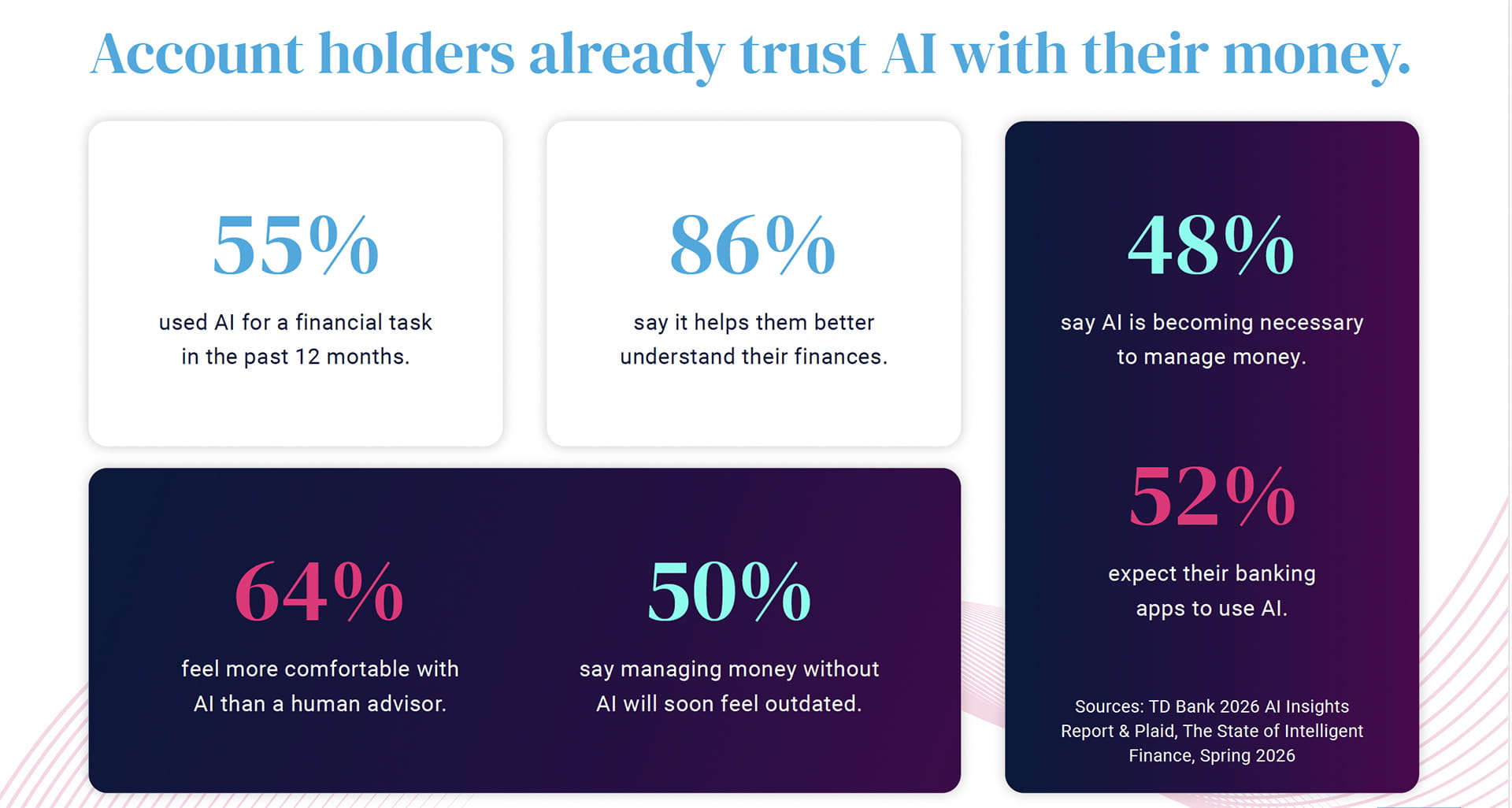
This isn’t a handful of curious early adopters. It’s the new normal. 55% percent of people have used AI for a financial task in the past twelve months, up from just 10% the year before, according to TD Bank’s 2026 AI Insights Report.
Eighty-six percent say it’s helped them understand their own finances better. 50% say managing money without AI will soon feel outdated, and 52% already expect their banking app to use it.
The shift is already happening. Sixty-four percent of consumers say they feel more comfortable with AI than with a human advisor, putting the future of the financial relationship into question.
The Good, the Bad, and the Bot.
It’s worth understanding why this habit has taken hold so quickly. General AI chatbots are always available, offering debt payoff strategies, budgeting frameworks, and financial explanations at no cost.
They’re also judgment-free. Many people find it easier to admit a financial mistake to a chatbot than to a person who may be selling them something. And for many, the results feel real. Users credit AI with helping them create budgets they actually follow, understand complex topics like 401(k)s and high-yield savings accounts, and finally make sense of the math behind financial decisions.
But the limitations become clear quickly. Connecting or sharing financial data is the account holder’s responsibility, and once that information leaves their institution, it enters an environment outside the FI’s control. AI responses can be inaccurate, financial calculations can be wrong, and every recommendation still requires validation.
There’s also a trust gap. Many people hesitate to share sensitive financial information with a general-purpose chatbot, even if they appreciate the convenience it provides.
Put those two realities side by side and the takeaway isn’t that people want less AI. They want AI that understands their financial life, operates within a trusted environment, and delivers guidance they can feel confident acting on.
Story continued below…
FREE PAMPHLET
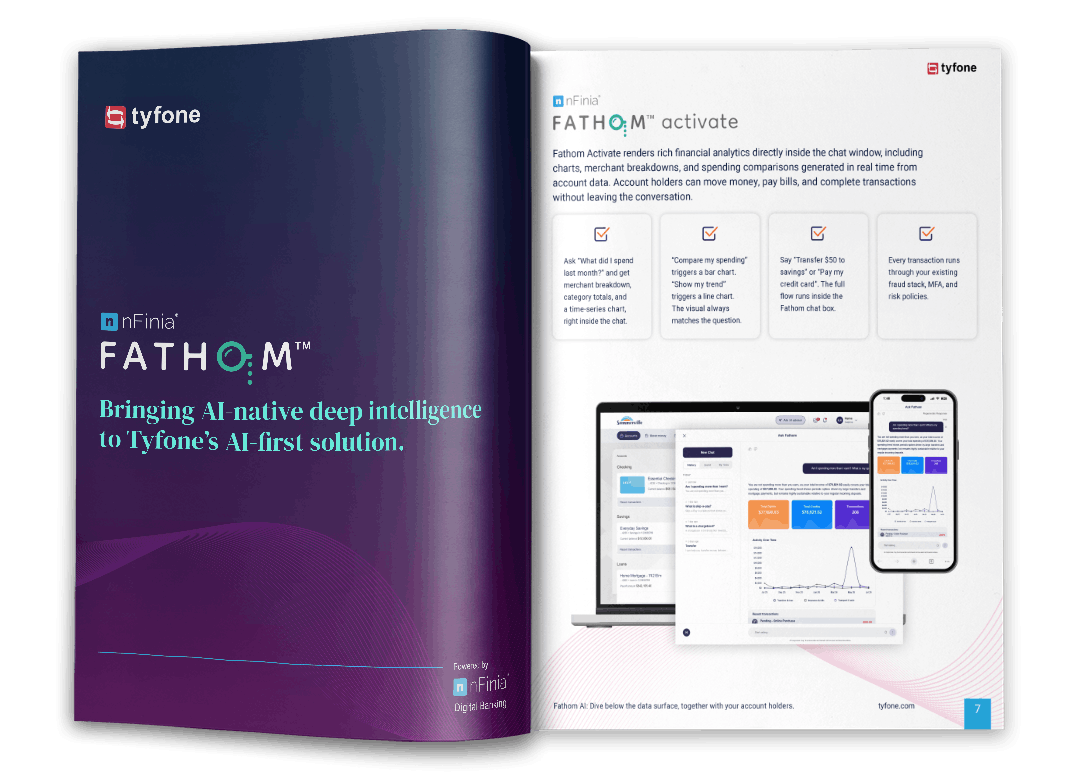
Bringing AI-native deep intelligence to Tyfone’s AI-first solution.
Most credit unions and community banks don’t have an AI strategy yet, and account holders aren’t waiting. They’re already comparing every digital experience, banking included, to ChatGPT. Stand still and get left behind.
Fathom is the AI layer woven throughout Tyfone’s digital banking ecosystem, combining account holder financial data, institutional knowledge, and native banking experiences into a single intelligence layer.
The conversation has left the building.
This is the silent risk financial institutions need to pay attention to. If the advice happens somewhere else, the relationship starts happening somewhere else too.
The account may still sit on your balance sheet. The direct deposit may still arrive. The app may still be downloaded. But the moments that build trust, the questions, the decisions, the guidance people rely on can slowly move outside your walls.
And nobody calls to tell you they’ve made the switch. There’s no cancellation notice when someone stops seeing your institution as their financial guide. They simply start asking questions somewhere else. What should I do with this debt? Should I refinance? How much should I save? Is this investment right for me? Over time, the AI that answers those questions becomes the relationship they remember.
That’s how financial relationships change today. Not with a closed account, but with a conversation that happens somewhere else and a gradual loss of connection to the institution that once owned the relationship.
The opportunity for financial institutions isn’t to fight AI. It’s to make sure AI works within a trusted relationship they already own. The institutions that bring intelligent, personalized guidance into their own digital experiences will remain part of the financial decisions that matter most.
The AI advisor needs a home. It should be yours.
A generic AI chatbot is impressive, but it’s also operating with a blindfold. It can analyze exported financial data, often pulled through third-party connections, but it doesn’t know the full relationship behind the numbers. It can’t see real-time account activity, understand your products and rates, take action within your ecosystem, or provide accountability when its answers miss the mark.
AI embedded inside your digital banking experience is fundamentally different. It is grounded in the financial reality you already manage. It can understand your account holders’ information, spending patterns and product relationships.
The question was never whether AI would compete with financial institutions. The question is whether AI will operate without the context of the institution or with it. And financial institutions already hold the most valuable asset AI needs: the trusted financial data and relationship behind every decision.
That context transforms AI from a buzzword into a growth engine. When the technology understands the full financial picture, every interaction becomes an opportunity to deepen the relationship.
See high-interest debt building? Surface a consolidation option or a lower-rate product the account holder may benefit from. Notice idle cash sitting untouched? Start a conversation about savings before another provider does. See healthy savings habits developing? Introduce planning tools that help account holders reach their goals.
This isn’t just a chatbot. It’s a personalized engagement engine built around the right advice, at the right moment, from the institution they already trust.
The last decade of digital banking was built around access, checking balances, moving money, and completing transactions. The next decade will be built around guidance. The institutions that win won’t be the ones with the longest feature lists. They’ll be the ones account holders turn to when they need to make financial decisions.
And that advantage comes down to trust.
Account holders are willing to experiment with AI for financial guidance, but they still expect privacy, accuracy, and accountability when decisions impact their financial lives.
That creates an advantage financial institutions already have. Trust isn’t something a general-purpose chatbot can manufacture overnight. It comes from the relationship, responsibility, and security that institutions have built over decades.
That’s the difference between an AI tool and an AI-powered relationship.
Meet Fathom: Tyfone’s conversational AI, built inside nFinia.
So how does a financial institution compete with a generic AI chatbot without building an AI team from the ground up? That’s exactly why Fathom exists.
Tyfone’s conversational AI was built inside nFinia digital banking, not bolted on afterward. It isn’t a separate widget, another app, or another destination for account holders to learn. It lives where the relationship already exists: inside your digital banking experience and under your institution’s brand.
A chatbot that operates without context needs access to the right context. Tyfone’s experience is grounded in the account holder’s financial relationship, including account information, transactions, products, rates, and institutional knowledge. Generic answers become relevant guidance by connecting responses to your institution’s products, policies, and trusted knowledge sources.
AI hallucinations require guardrails. Our solution’s retrieval-grounded responses help ensure answers are accurate, with the ability to recognize when a question falls outside its knowledge rather than inventing a response.
Account holders shouldn’t need to export statements, share sensitive information, or move their financial lives somewhere else. The Fathom experience works within the trusted environment they already use, minimizing exposure of personal information and protecting data throughout the interaction.
Unlike standalone AI tools, Tyfone’s Fathom keeps the relationship in-house. No new app. No additional login. No competing brand sitting between your institution and your account holders.
Behind every interaction are multiple layers of security and control. Requests are validated before processing. Session access is scoped. Sensitive information is minimized and masked before reaching the AI model. Responses are constrained to prevent unsupported answers, monitored through logging and feedback, and delivered within your institution’s digital experience.
The result is AI that is not only intelligent, but accountable.
Because in financial services, the question isn’t just whether AI can answer a question. It’s whether the right organization is responsible for the answer.
When account holders turn to AI with their financial questions, will they be talking to your institution, or building a relationship somewhere else?
That conversation is already happening. The opportunity is making sure it happens inside the relationship you’ve spent decades building.
See how Fathom brings trusted, conversational AI directly into nFinia digital banking.