FINTECH NEWS
The account-opening problem credit unions can’t afford to ignore.
Credit unions are under pressure to make digital onboarding faster and smarter while preserving fraud controls and the human service that can set them apart.
For credit unions, opening an account online once meant little more than replacing a paper application with a web form. That model is increasingly showing its age.
Applicants now expect financial services to respond in minutes, not days. Institutions, meanwhile, must reduce friction without giving up the security controls, employee judgment and personal relationships that remain central to the credit union model.
The result is a shift in what digital account opening is expected to accomplish. The technology is no longer simply a way to put an application on a screen. It is becoming part of the machinery for attracting deposits, converting applicants into members and allowing employees to spend less time on routine work.
At Forrit Credit Union in Clackamas, Ore., Aaron Goff, president and chief executive of the $82 million-asset institution, sees the issue in practical terms. With 4,463 members, the credit union does not have the resources to assign more employees to every operational challenge.
“We need to grow membership and deposits, and we also need to become more efficient, but we don’t want to lose that personal touch and feel to members,” Goff said. The goal, he said, is to make it easier for people to do business with the credit union while reducing the cost of acquiring and serving members.
That means deciding carefully what technology should handle.
Goff identified unnecessary steps, repetitive data entry and manual intervention as major sources of friction. Identity verification, data collection and straightforward decisions can be automated, he said, while employees can concentrate on complicated situations and relationship-building.
Real-time decisioning has become particularly important. Consumers have grown accustomed to immediate results from online retailers and technology-oriented financial services, Goff said. Credit unions need to provide similar convenience while preserving the personal service that distinguishes them.
Story continued below…
FREE PAMPHLET
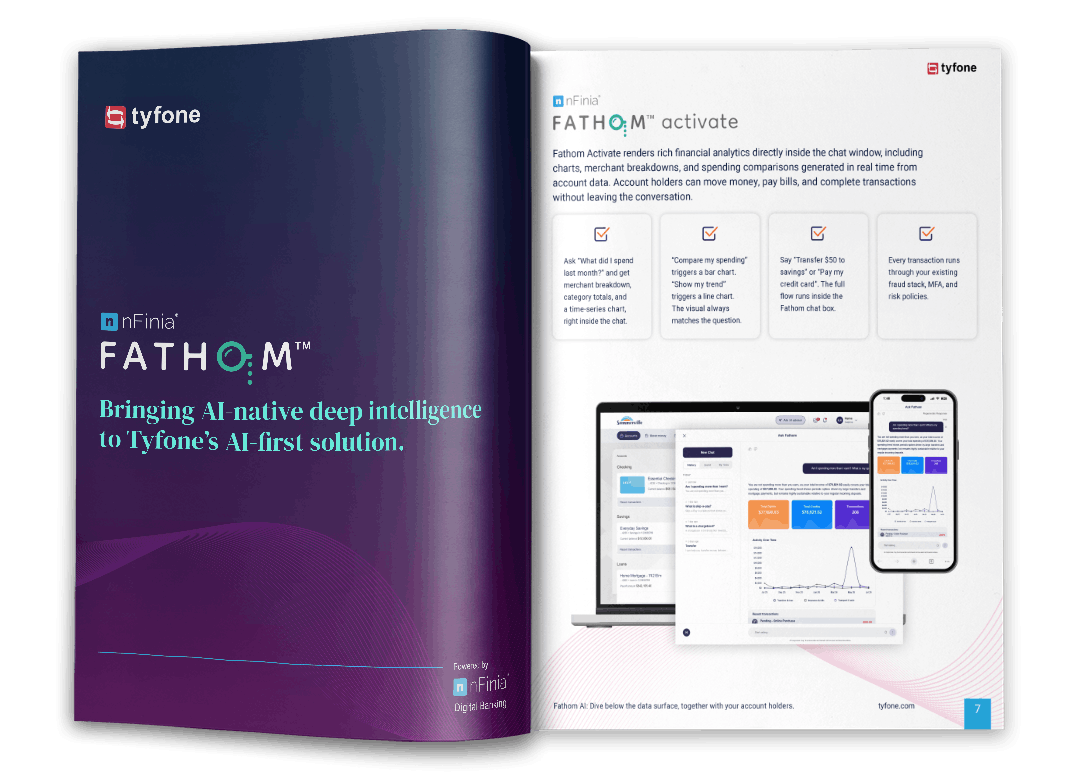
Bringing AI-native deep intelligence to Tyfone’s AI-first solution.
Most credit unions and community banks don’t have an AI strategy yet, and account holders aren’t waiting. They’re already comparing every digital experience, banking included, to ChatGPT. Stand still and get left behind.
Fathom is the AI layer woven throughout Tyfone’s digital banking ecosystem, combining account holder financial data, institutional knowledge, and native banking experiences into a single intelligence layer.
At 7 17 Credit Union in Warren, Ohio, John Demmler, president and chief executive of the $2.2 billion-asset institution, described the central challenge as balancing convenience with security. The credit union has 130,533 members.
“We want the account-opening experience to feel effortless while maintaining strong fraud controls,” Demmler said.
The credit union has streamlined its initial application, but Demmler said more work remains after an application is received, particularly in back-end efficiency and moving new members into digital banking once membership has been established.
That is also where Demmler sees a continuing role for employees. Suspected fraud requires judgment, he said, while new members with complex needs may still want to interact with a person.
The goal, in other words, is not to eliminate employees from the process but to use technology where it adds speed and efficiency and people where judgment or personal engagement matters.
For Georgia Heritage Federal Credit Union in Savannah, Ga., the technology challenge looks different at its $163 million asset size and 15,349 members.
Matt Selke, the credit union’s chief executive, pointed to integration as the key obstacle. Online banking, fraud detection and the core system all have to work together, he said. If those pieces are properly connected, much of the account-opening process can be automated in real time, with due diligence afterward.
Selke also offered a blunt view of the issue. If a $2 billion-asset credit union is still struggling with online account opening, he joked, its problems may extend beyond account opening.
His own comparisons illustrate how expectations have changed. Selke recalled opening an account with Navy Federal Credit Union about three years earlier, when he said it took roughly 48 to 72 hours for an online checking account to become fully functional. He later tested SoFi and found that an account and a $50,000 unsecured loan could be completed and deposited to another bank account within 24 to 36 hours, assuming qualification.
For Selke, real-time service offers a significant advantage, although he does not consider it an absolute requirement.
Across the three institutions, success is measured by more than how quickly an applicant completes a form.
At Forrit, Goff would track application abandonment, conversion rates, funded accounts, deposit growth and the staff time required to open and maintain accounts. He would also want to know whether new members go on to use additional services.
Selke takes a similarly practical approach. Ease of use, meeting implementation benchmarks for the core system and making sure the technology works as advertised all matter. So does price, although he said a higher cost could be justified if the system delivers the promised improvements.
The broader change is less about whether credit unions can offer online account opening than about what happens behind the screen.
A digital application can look modern while still relying on manual review, disconnected verification systems and staff intervention. The next stage requires those processes to work together, allowing automation to handle routine decisions while employees step in when judgment, fraud review or personal engagement is needed.
For credit unions competing with banks and fintech companies, digital account opening is becoming less a feature than an operational test: Can an institution make joining easy without making the relationship feel impersonal?
Ken McCarthy is manager of marketing communications at Tyfone, where he monitors the credit union industry and contributes to conversations shaping its future. He previously covered credit unions and community banking for American Banker and S&P Global Market Intelligence. He holds a journalism degree from Point Park University and has more than 15 years of experience covering financial services. He is also the author of three literary fiction novels.