FINTECH NEWS
The AI race for the credit union member.
Executives at two community credit unions say artificial intelligence may change how members interact with their institutions, but trust, lending and local relationships remain powerful advantages.
Artificial intelligence is changing the way consumers manage money, and for community credit unions the biggest risk may not be losing a transaction but losing the relationship around it.
That is the central argument of a new five-part white paper by Siva Narendra, chief executive of Tyfone, a Portland, Ore., digital banking provider. The series argues that data aggregation, conversational AI and new payment systems are steadily weakening the traditional advantages that banks and credit unions have relied on to keep customers close.
The shift is already visible in the way consumers organize their finances. In the paper, Narendra describes connecting 28 accounts held at eight financial institutions through an AI platform integrated with Plaid. The result was a consolidated picture of his finances that no single institution could provide on its own.
Narendra argues that the exercise illustrates a broader change: Financial institutions may still hold the accounts, but consumers can increasingly move their financial information to outside platforms and see their entire financial lives in one place.
That could make the old idea of account ownership as a source of loyalty less reliable. Checking accounts, for example, can become little more than the place where a paycheck arrives before money is shifted to an investment platform or another high-yield option, according to the paper.
The next layer is advice.
Narendra contends that conversational AI is becoming a new interface between consumers and their money. Rather than asking a banker or financial adviser a question, consumers can increasingly turn to an AI system that can draw from information across multiple accounts.
For community institutions, a proprietary chatbot may not be enough. A credit union’s system may know a member well, but an outside AI platform connected to aggregation tools can potentially see the broader financial picture.
Payments add another pressure point. Narendra points to digital wallets, buy-now-pay-later products, merchant payment platforms, instant-payment systems and stablecoins as technologies that could move more activity outside conventional banking relationships.
Yet he argues that community banks and credit unions still have an advantage in one critical area: lending.
Story continued below…
FREE PAMPHLET
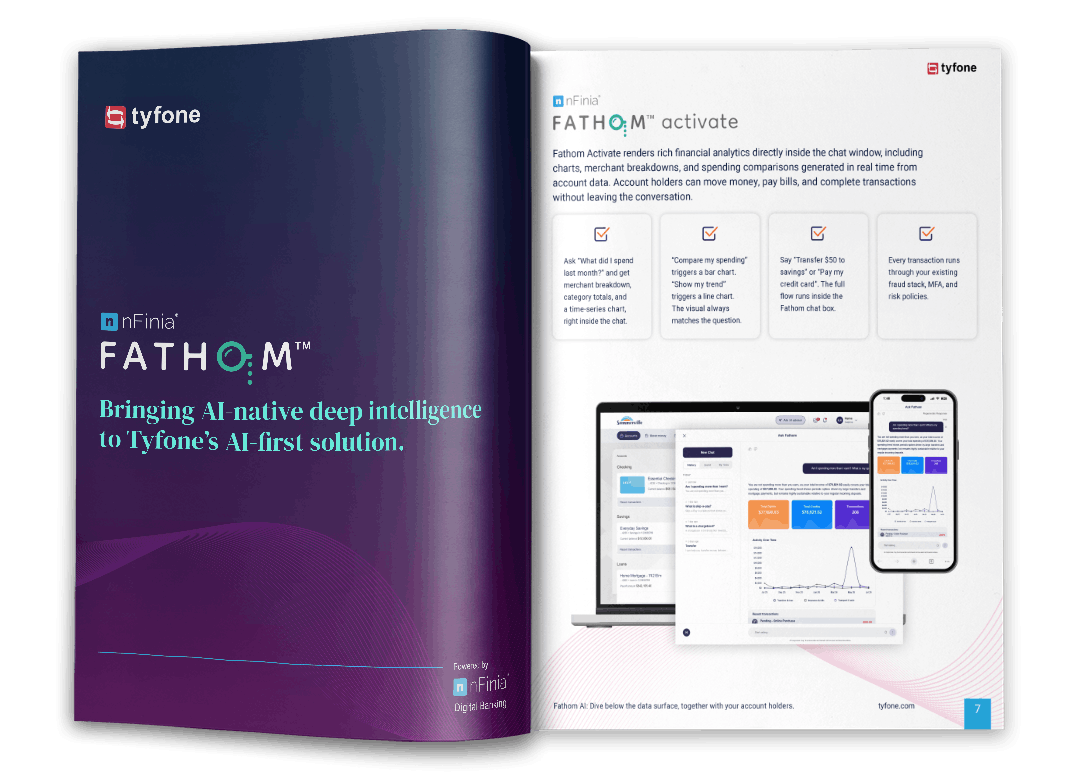
Bringing AI-native deep intelligence to Tyfone’s AI-first solution.
Most credit unions and community banks don’t have an AI strategy yet, and account holders aren’t waiting. They’re already comparing every digital experience, banking included, to ChatGPT. Stand still and get left behind.
Fathom is the AI layer woven throughout Tyfone’s digital banking ecosystem, combining account holder financial data, institutional knowledge, and native banking experiences into a single intelligence layer.
Banks and credit unions have access to relatively inexpensive deposits, regulated charters and required capital. They also have years of information about borrowers that can be difficult for outside technology companies to replicate. Lending decisions are subject to regulatory requirements for consistency and explainability, another barrier to AI simply taking over underwriting.
But even lending is vulnerable when the application process becomes fast, standardized and almost invisible to the borrower, Narendra argues. Mortgage lending is one example. Fintech companies can also use proprietary transaction data to underwrite small-business loans or acquire bank charters and compete more directly with traditional lenders.
John Buckley Jr., president and CEO of Gerber Federal Credit Union in Fremont, Mich., said that distinction remains important because many of the borrowers served by credit unions do not fit neatly into automated models.
“As long as the depositors/consumers that fintechs appeal to fit into a neat set of predetermined criteria, fintechs will be a valid choice for them,” Buckley told Tyfone. His $260 million credit union has about 16,000 members.
But, he said, many of his members need something more tailored.
“My members need tailored solutions that are derived from a personal knowledge of their situations and needs,” Buckley said. “The credit union difference has always been and will always be about relationships, and there is no fintech that can replicate that.”
Judy DeLucca, president and CEO of New Orleans Firemen’s Federal Credit Union, sees the shift somewhat differently. Her $284 million credit union has 26,000 members, and she said AI is changing not just how members conduct transactions but where financial relationships begin.
“Credit unions can no longer assume that holding a member’s checking account means we have their full financial relationship,” DeLucca told Tyfone.
Her response is not to resist the technology. It is to combine it with the parts of credit union banking that are harder to automate: trust, personal service and responsible lending.
DeLucca said AI should be used to improve efficiency, identify member needs, provide better financial guidance and make borrowing faster, while leaving employees responsible for judgment and personal relationships.
“Lending remains one of our greatest strengths, especially when we look beyond a credit score and take the time to understand the person behind the application,” she said.
She also sees a continuing role for branches and employees, particularly when members are making important or emotionally difficult financial decisions.
The debate comes as Tyfone itself moves further into AI. The company recently introduced nFinia Reimagined, an updated digital banking platform built around Fathom, its AI technology integrated throughout the platform.
Tyfone says Fathom allows account holders to interact with their financial institution using natural language and receive responses based on their financial information as well as the institution’s products, policies and services. The company is positioning the technology as a way to keep more financial conversations within the institution’s own digital banking environment.
Tyfone cited the 2026 TD Bank AI Insights Report, which found that 78% of Americans use AI-powered tools in their daily lives and 55% already use AI to help manage their finances.
That trend creates a difficult strategic question for credit unions. They can embrace AI to make their services easier and more useful, but in doing so they may also be competing on territory where technology companies already have a head start.
Narendra’s conclusion is not that community institutions are destined to lose. Instead, he argues that they need to rethink where their advantage actually lies. Data may be increasingly portable. Payments may be increasingly detached from traditional banking. Advice may increasingly come from machines.
Lending, trust and personal knowledge of members are harder to move.
The challenge is making sure those advantages remain connected to the member before someone else owns the conversation.
Ken McCarthy is manager of marketing communications at Tyfone, where he monitors the credit union industry and contributes to conversations shaping its future. He previously covered credit unions and community banking for American Banker and S&P Global Market Intelligence. He holds a journalism degree from Point Park University and has more than 15 years of experience covering financial services. He is also the author of three literary fiction novels.