
INDUSTRY NEWS
Credit unions test AI with guardrails.
At a Philadelphia industry summit, executives and regulators described a cautious approach to artificial intelligence: use it to make employees more productive, but keep people in control.
For Jason Mertz-Prickett, the chief executive of a $92.7 million-asset credit union in California, artificial intelligence is less about chasing the newest technology than finding ways to give a small institution more time.
Upward Credit Union in Burlingame has deployed Microsoft Copilot to managers and selected employees, while Mertz-Prickett and the chief operating officer are the only employees permitted to use ChatGPT. The tools help with tasks including reviewing policies, drafting communications and developing member messages.
The goal, Mertz-Prickett said Wednesday at the National Association of State Credit Union Supervisors’ annual State System Summit in Philadelphia, is not to eliminate jobs. It is to make employees more efficient and free them to spend more time with members.
“Our employees love it, our board loves it,” he said during a session titled “From Innovation to Implementation: What Actually Works.” The technology has allowed employees to spend more time working directly with members while producing what he described as a stronger work product.
For Upward, the experiment reflects a broader challenge facing smaller credit unions. Institutions do not necessarily need to be first to adopt every new technology, Mertz-Prickett said. They need to figure out how to use tools already available without exposing member information or taking on risks they do not understand.
That caution has shaped Upward’s approach from the beginning.
Mertz-Prickett said he took an artificial-intelligence policy to the credit union’s board about three years ago, before Upward was using Copilot or ChatGPT in its operations. The move was intended to establish clear rules before the technology became embedded in the institution’s work.
Among those rules: Employees cannot put proprietary or nonpublic information into the AI platforms. Any material intended for members must be reviewed by a senior manager before it is sent out.
The policy also gave employees a common understanding of what they could and could not do with the technology as Copilot was gradually introduced, Mertz-Prickett said.
Story continued below…
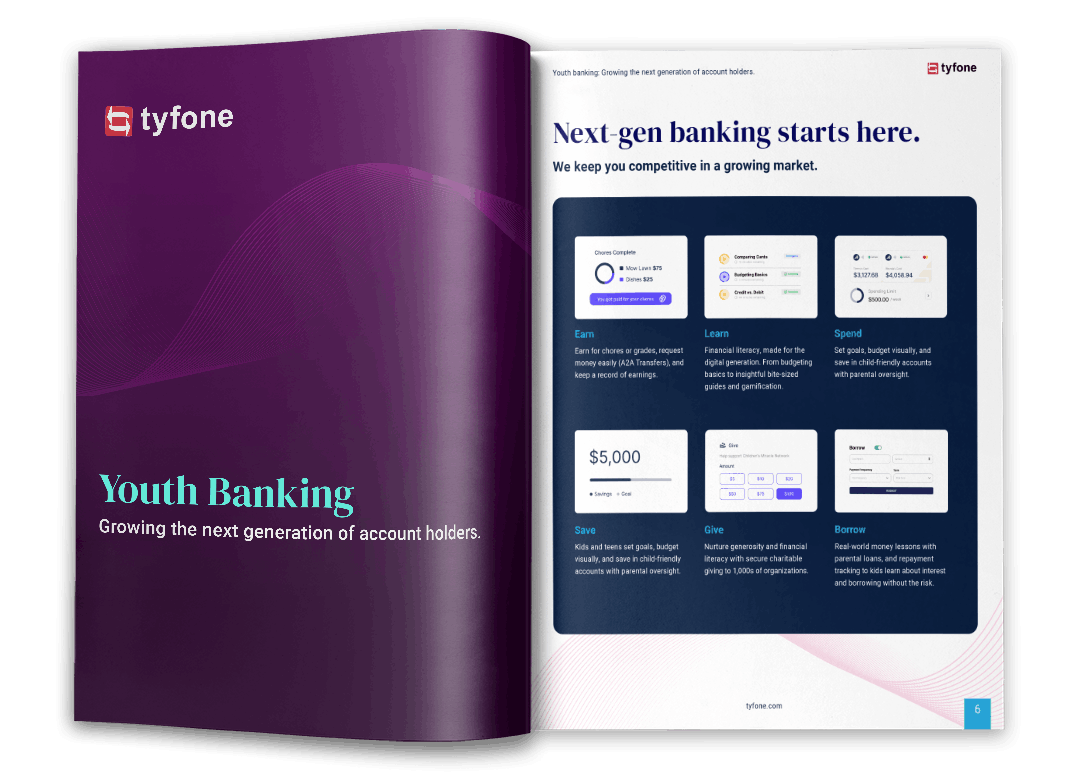
FREE PAMPHLET
Youth banking: Growing the next generation of account holders.
Financial habits are formed early, but most financial tools are designed for adults. As a result, families often rely on cash, shared cards, or disconnected apps to teach money management, making it difficult to balance independence with oversight.
At the same time, younger generations expect intuitive digital experiences, creating a gap between how they interact with money and how financial services are delivered. Financial institutions need age-appropriate solutions that engage younger account holders while supporting parents and caregivers.
For a small credit union, the potential payoff is straightforward. Mertz-Prickett said he can use ChatGPT to help develop a policy that addresses National Credit Union Administration rules and regulations rather than starting the document from scratch. The output is treated as a starting point, not a finished product.
That distinction matters to regulators.
Melissa Sneed, senior deputy commissioner for the Georgia Department of Banking and Finance, said during the session that regulators were approaching artificial intelligence through a familiar framework: The level of oversight should correspond to the risks created by how the technology is being used.
An internal application that does not involve member data and remains subject to substantial human review would warrant a different level of governance than an AI system making customer-facing decisions, she said.
For lower-risk uses, regulators would expect measures including board approval or policy development, oversight and trained employees. As the technology moves into areas where customer decisions are involved and human review becomes less direct, the expectations for governance, procedures and staff training rise.
“You can’t outsource your risk,” Sneed said.
That principle has become particularly relevant as credit unions turn to outside technology vendors. Mertz-Prickett warned against adopting a product simply because another institution has done so.
He described a recurring problem in which executives rush to become early adopters of a vendor’s technology without fully understanding how it works. The shortcomings can become apparent when examiners ask questions that the credit union cannot answer.
“You have no idea what this company is doing for your credit union but you think you do,” he said.
The concern is not limited to artificial intelligence itself. Sneed said the regulatory framework surrounding AI builds on years of expectations for third-party relationships, including due diligence and heightened scrutiny when technology touches lending or fair-lending requirements.
For credit unions, that means the novelty of AI does not eliminate older responsibilities. Institutions remain accountable for the technologies they deploy, even when the underlying systems are built and operated by someone else.
At Upward, the answer has been to put governance ahead of adoption. Mertz-Prickett said the early AI policy gave the board and employees a framework for discussing the technology before the institution began using it widely.
That has allowed the credit union to expand its use gradually while keeping restrictions around member information and human review.
The approach also reflects a practical calculation for a $92.7 million-asset institution. Upward does not have to outspend larger competitors or become the first credit union to adopt every emerging tool. Instead, it can use widely available technology to stretch the capacity of its existing staff.
The test, as described in Philadelphia, is whether that efficiency ultimately improves the member experience without creating new problems that outweigh the gains.
For regulators, the answer will depend on the use. For credit unions, it may depend just as much on whether they understand the technology before putting it to work.
“And so you get into these relationships where you have no idea what this company is doing for your credit union but you think you do.”
– Jason Mertz-Prickett
President & CEO
Upward Credit Union
Ken McCarthy is manager of marketing communications at Tyfone, where he monitors the credit union industry and contributes to conversations shaping its future. He previously covered credit unions and community banking for American Banker and S&P Global Market Intelligence. He holds a journalism degree from Point Park University and has more than 15 years of experience covering financial services. He is also the author of three literary fiction novels.