
INDUSTRY NEWS
At Members 1st, the CEO’s AI avatar has a seat at the table.
The Pennsylvania credit union is building governance rules and digital “twins” for executives as it pushes deeper into artificial intelligence, even as regulation remains unsettled.
At a strategic planning retreat this spring, board members at Members 1st Federal Credit Union were divided into six groups and assigned six different artificial-intelligence avatars.
Some avatars walked directors through market disruptions. Others simulated cyber events or operational crises. The software listened to discussions, summarized themes and flagged disagreements. Then, in a final twist, the findings were delivered back to the board by an AI-generated version of the credit union’s chief executive, Mike Wilson.
“It was me,” Wilson said during a recent interview with Tyfone. “It was wild for me to see as well because I do a lot of media and a lot of speaking. I mean, it was me! And I didn’t record one minute of it.”
For Wilson, the exercise was not a gimmick so much as a warning — and a preview of what he believes is coming for financial institutions that fail to prepare for AI’s rapid expansion.
“We can’t run from it,” he said. “We have to be educated on it.”
That message is becoming increasingly common across banking and credit unions, where executives are trying to balance the promise of AI-powered efficiency with growing concerns about fraud, governance and future regulation. But Members 1st, an $8.6 billion-asset credit union based in Enola, Pa., has moved more aggressively than many peers by formalizing AI oversight before deploying the technology broadly.
The institution, which serves roughly 630,000 members, earned $48.1 million in the first quarter of 2026, up from $40.1 million a year earlier.
Story continued below…
FREE PAMPHLET
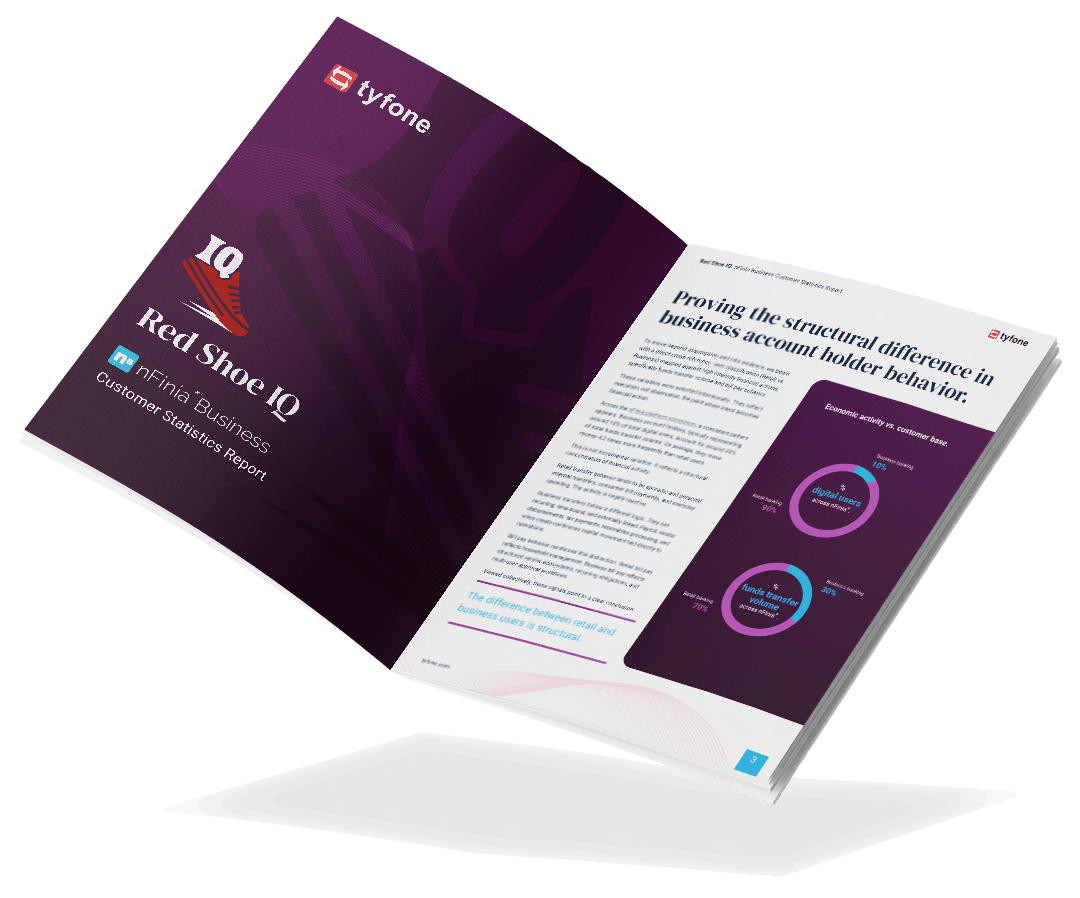
Red Shoe IQ: nFinia Business customer statistics report.
For years, financial institutions assumed retail and business users were simply variations of the same digital persona. But a full year of behavioral data tells a different story. Insights from Tyfone Red Shoe IQ reveal that business users don’t just use digital banking more, they use it differently.
Download the full report to see what the data means for your digital strategy.
Wilson said the credit union spent much of last year building what it calls an “AI center of excellence,” tying the initiative into strategic planning, project management and vendor oversight. The organization also appointed an AI officer, a role Wilson said the board now formally renews each year, similar to positions overseeing anti-money-laundering compliance or information security.
The credit union adopted those governance measures before expanding its use of automation, bots and AI-assisted underwriting.
Wilson said he worries some financial institutions are moving too quickly.
“We’re at a time where AI is not regulated yet,” he said. “But by the same token, it’s one of those areas that will absolutely be regulated and probably heavily.”
The concern reflects a broader uncertainty hanging over the banking industry. Federal agencies have encouraged experimentation with AI while offering limited formal guidance on how it should be governed. Financial institutions are left trying to modernize while guessing at what future rules may require.
Wilson said that uncertainty is shaping how Members 1st approaches deployment.
“If people get too cute with the way they’re using the technology,” he said, “they may build out workflow processes that they become reliant on, and then a regulation comes out that says you can’t do that anymore.”
Even so, the credit union is leaning heavily into automation where executives believe it can remove repetitive work rather than replace employees outright.
Wilson pointed to the organization’s call center as one example.
Several years ago, Members 1st found itself adding staff simply to keep pace with volume. After analyzing the calls, executives discovered that most members were asking a single question: What is my balance?
The credit union automated those inquiries, allowing callers to receive balance information immediately without waiting for an employee. Human agents were redirected toward more complex conversations involving fraud, lending and financial guidance.
“We have totally transformed our call center,” Wilson said.
He described a similar strategy in underwriting. Members 1st currently originates between $125 million and $150 million in auto loans each month, according to Wilson. Rather than having underwriters spend time reviewing straightforward applications from borrowers with pristine credit, the credit union is exploring ways to automate simpler decisions.
The goal, Wilson said, is to free employees to spend more time evaluating applicants whose financial histories require judgment and context.
“We want you guys to change a life, not check a box,” he said, describing conversations with underwriting staff.
That approach reflects a growing divide in how financial institutions talk about AI internally. While fears about job losses persist, many executives now frame the technology as a tool for reallocating labor rather than eliminating it altogether.
Fraud prevention has become another major focus.
Wilson said Members 1st uses AI and data analysis to identify patterns tied to account takeover schemes and compromised payment cards. The credit union also works with vendors that scan the internet for stolen card information and fraudulent websites impersonating the institution.
“We have substantially cut our fraud losses,” he said.
Those investments have become increasingly necessary as fraud schemes grow more sophisticated and digital banking expands. Financial institutions across the country are facing rising pressure to stop scams quickly while minimizing disruptions for legitimate customers.
Wilson argued that controlling and securing the institution’s own data gives Members 1st an advantage, though he acknowledged that doing so requires significant spending on cybersecurity infrastructure.
The broader challenge, he said, is that banks and credit unions remain constrained by aging technology systems even as member expectations continue to rise.
“In this industry, whether you’re a bank or a credit union, we’re kind of plagued with legacy archaic systems,” Wilson said.
AI, he added, may help institutions bridge some of those gaps by connecting disconnected systems and improving personalization for members.
For now, Members 1st is also experimenting with a more unusual use case: executive AI avatars.
Wilson said each member of his executive team is receiving a customized avatar designed to interact daily with its human counterpart. The idea is partly educational and partly operational — helping executives grow comfortable with the technology while exploring practical applications within their business units.
The avatars can even be assigned different personalities.
Wilson laughed while describing the initiative, but his tone remained serious about its implications.
“This is bigger than an IT thing. It would really behoove CEOs to get in front of it with both their boards, as well as their workforce.”
– Mike Wilson
CEO
Members 1st Federal Credit Union
Ken McCarthy is manager of marketing communications at Tyfone, where he monitors the credit union industry and contributes to conversations shaping its future. He previously covered credit unions and community banking for American Banker and S&P Global Market Intelligence. He holds a journalism degree from Point Park University and has more than 15 years of experience covering financial services. He is also the author of three literary fiction novels.