

Why speed is becoming a competitive advantage.
Borrowers increasingly expect speed alongside competitive rates when choosing a lender. Digitizing loan origination helps financial institutions meet that expectation by streamlining the application, verification, underwriting, closing and funding process.
For community banks and credit unions, that creates an opportunity to compete on speed without giving up the personal service that sets them apart.
Rate still matters. So does speed.
Picture a borrower who applies for an auto loan on a Tuesday night.
By Wednesday morning, one lender has sent an approval and a clear path forward. Another has sent an email asking for a pay stub.
The second lender may offer a better rate. But the first lender has already made it easy to move forward.
That dynamic applies across mortgages, personal loans, home equity and other lending products. Borrowers increasingly expect financial services to be fast and convenient, and lending is no exception.
For relationship-focused institutions, digital loan origination provides a way to meet that expectation while keeping people at the center of the lending experience.
What slows down manual lending?
Most delays don’t come from underwriting judgment. They come from the work surrounding it.
In a manual or partially digital workflow, time can disappear through:

Re-keying data.
Staff enter the same information into multiple systems.

Chasing documents.
Pay stubs, tax returns and IDs arrive through email, fax or branch visits.

Waiting in queues.
Files sit until someone is available to review them.

Printing and signing.
Disclosures and closing documents create additional steps.

Status questions.
Borrowers call for updates, pulling loan officers away from active files.
Most of these tasks don’t require the expertise of a loan officer. But they take time away from helping borrowers.
Digital loan origination addresses these bottlenecks by automating verification and decisioning, reducing manual work, moving the lending process into digital workflows and giving lending teams centralized visibility.
The goal isn’t to remove people from lending. It’s to remove the busywork so lending teams can spend more time doing what they do best: helping borrowers.
Does automation make lending less personal?
It can do the opposite.
When technology handles routine tasks, lending teams have more time for the conversations that actually require a person. That could mean helping a first-time borrower understand a credit decision, explaining the cost of a home equity line or working through a more complex application.
Automation can also make decisioning more consistent. Real-time workflows can apply established credit policies, calculate key lending metrics and route exceptions to the right person.
Simple applications can keep moving while complex ones get the attention they need.
For relationship lenders, that’s the real value of automation: less time managing the lending cycle and more time helping the borrower.
Story continued below…
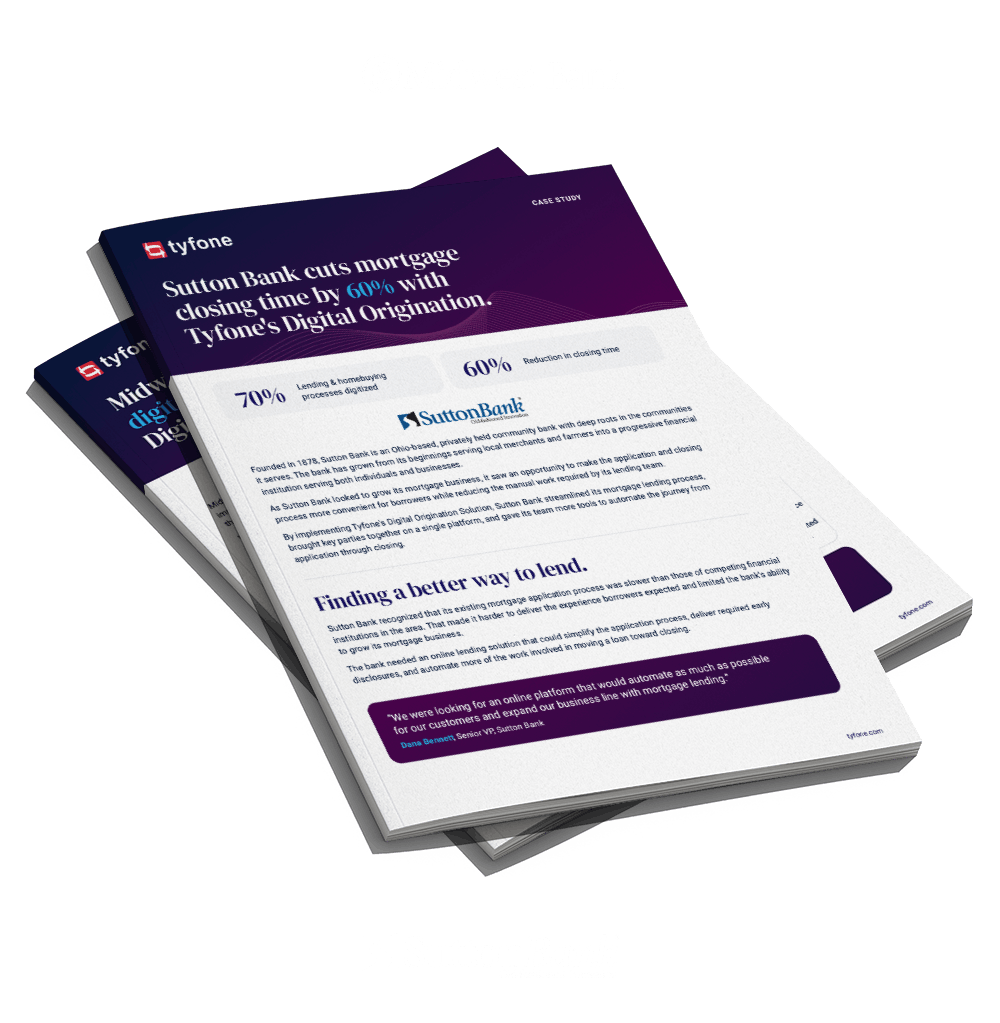
FREE CASE STUDIES
Borrowers expect speed. Your lending process should deliver.
Borrowers want answers fast. No waiting. No paperwork. No unnecessary back-and-forth. Manual processes and disconnected systems make lending harder, slowing decisions, adding work for staff, and creating friction at every step.
Tyfone makes lending faster and simpler with a flexible, white-label experience built around your policies. From application to funding, give borrowers a seamless experience across digital and in-branch channels.
Why digitize the lending lifecycle?
Digitizing the application is only part of the equation.
A borrower can receive a real-time decision and still face delays if closing and funding depend on manual workflows.
The lending lifecycle can be thought of in five stages:
Apply
Verify
Underwrite
Close
Fund
When those stages run through connected workflows, information doesn’t have to move between disconnected systems at every step.
Borrowers can complete applications digitally, receive disclosures electronically and move through the process across digital and in-branch channels. Lending teams can manage products, workflows and borrower interactions from a centralized platform, with real-time visibility into lending activity.
That helps reduce manual work and gives lenders a clearer view of where time is being lost.
If you’re measuring only time to decision, you’re missing part of the picture. Time to close and time to fund matter too.
Read our Digital Loan Origination case studies now.
One platform can simplify more than the borrower experience.
Many institutions digitize lending one product at a time: a mortgage system here, a card application there, while consumer and business lending continue through separate journeys.
Over time, that can create a “Frankenstein” experience for both borrowers and staff: different applications, workflows and systems stitched together across the lending portfolio.
A unified origination platform can bring multiple lending products into one environment, including consumer, auto, mortgage, home equity and business lending.
That means:

One experience for account holders.
Borrowers get a consistent digital experience across loan products.
One system for staff.
Lending teams work across products through connected workflows instead of separate processes.
One view for leadership.
Centralized reporting provides visibility across the lending portfolio.
Once the platform is in place, adding another lending product can be simpler than starting another technology project from scratch.
Your lending technology should fit your policies, not the other way around.
Your lending journey is unique to your institution. Your technology shouldn’t force you into a predefined workflow.
A core-agnostic origination platform connects with your existing core and other systems while giving your team control over products, eligibility rules and workflows.
That flexibility matters when you want to introduce a new product, change a decision rule or adjust the application experience.
The same principle applies to the borrower experience. Digital lending should carry your brand across online, mobile, in-branch and staff-assisted channels.
Technology should adapt to the way you lend, not the other way around.
What should you look for in a digital loan origination platform?
If you’re evaluating digital origination, start with these questions:

Does it support your lending portfolio?
Consumer, auto, mortgage, home equity and business lending may each have different requirements.

Is it core-agnostic?
It should work with your existing core and technology environment.

Can your team manage it without relying on engineers?
Look for configurable products, rules and workflows that business users can manage without ongoing technical support.

Does it support real-time decisioning?
Look for automated workflows that can apply your policies and calculate key lending metrics.

Does it digitize closing?
Digital disclosures and automated closing workflows should be part of the lending process.

Is it omnichannel?
Borrowers should be able to start online, continue on mobile and receive help in a branch when needed.

Does it integrate with your ecosystem?
Credit bureaus, verification services, document providers and payment systems should connect through established integrations.

Does it give staff a single view?
Teams should be able to see where applications stand throughout the lending workflow.

How quickly can you go live?
Understand implementation requirements, timelines and training before choosing a platform.
The right platform can help shorten the lending cycle while giving your team more time to focus on borrowers.
Speed is more than an operational metric.
Borrower expectations will continue to evolve. For financial institutions, keeping pace doesn’t mean choosing technology over relationships.
It means using technology to make the relationship easier.
Digital loan origination can remove repetitive work, accelerate decisions, simplify closing and give lending teams more time for the people behind each application.
Our solution brings those capabilities together in a core-agnostic platform built around your lending policies, workflows and borrower experience.
See how our customers are using Digital Origination.