Beyond customization: The future of personalized digital banking.
Digital banking has become highly personalized in appearance, but far less so in how the experience actually works. Most platforms can recognize an account holder’s preferences, but they do little to adapt the experience around who that person is, what they need, or how they interact with their finances.
Radical personalization takes a different approach. It means shaping the digital banking experience around each account holder’s needs, using a trusted identity and relevant financial data.
Much of the personalization offered today is surface-level. Users can move a menu, change a profile icon, or choose a color or background. That is customization, not true personalization. It changes how the app looks, but not how it works for the individual using it.
Radical personalization goes further. It creates an experience that responds to the individual account holder. To do that safely, a financial institution needs confidence that the person logging in is really who they say they are. When Alex logs in, the institution needs to know it is actually Alex.
That is the foundation of Tyfone’s approach with nFinia, its digital banking platform for credit unions and community banks. Cryptographic Device Authentication (CDA) establishes a trusted device identity. Fathom, the AI layer embedded in nFinia, can then use that secure identity and relevant financial data to make the experience more relevant to each account holder.
Together, identity and intelligence create a path to more personalized digital banking without sacrificing security.
In this article, we’ll explore what these concepts mean, how they work together, and how they can help financial institutions deliver a more modern, personalized and secure digital banking experience.
How does Cryptographic Device Authentication help prevent account takeovers?
Cryptographic Device Authentication (CDA) gives each trusted device a unique cryptographic identity associated with the account holder. A stolen password or intercepted one-time passcode (OTP) is not enough to authenticate from an untrusted device. This adds another barrier against account takeover.
Passwords and OTPs have a common weakness. They are pieces of information, and information can be phished, guessed, bought or intercepted. Once a fraudster has them, a system has a harder time distinguishing an imposter from the legitimate account holder.
CDA works on a different principle. The account holder registers a phone or tablet as a trusted device. CDA establishes a cryptographic relationship between that device and the account holder. From then on, the device provides cryptographic proof that helps verify the account holder.
The security gain comes with a usability gain. Because the device provides the authentication proof, institutions can rely less on routine OTP challenges. Account holders spend less time typing codes into everyday sessions. Step-up checks can happen when risk signals call for them rather than by default. If CDA authentication is unavailable or fails, OTP can remain available as a fallback.
Stronger protection with less friction is rare in security. It is also an important foundation for radical personalization. Once the institution can establish a real and secure identity, it has a stronger foundation for creating a more relevant experience for that person.
How do trusted-device approvals work in real time?
When a login or sensitive action requires additional verification, nFinia can send a push notification to the account holder’s trusted device for approval. The device provides a secure way to verify the request without requiring the account holder to enter a code.
Here’s how it works.
Register.
The account holder registers a phone or tablet as a trusted device through CDA. The device is cryptographically bound to the account, creating a secure relationship that the system can verify in future sessions.
Request.
A login or sensitive action triggers an authentication request.
Authentication.
A notification is sent to the device.
- Silent authentication (trusted device, low-risk context): The device verifies itself in the background using cryptographic proof. The account holder sees no interruption and no code entry is required. The session simply continues.
- Push approval (non-trusted device or elevated risk). A notification is sent to the trusted device asking the account holder to explicitly approve or reject the request. If approved, the request continues. If rejected, it stops immediately.
This puts the account holder in control at important moments, such as logins, profile changes and money movement. Even if someone obtains an account holder’s password, they still need access to the device to approve a request.
For legitimate account holders, the experience is simple: a familiar tap instead of manually entering a one-time code. For financial institutions, this type of authentication adds another layer of protection without adding unnecessary friction to everyday digital banking.
This is an important foundation for radical personalization. The security experience can adapt to risk and context rather than treating every session the same.
Story continued below…
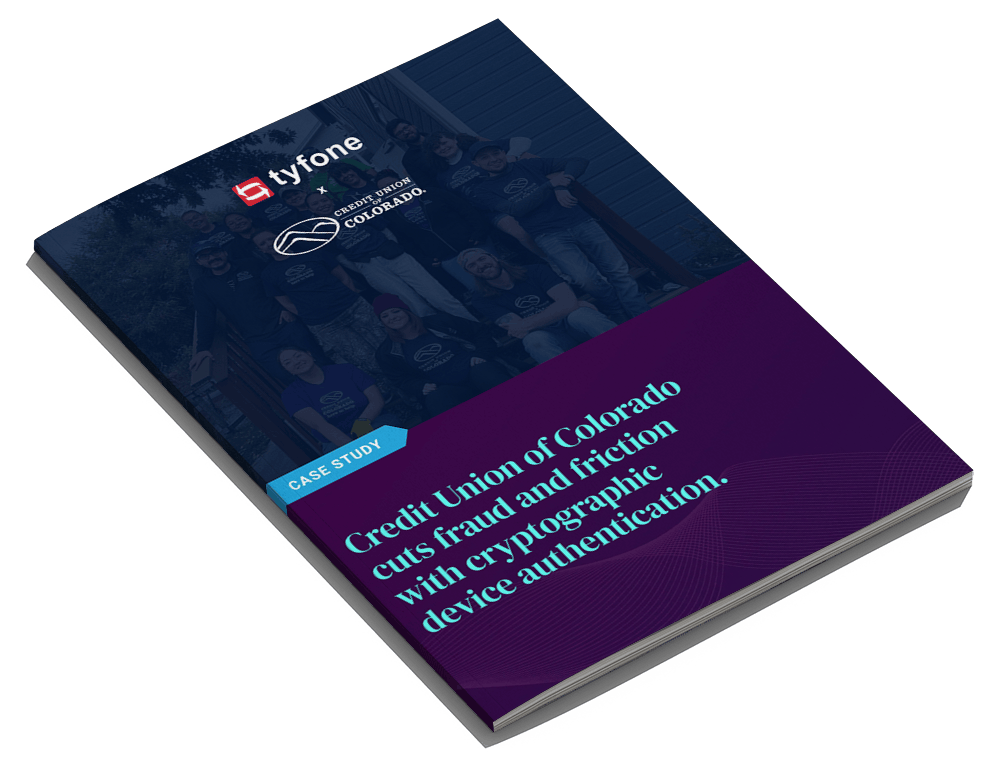
FREE CASE STUDY
CU of CO cuts fraud and friction with CDA.
Personalization in digital banking should go beyond changing colors, rearranging menus or adding a favorite team’s logo. Real personalization starts with knowing who the account holder is and understanding what they need.
Credit Union of Colorado (CU of CO)’s experience shows why trust comes first. By combining Cryptographic Device Authentication (CDA) with real-time fraud intelligence, the credit union strengthened security, reduced friction by 90% and cut manual fraud reviews by 98%.
How does Fathom personalize digital banking?
Fathom, Tyfone’s AI layer embedded in nFinia, understands intent rather than relying only on keywords. It can answer questions in plain language using the institution’s approved content and the account holder’s relevant account information. It can also help account holders take action without leaving the conversation.
Traditional chatbots often match keywords to scripted replies. Ask the same question in a different way and the experience can break down. Fathom works from the meaning behind the question. For example, a question such as “How do I set up direct deposit?” can return a clear answer and guide the account holder to the right place in nFinia. Fathom can also support questions before login, helping account holders find information even when they cannot access their account.
Answers are grounded in content approved by the institution. That can include policies, rates, product information and documents. When approved content changes, Fathom can reflect those changes so account holders receive information that aligns with the institution’s current content.
Fathom can also use account and transaction data available within nFinia. An account holder can ask about their spending and see category totals, spending breakdowns or trends directly in the conversation.
From there, the conversation can become action. Depending on the capabilities enabled by the institution, account holders can view spending insights, move money between accounts, pay bills, pause a card and more.
For the institution, this can mean fewer routine “where do I find” questions and fewer basic spending inquiries reaching staff. Fathom Admin provides visibility into query trends and unanswered questions, helping institutions identify content gaps and opportunities to improve the digital experience.
Is AI in digital banking secure?
AI in digital banking is only as secure as the controls around it. In nFinia, Fathom actions remain subject to the institution’s existing fraud controls, MFA and risk policies.
That principle matters. Many institutions worry that adding AI means opening a new door into the core. With Fathom, there is no side entrance. Actions initiated through the AI experience follow the same controls that govern the rest of the digital banking platform.
A transfer requested in conversation follows the same rules as a transfer started from the Move Money screen. If a request requires additional authentication or trusted-device approval, the same controls apply.
Fathom is built with guardrails at every step:

Grounded answers.
Responses come from the institution’s approved content and the account holder’s relevant data. Fathom is designed to stay within the information and capabilities available to it.
Data minimization.
Passwords and banking credentials are not sent to the model. Account numbers are masked.
Scoped sessions.
Identity, scope and session integrity are confirmed for requests. Chat history remains isolated to the individual account holder.
This is where CDA and Fathom come full circle. CDA establishes a trusted identity. Fathom can then make the experience more relevant to that account holder. The institution’s controls determine what the platform is allowed to do.
Personalization never has to come at the cost of protection.
What should credit unions and community banks look for in a personalization strategy?
The right personalization strategy brings relevance and security together. When evaluating a digital banking provider, financial institutions should ask:

Does personalization start with verified identity?
Look for strong, device-based authentication rather than relying on passwords and OTPs alone.

Is the AI embedded in the platform?
An AI layer built into digital banking can work with relevant account data and existing platform controls rather than operating as a separate chatbot.

Are answers grounded in your content?
The AI should work from your approved policies, rates and documents, along with the account holder’s relevant data.

Can the AI act, not just answer?
Account holders should be able to complete appropriate tasks within the conversation rather than being sent somewhere else for every action.

Can you build tools without development work?
Institutions should have ways to create and target digital experiences without relying on development resources for every change.

Do your security policies govern AI actions?
Fraud controls, MFA, permissions and approvals should apply consistently across the digital banking experience.
What if digital banking could be redefined?
Radical personalization is not a feature. It is a different way of thinking about the relationship between an institution and the people it serves.
Customization asks the account holder to make the experience fit them. Radical personalization changes the experience itself based on who the account holder is, what they need and what they are trying to accomplish.
With CDA, nFinia can establish a trusted identity for Alex. With Fathom, that experience can become more relevant to Alex’s needs. Alex can get answers in plain language, access tools aligned to their needs and complete appropriate actions without unnecessary friction.
The institution gets more than a personalized interface. It gets a digital experience built around verified identity, relevant intelligence and the controls already in place.
Innovation and security do not have to compete. On nFinia, they can work together.