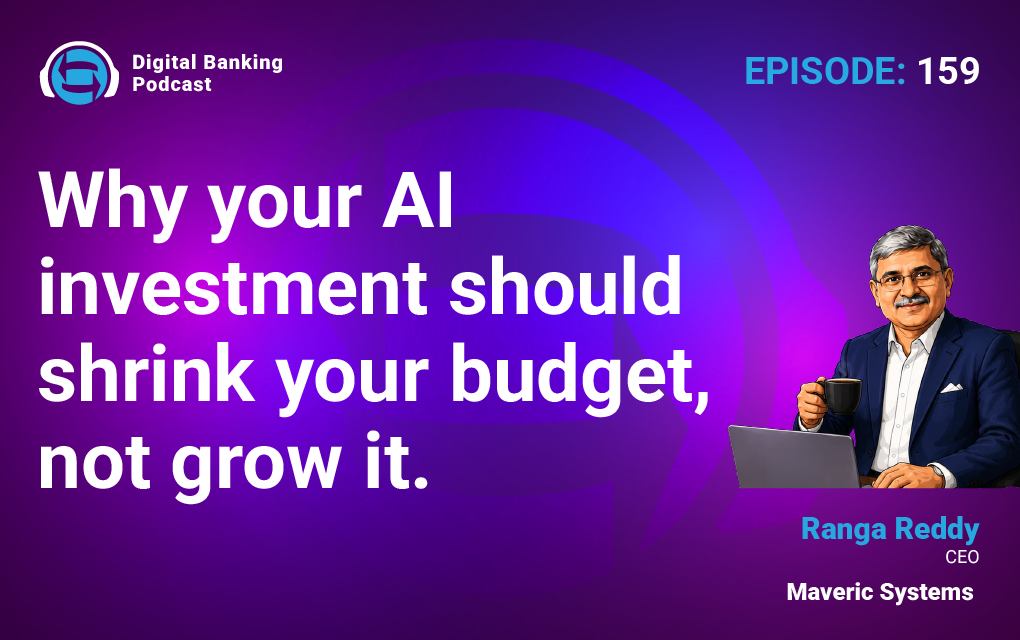
Why your AI investment should shrink your budget, not grow it, with Ranga Reddy.
“AI is not cheap.”
EPISODE:
160
with guest:

Ranga Reddy
CEO
Maveric Systems
Episode Summary
In the latest episode of the Digital Banking Podcast, host Josh DeTar of Tyfone welcomed Ranga Reddy, CEO of Maveric Systems, a technology and consulting firm that had spent nearly 25 years working with banks around the world. Reddy built his career on listening before speaking, a habit that carried through two failed startups before he found lasting success partnering with financial institutions on their toughest technology problems.
Reddy walked through how AI adoption had shifted from a race to find use cases into a much harder conversation about trust. He ranked North America ahead of Europe and the Middle East in AI maturity, tracing the gap to longer-standing partnerships between banks and Big Tech and to how quickly regulators in each region had built the governance frameworks banks needed to move forward. He argued that the banks furthest along had stopped treating governance as a compliance checkpoint at the end of a project and started designing it into the engineering process from day one.
The conversation turned to what smaller institutions got wrong when adopting AI. Reddy introduced the idea of a “right to win,” the argument that tier two and tier three banks should amplify their own local strengths rather than copy what tier one banks were doing. He also pushed back on the instinct to buy AI solutions off the shelf the way smaller banks had always bought core systems, arguing that AI required more building, more internally developed talent, and a discipline where every dollar invested needed to free up an equal or greater amount elsewhere in the budget.
Key Insights
Trust, not use cases, became the real AI conversation.
Reddy said the AI conversation with banks had moved past finding possible use cases and into a much harder question of trust: how to govern AI well enough to let it operate inside a regulated environment. He ranked AI maturity as highest in North America, then Europe, then the Middle East, and traced the gap to two things, how long banks in each region had partnered directly with Big Tech, and how far behind regulators and available talent were in each market. The banks furthest along, he said, had stopped treating governance as a compliance step at the end of a project and started building it into the engineering process from the very beginning.
Smaller banks needed a “right to win,” not a tier one playbook.
Reddy introduced what he called a bank’s “right to win,” the specific local strength that made a tier two or tier three institution valuable in a way a larger competitor could not easily replicate. His biggest frustration was watching smaller banks copy whatever a tier one bank was doing with AI instead of using it to amplify their own core competency. He paired that with a warning about build versus buy: smaller banks accustomed to buying core systems off the shelf needed to get comfortable building AI capability themselves, and investing in longer-term technology partnerships rather than one-off vendor purchases.
AI had to pay for itself, not just add to the budget.
Reddy argued that an AI investment should never simply sit on top of an existing technology budget. If a bank spent two to three million dollars on an AI initiative, that initiative needed to free up an equal or greater amount elsewhere, citing an example of a bank cutting its lending quality assurance costs from twelve million dollars to six million within a year of applying AI. He also flagged a newer problem showing up at banks further along in adoption: staff burning through their entire AI token quota before lunch, with tokenomics becoming its own discipline that finance teams had not yet fully grappled with.
About The Guest

Ranga leads a 1,500-person global services firm serving banks across North America, Europe, and the Middle East. His 80-person AI Competency Team was built primarily from internal talent — 60 of the 80 members were reskilled from adjacent technology roles rather than hired externally. Before Maveric, he attempted to launch a product ordering and delivery app well before the mobile ecosystem or consumer readiness existed to support it.