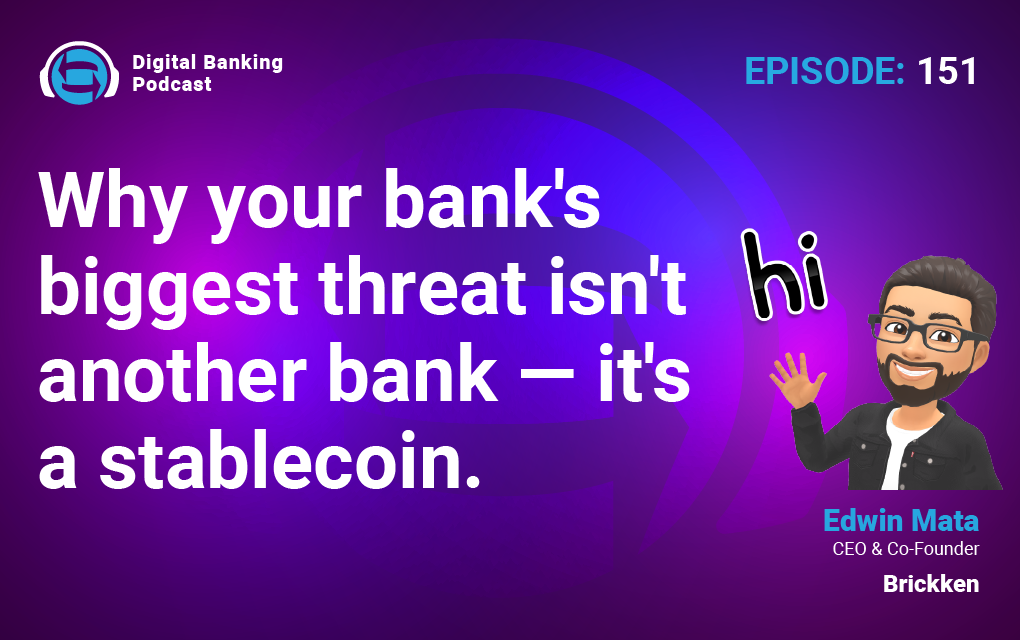
Why your bank’s biggest threat isn’t another bank — it’s a stablecoin, with Edwin Mata.
“All I’m saying is that great banking products need to think about these things, and they struggle for years. They’re coming in late… If a bank would have done this five, 10 years ago, that bank today, quadrillion.”
EPISODE:
151
with guest:

Edwin Mata
CEO & Co-Founder
Brickken
Episode Summary
In this episode of the Digital Banking Podcast, host Josh DeTar sat down with Edwin Mata, CEO and Co-Founder of Brickken, to unpack one of the most misunderstood — yet most consequential — shifts in financial services: tokenization. Mata, a former M&A lawyer turned legal-tech and fintech founder, brought a unique cross-disciplinary lens to the conversation, drawing on a career spent translating between lawyers, financiers, and technologists. The two explored how tokenization is far from a fringe crypto concept, pointing to everyday examples like DocuSign, credit cards, and casino chips as proof that tokens have quietly powered commerce for decades.
The conversation moved from foundational definitions into the real-world implications for banks, fintechs, and consumers. Mata explained why blockchain-based infrastructure is enabling 24/7 settlement, global liquidity access, and dramatically lower fees — and why countries with weaker banking infrastructure (Venezuela, Argentina, and the Mexico-to-U.S. remittance corridor) adopted stablecoins long before tier-one nations took them seriously. He also unpacked why legacy banks, burdened by decades of layered tech debt, are struggling to compete with neobanks and crypto-native players who can offer integrated stablecoin and fiat experiences.
The episode closed with a candid look at the U.S. regulatory landscape, including the Clarity Act, skinny master accounts, and what increased fintech access to Federal Reserve rails could mean for community banks and credit unions. Mata and DeTar agreed that while competition will compress margins and force product innovation, the institutions that lean into the new infrastructure — rather than resist it — will be the ones that remain relevant to their communities.
Key Insights
Tokenization Isn’t New — Banks Just Missed Their Window
Most executives associate tokenization exclusively with blockchain and cryptocurrency, but Edwin makes a compelling case that tokenization has been embedded in everyday financial life for decades. A credit card is a token representing a bank deposit. A casino chip is a token representing legal tender. DocuSign created tokens to represent binding agreements. The novelty isn’t the concept — it’s that financial instruments themselves can now be tokenized on an open, interoperable ledger. For community FIs, this reframing matters because it strips away the mystique: tokenization is simply operational efficiency layered on top of existing financial products. The institutions that recognize this early can adopt the infrastructure as a tool; those that don’t will watch fintechs and exchanges absorb deposit relationships through superior products.
The Real Disruption Is Stablecoin Yield, Not Bitcoin
Edwin is direct about where the existential threat to traditional banking actually lives: it’s not in volatile crypto assets — it’s in stablecoin yield. If stablecoin yield becomes broadly permitted (a fight currently playing out in the US Clarity Act debates), the question every consumer will ask is, “Why am I keeping money in a checking account earning nothing when I can hold a dollar-equivalent stablecoin earning yield?” Edwin himself admits he keeps minimal funds in traditional banks because yield-generating alternatives are more compelling. For community FIs, this isn’t a distant concern — it’s a deposit franchise question with a five-year horizon. The institutions that figure out how to offer dual-rail accounts (legal tender + stablecoin, seamlessly transferable, both yield-bearing) will retain the relationships. Those that don’t risk becoming bill-pay utilities.
Tokenization Took Off Where Banking Failed First
The adoption curve for blockchain-based finance didn’t start in the US or Western Europe — it started in Venezuela, Argentina, and remittance corridors where predatory intermediaries and currency instability made traditional banking unworkable. Edwin draws a parallel to how developing markets skipped landlines entirely and went straight to mobile. The lesson for community FIs: infrastructure leapfrogging is a real phenomenon, and the markets that adopt new financial rails first do so out of necessity, not novelty. When younger US consumers, gig workers, and small businesses begin choosing stablecoin-based products for the same efficiency reasons, the adoption curve will be just as steep — and community FIs anchored to legacy infrastructure will face the same disintermediation that taxis faced from Uber.
Skinny Master Accounts Signal the End of the Monopoly
When Josh raises the Trump administration’s expansion of Skinny Master accounts — giving non-bank fintechs direct access to Federal Reserve master accounts — Edwin frames it as “the monopoly getting broken.” For decades, banks have charged fees on top of capital access because they were the gatekeepers to the underlying rails. As more fintechs gain direct access, those access-based fees compress, and competition shifts to product quality, user experience, and yield. Edwin is bullish on what this means for consumers but candid about what it means for incumbents: the institutions that don’t reposition themselves as service-and-experience providers — rather than infrastructure gatekeepers — will lose pricing power. For community FIs, the strategic question becomes: what unique value do we provide when capital access is no longer scarce?
About The Guest

Edwin is a former M&A lawyer who transitioned from corporate law into the startup world, eventually co-founding Brickken in 2020 to build infrastructure for tokenizing real-world financial instruments. Brickken focuses on representing equity, debt, bonds, profit-sharing, and other securities on blockchain rails — enabling 24/7 transactions, zero-settlement times, and global capital access. Edwin’s background uniquely blends regulatory expertise with deep technology understanding, allowing him to translate complex blockchain concepts into terms financial executives can act on.