
Banks confront a familiar question: Grow bigger or sell.
Two recent bank sales highlighted a broader debate in regional banking over whether midsize institutions can still compete as technology costs and regulatory demands rise.
At a banking conference in Dallas this spring, two recently retired chief executives offered a candid explanation for why their institutions agreed to sell: staying independent was becoming harder to justify.
Jeff Marsico, a principal of consulting services at Wolf & Company, recounted those discussions in a March 28 blog post examining the recent sales of Cadence Bank to Huntington Bancshares and Stellar Bancorp to Prosperity Bancshares.
The transactions, he argued, reflected mounting structural pressures in banking rather than weakness at either institution. Regulatory thresholds, technology spending and the search for scale have increasingly reshaped decisions in the regional banking industry, particularly for banks hovering around $10 billion or $50 billion in assets.
“Technology is a major driver,” Marsico wrote, describing how the growing expense of digital banking platforms has widened the gap between large and midsize institutions.
Marsico drew heavily from a panel discussion at the 141st annual convention of the Texas Bankers Association featuring Dan Rollins, the former chairman and chief executive of Cadence, and Bob Franklin, chief executive of Stellar.
Story continued below…
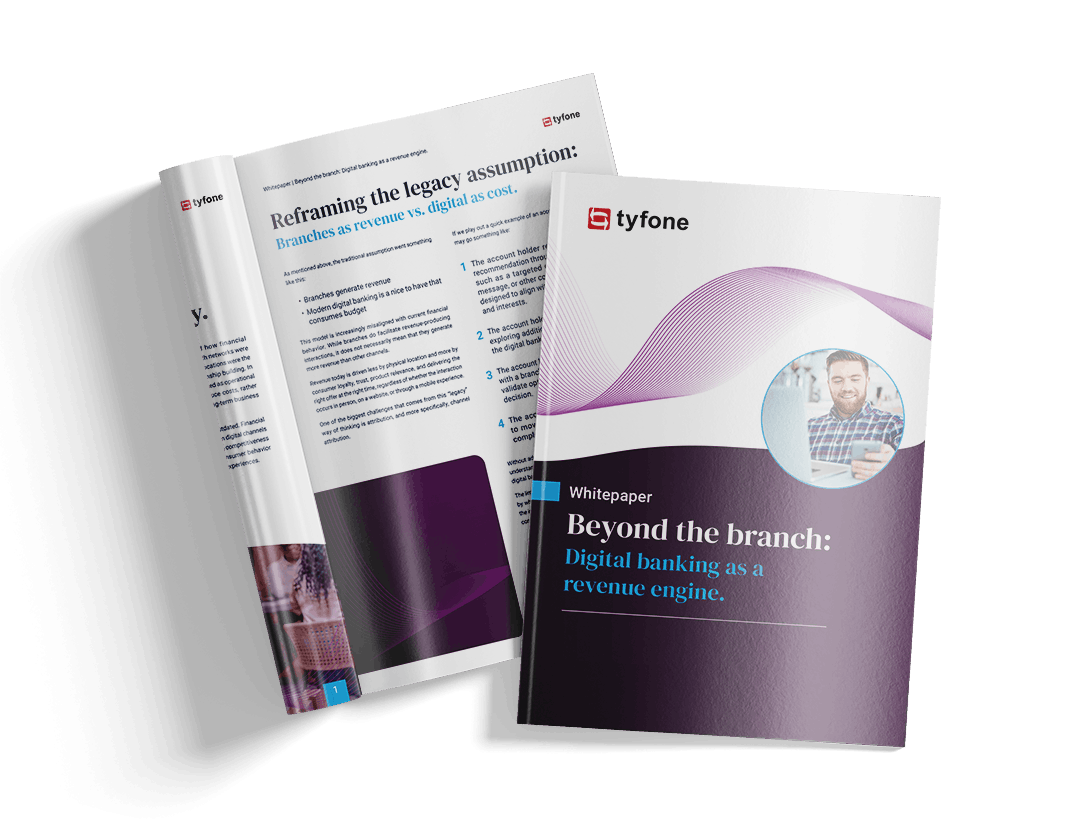
FREE WHITEPAPER
Beyond the branch: Digital banking as a revenue engine.
For decades, financial institutions have treated digital banking as a cost center while branches were seen as the primary drivers of revenue. But with consumer behavior shifting toward digital-first interactions, this traditional mindset is no longer enough.
Read our exclusive whitepaper and explore how modern digital banking platforms can become strategic engines for growth, engagement, and measurable revenue.
Cadence, with roughly $50 billion in assets before its sale, faced what Marsico described as a “step-change” in compliance and operational costs tied to its size. Huntington, he noted, had spent years investing heavily in technology infrastructure and digital capabilities — investments that would have been difficult for Cadence to replicate at the same pace.
“Huntington wasn’t investing in things that Cadence was not,” Marsico wrote. “It was just that Huntington started years before, and was investing 10x as much.”
For Stellar, which sat near the $10 billion asset threshold that triggers additional regulatory requirements under the Durbin amendment, the economics were different but no less challenging. Marsico said the bank had pursued acquisitions in an effort to grow toward $15 billion in assets but ultimately failed to secure a deal large enough to offset rising fixed costs.
Instead, Stellar agreed to sell to Prosperity, creating one of the larger Texas-based deposit franchises.
Marsico said both cases underscored a reality increasingly confronting regional banks: size itself may be becoming a competitive necessity.
“Their decisions reflect a broader trend in regional banking consolidation where size increasingly determines perceived competitiveness,” he wrote.
Yet the analysis also raised a deeper question about identity in modern banking. As institutions expand across multiple states and hundreds of branches, Marsico questioned whether the label “community bank” still carries meaning.
“Does ‘community bank’ resonate when you have nearly 400 branches in over 300 communities?” he wrote.
The concern is not merely semantic. Marsico suggested that as banks grow larger, they are often pushed into larger lending markets and more standardized pricing models, making it harder to distinguish themselves from competitors.
“If that is the case,” he wrote, “then size would presumably be the only thing that matters.”
“Both Cadence and Stellar ultimately sold not due to immediate need to do so, but because of structural industry pressures—scale, regulation, and technology investment requirements.”
– Jeff Marsico
Principal of Consulting Services
Wolf & Company
Ken McCarthy is manager of marketing communications at Tyfone, where he monitors the credit union industry and contributes to conversations shaping its future. He previously covered credit unions and community banking for American Banker and S&P Global Market Intelligence. He holds a journalism degree from Point Park University and has more than 15 years of experience covering financial services. He is also the author of three literary fiction novels.