
How credit unions are losing the next generation and what to do about it.
The next generation of members is being formed right now. Some of them are sitting at kitchen tables, opening apps their parents have never heard of, building financial habits that will last decades. The credit unions that show up for this moment, with the right tools, the right experience, and the right brand, all in one place, will be the ones those young people trust with their first mortgage, their first business account, and eventually, their own children’s first savings goal.
There is a slow-moving but significant challenge unfolding across many credit unions. It doesn’t appear as a sudden wave of account closures or an immediate drop in deposits.
Instead, it is happening gradually, almost invisibly, as younger consumers choose other financial providers for their first meaningful financial relationships.
A parent opens a youth banking account for their 10 year old child. The child gets a debit card. They may check their balance a couple times. When they grow to 15, they discover youth centered fintech solutions such as Greenlight. The experience is engaging, modern, and built for them. The credit union’s app, by comparison, feels outdated.
By the time they turn 18, they don’t want to walk into a branch to upgrade to an adult account. They just stay with their preferred fintech solution. Five years later, when they take out their first loan for a big expense or open a joint account, the credit union isn’t even part of the conversation.
This isn’t a hypothetical scenario. It’s a growing pattern across the credit union industry, and institutions that fail to adapt risk becoming irrelevant to the next generation of members.
Why young account holders are walking out the digital door.
To understand why credit unions are losing this demographic, we need to dive deeper into how financial habits actually form.
Research shows that the financial behaviors people develop in their childhood tend to stick as they grow into adulthood. The institution where someone opens their first account, makes their first purchase, sets their first savings goal, has an enormous head start on building a lifelong relationship. It’s not just sentimental. It’s structural. First mover advantage in financial services is real.
The problem is that most financial institutions aren’t showing up for that moment in a meaningful way. They offer a youth savings account, maybe a debit card if the parent asks and call it a day. There’s no age-appropriate digital experience, no engagement loop, no tools that make a 12-year-old feel like banking is actually relevant to their life.
Meanwhile, fintechs are building entire product lines around this gap. Apps like Greenlight have raised hundreds of millions of dollars to create mobile first and engaging family banking experiences with features such as gamification, chore tracking, allowance automation, spending controls and more. They’re not trying to be a full-service bank. They’re trying to be the first financial relationship and they’re winning it.
The real cost of getting this wrong.
When a financial institution loses a young account holder to a fintech, the immediate financial impact looks small. A $200 savings balance isn’t going to move the needle on the balance sheet. But the long-term cost is substantial, and it compounds in ways that aren’t always easy to model.
Here’s what’s actually walking out the door when that relationship goes to a competitor:

Deposits.
Youth members grow up. A 13-year-old with $300 in savings becomes a 28-year-old with a mortgage, a car loan, and a direct deposit paycheck. That’s a household relationship worth tens of thousands of dollars in lifetime value.

Interchange revenue.
Every debit card swipe generates interchange. Youth accounts with active debit cards drive real transaction volume especially for teens with part-time jobs.

Data.
Behavioral and transactional data from young consumers gives institutions early insight into financial patterns that can inform personalized product offerings down the road.

Household relationships.
Youth accounts don’t exist in isolation. They bring parents deeper into your ecosystem. A parent who opens a youth account for their child tends to consolidate more of their own banking at that institution.

Long-term loyalty.
The probability that someone stays with their first financial institution into adulthood drops dramatically once they’ve had a better digital experience elsewhere. You don’t get a second chance to be someone’s first.
Story continued below…
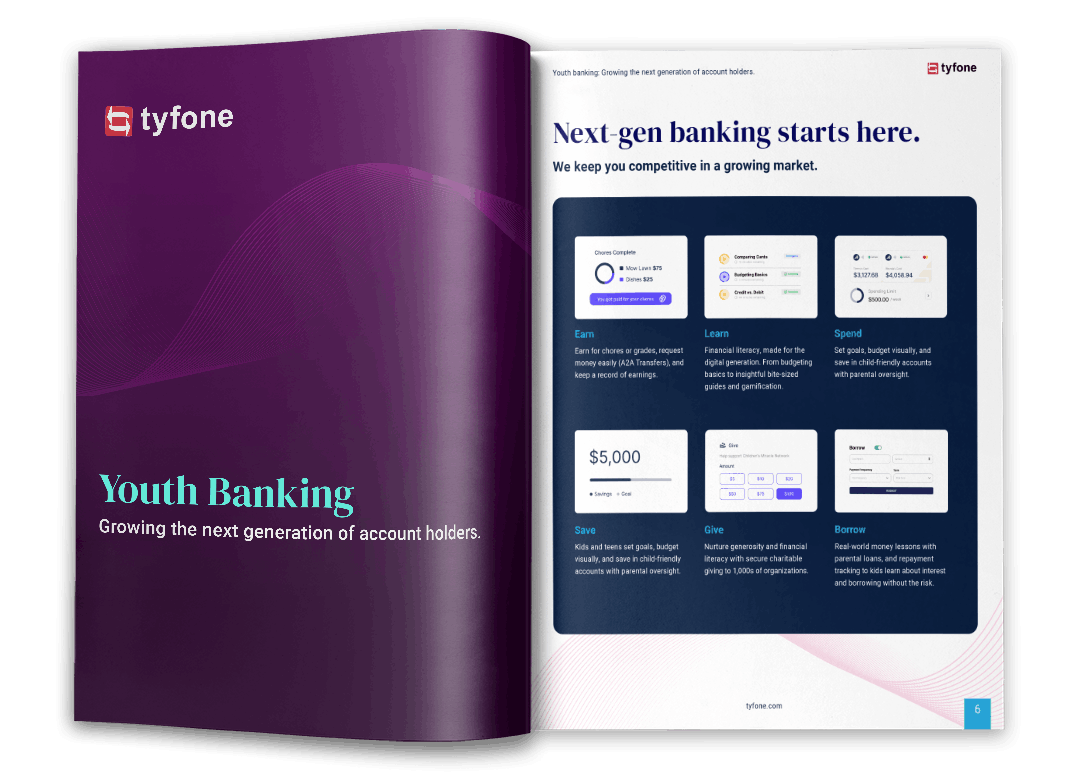
FREE PAMPHLET
Youth banking: Growing the next generation of account holders.
Financial habits are formed early, but most financial tools are designed for adults. As a result, families often rely on cash, shared cards, or disconnected apps to teach money management, making it difficult to balance independence with oversight.
At the same time, younger generations expect intuitive digital experiences, creating a gap between how they interact with money and how financial services are delivered. Financial institutions need age-appropriate solutions that engage younger account holders while supporting parents and caregivers.
What young people actually need from a banking experience.
The mistake most financial institutions make is assuming that youth banking is just regular banking with a lower minimum balance. This is far from the truth. Children and teenagers have fundamentally different relationships with money and a digital banking experience that works for them has to be built around how they actually learn, earn, spend, and save.
A 10-year-old isn’t thinking about interest rates. They’re thinking about whether they’ve saved enough to buy a new video game. A 15-year-old with a part-time job isn’t worried about overdraft protection, they want to know how much they made this week, how much they can spend, and maybe how much they should put aside.
The experiences that resonate with young account holders tend to share a few common characteristics. Financial literacy has to be baked in, not bolted on. Bite-sized educational content, gamified challenges, and real-world application of concepts like budgeting and saving make money feel approachable rather than abstract.
The ability to earn through chores or tasks, with parents approving and releasing funds directly through the app, bridges the gap between “my parents give me money” and “I earn money.” Goal-based savings, where kids can visualize a progress bar towards something they actually want, drives engagement in a way that a generic savings account never will.
On the other side of the equation, parents want visibility and control. They want to understand how their children are spending money, receive alerts when transactions occur, and have the ability to set spending limits or temporarily disable cards when needed.
After all, most parents have heard stories of children spending hundreds of dollars on in-app purchases, mobile games, or Fortnite skins without fully understanding the consequences. Features that provide oversight and guardrails help parents feel confident while still giving young consumers the freedom to learn financial responsibility in a safe environment.
Why white-label matters more than most institutions realize.
One of the subtler ways credit unions lose the next generation is through brand attrition. When a young account holder uses a fintech app every day, they’re building a relationship with that brand, not with their local credit union.
This is exactly the problem Tyfone’s Youth Banking solution is built to solve.
A white-labeled experience embedded in your digital banking platform keeps your institution’s name and identity front and center. The account holder sees your logo, your colors, your brand. The relationship stays with you.
Compare that to a third-party app your institution might recommend to families but has no control over. You’re essentially outsourcing the most formative financial experiences of young members to a competitor. They get the loyalty. You get the liability of a limited savings account.
There’s also the question of the transition to adult banking. Fintechs that specialize in youth accounts often have no clear path for consumers who age out of their product. They stop at 18. Your institution doesn’t. A youth banking solution that’s built into your digital banking platform creates a natural, frictionless progression, from a first savings goal at age 10 to a first auto loan at 22, without ever requiring the account holder to start over somewhere new.
The window to course-correct is closing.
The fintech companies targeting your account holders aren’t standing still. They’re raising capital, developing new innovative features and getting better at developing loyalty with families. Every year that passes without a compelling youth banking experience is another wave of young consumers that gets claimed by a competitor.
The good news is that credit unions have a genuine advantage fintechs can’t replicate: deep community roots, trust, and a full-service relationship that extends well beyond a debit card for teens. The challenge is channeling those advantages into a digital experience that young people actually want to use, and that’s precisely where Tyfone’s Youth Banking solution comes in.
What makes Tyfone’s approach different from most youth banking offerings on the market is that it’s native to the nFinia digital banking platform. Youth Banking lives inside the same digital banking environment that a parent uses to check their mortgage balance or pay a bill.
When a modern youth banking experience is active in your digital banking platform, every interaction a young consumer has reinforces their connection to the credit union, not to a fintech company that has no stake in their long-term financial life. A 10-year-old earning allowance for chores is already inside the same environment where they’ll eventually set up direct deposit as a young adult. The relationship doesn’t have to restart at 18. It’s been building the whole time.
The next generation of members is being formed right now. Some of them are sitting at kitchen tables, opening apps their parents have never heard of, building financial habits that will last decades. The credit unions that show up for this moment, with the right tools, the right experience, and the right brand, all in one place, will be the ones those young people trust with their first mortgage, their first business account, and eventually, their own children’s first savings goal.
The ones that don’t will keep losing account holders to fintechs they’ll never get back.