
The growth opportunity hiding in digital loan origination.
Digital loan origination has changed what businesses expect from the lending experience.
Applications that once depended on paper forms, branch visits, manual data entry, and days of back-and-forth can now move through a largely digital process.
Automated verification, real-time calculations, configurable workflows, and faster underwriting are helping financial institutions make lending more efficient while giving businesses a simpler path to financing.
And the demand for financing remains significant. 38% of small employer firms applied for a loan, line of credit, or merchant cash advance in 2025, while 60% sought some form of financing, according to the Federal Reserve’s 2026 Small Business Credit Survey.
At the same time, the way businesses seek financing is changing. 29% of financing applicants turned to online fintech lenders in 2025, up from 17% in 2020, according to the Federal Reserve.
That progress has raised the bar for digital lending. Speed matters. Digital access matters. But for financial institutions, the opportunity doesn’t end with a faster loan.
The real question is what happens after approval. Can the institution turn that lending interaction into a broader banking relationship?
That’s where the next evolution of digital loan origination begins.
The loan is the starting point.
By the time a business reaches loan approval, the institution has already done a significant amount of work. Information has been collected, the business and its owners may have been verified, financial information has been evaluated, and the application has moved through the institution’s decisioning process.
Just as importantly, the business is already engaged.
That creates a valuable moment for the institution. Instead of treating approval as the finish line, it can become a natural transition into the next stage of the relationship.
For example, the business may need an account to receive loan proceeds. It may need a business credit card for expenses. It may benefit from treasury or payment services. And as its needs change, it may eventually return for additional financing.
The opportunity isn’t limited to large commercial deals, either. In the Federal Reserve’s 2024 survey, 40% of financing applicants sought less than $50,000.
That means institutions have an opportunity to make smaller, recurring lending interactions easier to initiate, process, and build upon.
Traditionally, those products and services can live in separate processes. The business may complete its loan application in one system, then be directed to another application to open an account or begin another product relationship.
The technology successfully digitized the lending process. The next opportunity is connecting what comes after it.
Every additional application, handoff, or repeated request for information introduces friction for the business and additional work for the institution.
A connected origination experience gives institutions a different option: use the information, context, and momentum already established during lending to make the broader relationship easier to build.
Story continued below…
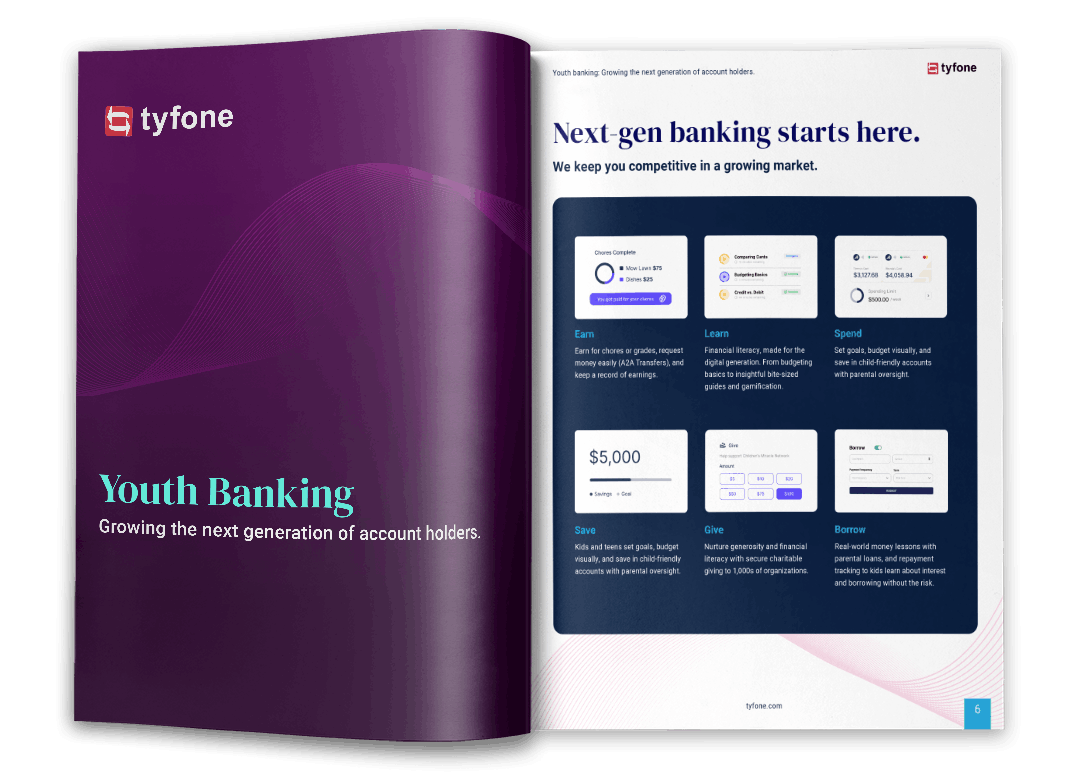
FREE PAMPHLET
Youth banking: Growing the next generation of account holders.
Financial habits are formed early, but most financial tools are designed for adults. As a result, families often rely on cash, shared cards, or disconnected apps to teach money management, making it difficult to balance independence with oversight.
At the same time, younger generations expect intuitive digital experiences, creating a gap between how they interact with money and how financial services are delivered. Financial institutions need age-appropriate solutions that engage younger account holders while supporting parents and caregivers.
What that looks like in practice
A next-generation digital origination experience should still deliver the capabilities institutions expect from modern lending technology. The difference is how those capabilities work together.
- Configured around the institution
Every institution has its own credit policies, products, approval requirements, and risk parameters. Digital lending technology should support those differences rather than forcing every institution into the same workflow.
Configurable processes allow institutions to determine what information is collected, which steps can be automated, where approvals are required, and when employees need to get involved.
- Built for the full lending portfolio
Business lending isn’t a single product. Institutions may offer working capital, small-business loans, equipment financing, commercial real estate, auto, home equity, land and lot loans, and other secured and unsecured products.
Supporting those products through a unified origination environment can create more consistent experiences while reducing the need to manage disconnected lending processes.
Automated where it makes sense
Modern lending technology can take much of the repetitive work out of origination.
Identity and business verification, asset and employment verification, real-time calculations, underwriting, disclosures, and other steps can be automated or streamlined according to the institution’s requirements.
That can reduce manual effort, accelerate decisioning, and give lending teams more time to focus on higher-value work and complex relationships.
Available wherever the relationship starts
A business owner may begin an application online, continue from a mobile device, work with a lender in a branch, or have an employee initiate the process.
A modern origination platform should support those paths through the same underlying process, giving businesses flexibility without creating entirely separate experiences behind each channel.
Connected to what comes next
This is where digital origination can become more than a lending tool.
Once an application reaches approval, relevant next steps can become part of the same connected experience. That could mean opening the deposit account associated with the loan, applying for a business credit card, or introducing other products and services that fit the relationship.
Efficiency and growth can work together.
The value of this approach isn’t limited to the business experience.
Modern origination can help institutions reduce manual work, eliminate redundant data entry, standardize processes, and move applications through the lending lifecycle more efficiently.
That efficiency can translate into measurable results. For example, Tyfone’s digital lending implementations have delivered outcomes such as up to 75% faster closing times for small-business loans, 30% increases in loans funded per month, and 20% less time spent underwriting a file.
Those improvements give institutions more capacity, but the opportunity goes beyond processing more loans.
When lending teams spend less time on repetitive work, they have more capacity for complex deals and relationship management. And when information can move with the borrower into the next product or service, the institution can make it easier to build on an existing relationship.
The goal isn’t simply to process loans faster. It’s to create more value from every lending interaction.
Where Tyfone fits.
Tyfone’s Digital Loan Origination solution is designed around that broader opportunity.
It gives financial institutions a configurable digital lending experience with automated verification, real-time calculations, decisioning, digital disclosures, and other capabilities designed to streamline origination.
But lending doesn’t have to exist separately from the rest of the relationship.
Tyfone can connect digital lending with broader account-opening experiences, including deposit accounts and credit cards, giving institutions a way to move from a lending interaction to a broader banking relationship within a connected origination experience.
The solution also supports online, mobile, in-branch, and employee-assisted applications, helping institutions create a consistent experience across the channels where lending relationships begin.
The result is a different way to think about digital loan origination:
Not just faster lending. A better path from lending to building a long-lasting relationship.
The next chapter of digital loan origination.
Digital loan origination has already transformed the lending process. Institutions can automate more, make faster decisions, reduce manual work, and give businesses a much easier way to apply for financing.
The next opportunity is to build on that experience.
A loan can solve an immediate need. It can also open the door to a much broader relationship.
For financial institutions, the question isn’t simply how quickly they can get a business to approval.
It’s how much more they can do with the relationship once they get there.
That’s the next evolution of digital loan origination.