
A 5-PART WHITEPAPER SERIES
Part 4: Lending as your fulcrum.
Why credit excellence defends everything else.
Part Four of five, written for the boards and CEOs of community banks and credit unions. Outsiders are consolidating your consumers’ data, the world’s largest AI companies are making themselves the new front door to your consumers’ finances, and a new breed of digital entities is disintermediating payments and money itself. This series shows what these forces can take, what they cannot, and what to do about it.
By Dr. Siva Narendra, CEO & Co-Founder, Tyfone

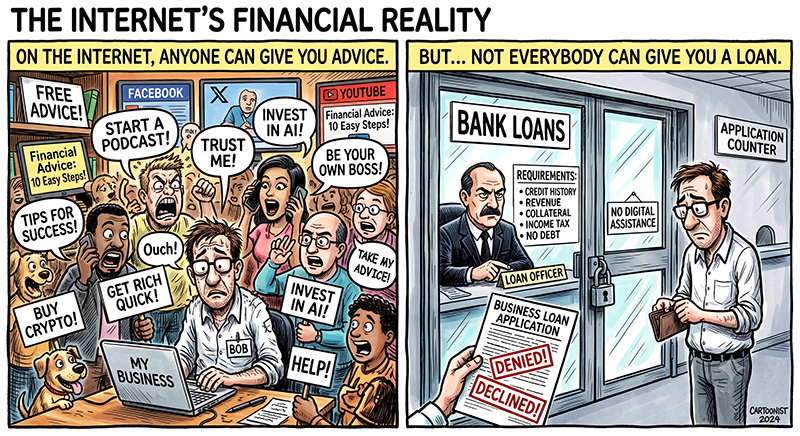
Image generated by Gemini
Executive summary.
The first three papers in this series closed doors. Outsiders have consolidated your consumers’ data, the relationship is moving to AI interfaces that sit between the consumer and every account they hold, and payments and money itself are moving to rails that bypass the institution.
Each paper ended with the same question: what remains that none of these forces can take? This paper gives the answer: lending. Credit is protected by structural walls (cheap deposit funding, a charter, regulatory capital, and private knowledge of the borrower) that no aggregator or AI interface can copy, and by a regulatory requirement that loan decisions be consistent and auditable, which AI by its nature cannot satisfy on its own. But this paper is not a comfort.
The moat is real, and it is being chipped away in specific, instructive ways: where getting a loan was reduced to a frictionless transaction, where a platform’s own data substituted for the relationship, and where a fintech simply bought its way inside the walls by becoming a bank. The ground holds. It is not gone yet. And it will not defend itself.
The claim, stated carefully.
This series has been skeptical of easy answers, so the claim here must be precise. The claim is not that lending is safe. It is that lending is the one major function of a community financial institution where the structure of the business still favors you. Here, the attacker must acquire what you already have (deposits, a charter, capital, and years of customer knowledge) rather than simply stepping in front of you with a better app.
Information could be intercepted by an aggregator. Payments could be intercepted by a wallet or a new rail. Advice could be intercepted by a model reading your data from a distance. A loan cannot be intercepted the same way, because a loan is not information about money. It is the money, carried as risk on a regulated balance sheet for years. That difference is the fulcrum.
The four walls.
Four structural requirements separate a chartered lender from every platform circling it.
Funding: Banks and credit unions do something no platform does. They create safe, insured deposits and lend them out. Those deposits fund loans at a cost averaging around 1%, cheaper than anything a fintech can borrow. Fintech and AI lending platforms have no deposits. They rent balance sheets from partner banks or sell their loans to investors, and they pay for the privilege out of their margin. Whoever has the cheapest funding can offer the best price or absorb the most risk, and on funding cost the community institution still wins.
Charter: A charter is more than permission; it is a nationwide legal operating system. It carries deposit insurance and the consumer trust that comes with it, and it lets an institution run uniform lending programs across state lines. Non-bank lenders without a charter face licensing rules and interest-rate limits that differ state by state, which is why so many of them rent a bank’s charter through “true lender” arrangements. The workaround is the proof: the charter is the asset.
Capital: Regulated lenders must hold capital against their loans, a cost the capital-light platforms have built their entire models to avoid. But the avoidance is also the constraint: a platform that holds no capital cannot hold loans, and a lender that cannot hold loans does not control pricing, servicing, workouts, or the relationship that surrounds them.
Private knowledge of the borrower: The biggest barrier is information. Decades of research confirms what community bankers know by instinct: an institution learns things about a borrower over years of deposit activity, payment history, and human contact that no outsider can see or verify. Researchers call it “soft information.” Petersen and Rajan showed that the biggest benefit of a long banking relationship is that the borrower can actually get credit, not just cheaper credit, and that borrowers who spread themselves across many lenders pay more and get less.
Berger and Udell showed that institutions act on what they learn over time: borrowers with longer relationships get lower rates and pledge collateral less often. Smaller institutions are structurally better at this, because fewer layers sit between the loan officer who knows the borrower and the management that sets the terms.
The result is a self-selection engine: borrowers whose strength shows in person but not in a credit file seek out relationship lenders, because only relationship lenders can see them.
“Lending remains one of our greatest strengths, especially when we look beyond a credit score and take the time to understand the person behind the application.”
– Judy DeLucca
President & CEO
New Orleans Firemen’s Federal Credit Union
An AI platform, by contrast, underwrites entirely on rented data: credit bureau files, aggregated transactions, third-party feeds. Cut off the access and the model is blind. The one competitor that escapes this dependence is the commerce platform sitting on its own real-time customer data. This paper returns to that point below, because it marks exactly where the wall is thinnest.
The wall AI cannot cross alone.
There is a fifth barrier, newer than the other four and specific to the AI era. Loan decisions at a regulated institution must be consistent, repeatable, and explainable. A regulator must be able to audit exactly why a loan was approved or denied, and a denied applicant must be told the real reasons.
Generative AI does not work that way. Ask the same model the same question twice and you can get two different answers. That is tolerable for a chatbot suggesting a budget. It is not tolerable for a credit decision.
The consequence is architectural. AI in lending can gather, summarize, flag, and accelerate, but the decision itself must pass through clear, auditable rules owned by the regulated lender. The AI interfaces that captured the information layer in Part One and the advice layer in Part Two can reach all the way to the edge of the credit decision. At that edge, regulation hands the pen back to the institution. The consumer’s AI can recommend a loan. It cannot grant one.
Story continued below…
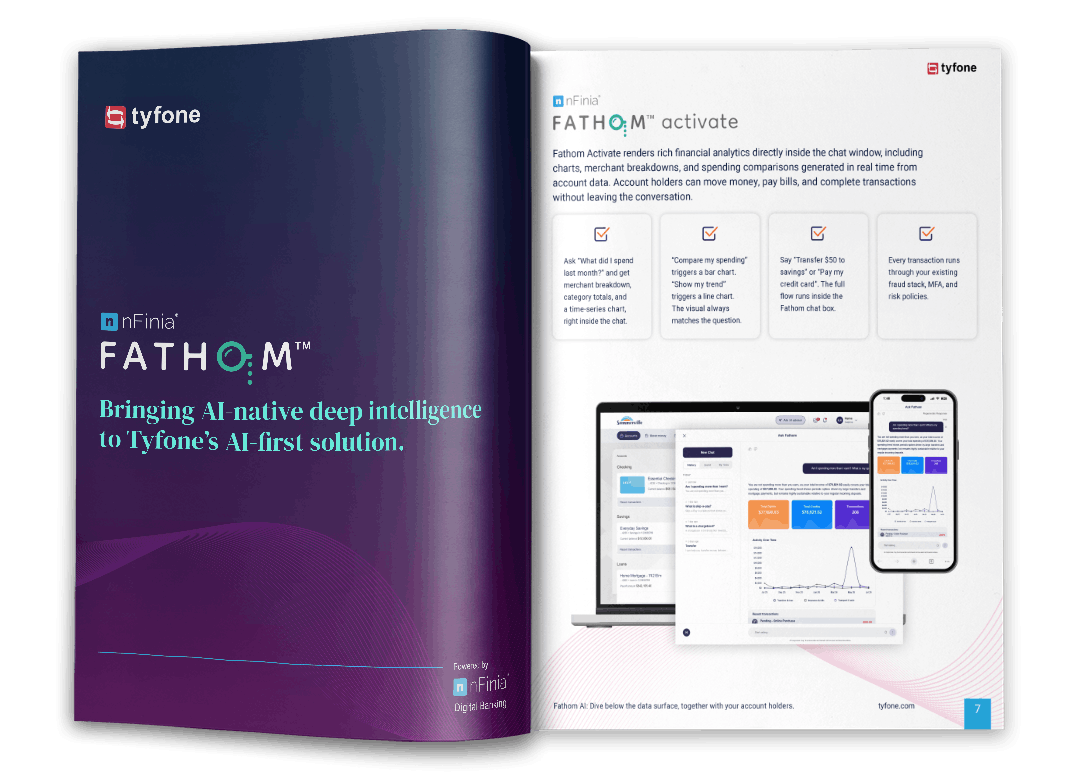
FREE PAMPHLET
Bringing AI-native deep intelligence to Tyfone’s AI-first solution.
Most credit unions and community banks don’t have an AI strategy yet, and account holders aren’t waiting. They’re already comparing every digital experience, banking included, to ChatGPT. Stand still and get left behind.
Fathom is the AI layer woven throughout Tyfone’s digital banking ecosystem, combining account holder financial data, institutional knowledge, and native banking experiences into a single intelligence layer.
The honest map: where the moat is being chipped away.
If the walls were sufficient on their own, this paper could end here. They are not, and a board should study the three breaches already on the record.
Breach one: frictionless origination. The mortgage lesson. Where a loan product became standardized enough to be sold the moment it was made, the balance-sheet wall stopped mattering and the contest collapsed to experience and speed.
The result is today’s mortgage market: nonbank lenders dominate the league tables, with Rocket Mortgage producing some 429,000 loans in 2025 and United Wholesale Mortgage roughly 422,000 on $164 billion of volume, while nonbank loan counts grew three times faster than banks’. The community institutions that once wrote mortgages across their communities now watch the product flow through two nonbank machines built entirely around frictionless origination.
Mortgage is the controlled experiment: when lending becomes a transaction, the transaction layer’s fate (Part Three) becomes lending’s fate.
Breach two: proprietary data. The Square lesson. Square Loans has originated more than $32 billion to small businesses since 2014, roughly $5.7 billion in 2024 alone, at an average loan size near $10,000, underwriting from the real-time payment flows it already processes for those merchants. It sees the merchant’s revenue daily, repays itself out of sales, and now extends offers to merchants within days of onboarding. This is the relationship lender’s private knowledge, industrialized: the commerce platform has turned “soft information” into a data feed it owns. Every community institution holding a small-business operating account while a point-of-sale platform watches the cash flow should recognize what is being taken.
Breach three: buying the charter. The SoFi lesson. SoFi did not work around the four walls; it acquired them. It obtained a national bank charter, built a deposit base almost entirely from direct-deposit customers, and scaled originations to a record $10.5 billion in a single quarter, $7.5 billion of it in personal loans. Read correctly, SoFi is the strongest evidence this paper has: to scale lending, the most successful fintech lender of its generation had to become a bank. The walls are real. The warning is equally real: the walls do not care who stands behind them, and a fintech with a charter and deposits is simply a new bank with a better experience competing for your member.
The synthesis of the three breaches is the discipline of this paper. The moat holds the decision; it does not hold the customer. Funding, charter, capital, and private knowledge determine who can profitably carry the loan. Experience determines who the borrower applies to.
Markets further down this curve show how fast the experience contest moves: in India’s small-ticket personal loan segment, fintech lenders captured nearly 90% of origination volume, and the accompanying delinquency data (early-stage rates more than double traditional lenders’) shows both the speed of capture and the price of speed without credit discipline.
In the U.S., AI lending platforms such as Upstart still facilitated under 5% of the unsecured personal-loan market as of 2020, but platform-reported results (models weighing over a thousand variables, claiming sharply lower loss rates at the same approval rates) show where the contest is heading.
The walls decide who can carry the loan. The experience decides who wins the borrower. An institution that holds the first and concedes the second ends up as the balance sheet behind someone else’s brand, the “true lender” in the fine print of another company’s loan.
The fulcrum effect: why credit defends everything else.
Re-anchor the relationship on lending, and the layers this series watched leave, begin to flow back, because a loan pulls on everything around it in a way no other product does.
A loan creates a mandatory, recurring, years-long touchpoint; the payment relationship follows it. A loan justifies and rewards deposit primacy; the operating account and the direct deposit follow it. A loan generates exactly the private repayment and behavior data that the relationship advantage compounds on; the next, better-priced loan follows it.
And a borrower in the middle of a loan is the one consumer for whom your institution is not interchangeable, whatever their AI interface recommends. Petersen and Rajan’s finding runs through all of it: long relationships expand a consumer’s access to credit, and access, not the app, is what an account holder remembers at the moment it matters.
This is why the series calls lending the fulcrum rather than merely the last revenue line. Deposits, payments, and even the advisory relationship are easier to win back from the position of incumbent lender than from any other position, and nearly impossible to win back from the position of commodity vault.
What this means for your board.
Strip this paper to its three sentences. The lending moat is real: funding, charter, capital, private knowledge, and the sole authority to decide are assets every platform must rent or buy. The moat is being chipped away: frictionless origination took mortgages, proprietary data is taking small business, and a purchased charter put a fintech inside the walls. And the moat is not gone yet: the structural walls still stand, the regulatory pen is still in your hand, and the borrower’s next loan is still yours to win.
That is the message, and the timing is the point. Mortgage shows what this looks like finished. Small-business lending shows it in progress. Consumer lending shows it beginning. An institution reading this series has not lost ground; it is standing on the last of it.
The first three papers argued that you cannot out-aggregate the aggregators, out-rail the wallets, or out-chat the chatbots, and nothing here changes that. What this paper adds is where real defensibility still exists: lending.
How to defend that position, and what else institutions may uniquely own, is not the subject here. Part Five delivers on the promise of this series: what to do about all of it, from data, to relationships, to money, and to the foundations that still matter.

About the author.
Dr. Siva Narendra is the CEO and Co-Founder of Tyfone, a leading digital banking technology provider serving community banks and credit unions across the United States. Over the past two decades, he has worked at the intersection of digital banking, payments, identity, and financial technology, helping institutions navigate periods of technological disruption while maintaining their competitive independence.
Sources
- Petersen, M. and Rajan, R., “The Benefits of Lending Relationships: Evidence from Small Business Data,” Journal of Finance, 1994.
- Berger, A. and Udell, G., “Relationship Lending and Lines of Credit in Small Firm Finance,” Journal of Business, 1995.
- Home Mortgage Disclosure Act 2025 data, Polygon Research analysis; HousingWire, American Banker, and National Mortgage News coverage of Rocket Mortgage and United Wholesale Mortgage origination volumes and nonbank growth rates, 2026.
- Block, Inc. / Square Loans origination disclosures and press materials, 2024-2026; deBanked online business lending tracking.
- SoFi Technologies Q4 2025 earnings results and call transcript; PYMNTS and Motley Fool coverage, January-February 2026.
- Upstart share of U.S. unsecured personal-loan market (c. 2020) and platform-reported underwriting performance claims.
- Industry data on Indian NBFC fintech origination share and delinquency in small-ticket personal lending, Q1 FY26.
- Regulatory requirements for explainable, reproducible credit decisioning (ECOA/Regulation B adverse-action framework); analysis of probabilistic AI systems as advisory rather than decisioning layers in regulated lending.
- Research on bank funding-cost advantages of insured deposit franchises and on “true lender” bank-partnership structures in non-bank lending.