
Cross-selling isn’t dead. It’s just no longer enough.
For decades, success in banking has been built on a simple idea: anticipate what account holders need, then put the right offer in front of them.
That way of thinking gave rise to everything from best-offer engines and pre-approval campaigns to personalized marketing campaigns and in-app promotions. Institutions invested heavily in these initiatives, and for good reason. Those strategies worked and generated real results.
But account holder behavior has changed. Today’s consumers don’t wait for financial institutions to define what they need. When they are ready to make a financial decision, they search, compare, or turn to conversational interfaces to get answers in real time.
This shifts the competitive advantage. It is no longer just about making the right offer. It is about being the institution account holders turn to when they are ready to act.
The pre-approval problem.
Imagine an account holder logging into their digital banking app simply to check whether their paycheck has cleared.
Before they even reach their balance, they are greeted with a banner: “You’re pre-approved for an auto loan up to $40,000”. At first glance, nothing is wrong with the offer. The account holder may very well qualify for it.
The issue is timing and context. They are not shopping for a car. They did not come into the app looking for financing. The offer interrupts rather than supports their intent.
Over time, account holders learn to ignore these messages. Banner blindness sets in. Marketing emails go unopened, while push notifications fade into background noise. Instead of capturing attention, these channels become easy to dismiss.
Financial decisions rarely happen because of a promotion. They happen because life creates a need, a car breaks down, a family moves, a child goes to college, or an account holder decides it is time to refinance.
When that moment arrives, the institution that wins is not the one that predicted it first.
It is the one that is easiest to ask.
From cross-selling to cross-buying.
This is where the shift to cross buying becomes important.
Cross selling begins with the institution. It identifies a potential need, predicts what the account holder might want, and delivers an offer through banners, emails, or notifications.
Cross buying begins with the account holder. The account holder arrives with a question, a goal, or a financial decision already in motion. Instead of creating demand, the institution responds to demand that already exists.
That distinction changes everything.
A question like “What are your current auto loan rates” is not a marketing signal to be interpreted later. It expresses intent in real time, in the account holder’s own words. At that moment, the question is no longer about prediction. It is about whether the digital experience can recognize intent and respond without friction.
Prediction still matters. It helps institutions understand behavior patterns, anticipate needs, and improve personalization at scale. But prediction and intent solve different problems. Prediction estimates what might happen next. Intent reflects what the account holder is trying to do right now.
When account holders are actively seeking information, they are already in a decision process. They are investing attention, comparing options, and narrowing choices. That creates a narrow but high value window where clarity, speed, and relevance matter more than promotion.
Yet most digital banking experiences were not built for this moment. Instead of immediate answers, account holders are routed through FAQ pages, navigation menus, product PDFs, or contact center handoffs.
Each step adds friction. Each delay breaks momentum. And each interruption increases the chance that the institution loses the moment entirely.
The institutions that win will not choose between prediction and intent. They will use prediction to understand behavior and intent to respond at the moment decisions are being made.
Story continued below…
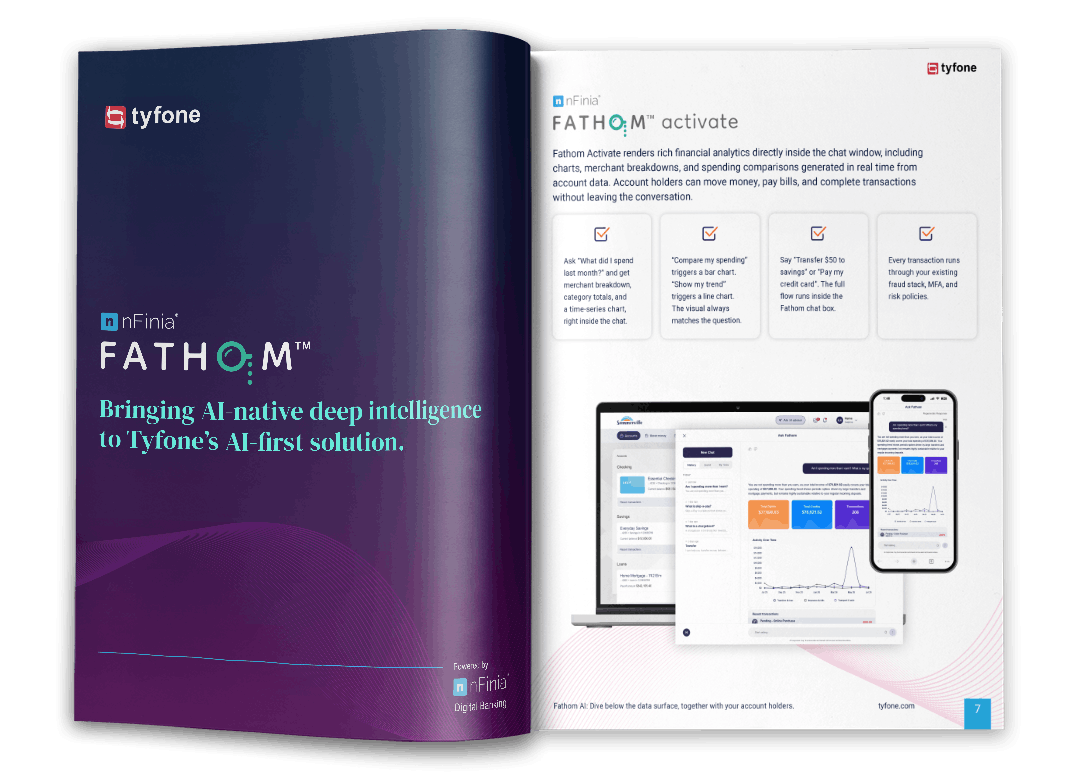
FREE PAMPHLET
Bringing AI-native deep intelligence to Tyfone’s AI-first solution.
Most credit unions and community banks don’t have an AI strategy yet, and account holders aren’t waiting. They’re already comparing every digital experience, banking included, to ChatGPT. Stand still and get left behind.
Fathom is the AI layer woven throughout Tyfone’s digital banking ecosystem, combining account holder financial data, institutional knowledge, and native banking experiences into a single intelligence layer.
How conversational AI changes the traditional experience.
Conversational AI shifts digital banking from a destination into a dialogue. Instead of navigating menus or searching static content, account holders simply ask.
“Can I afford a $40000 dollar auto loan?”
“What is my HELOC rate?”
“How much did I spend on restaurants last month?”
“Which savings account earns the highest APY?”
The experience shifts from searching for information to having a natural conversation with the institution. Questions become answers. Answers become actions.
Just as importantly, these conversations happen inside the institution’s own digital banking environment, not on external search engines or third party AI platforms. This keeps the relationship, context, and data inside the financial institution’s ecosystem.
It also allows institutions to respond using their own products, policies, and account holder relationships, rather than generic external responses. More importantly, it surfaces real time intent directly from account holder behavior inside the banking experience.
Instead of guessing what someone might need in the future, institutions can respond to what the account holder is trying to accomplish at the exact moment they ask.
How Fathom Deep Intelligence enables cross-buying.
Traditional engagement channels such as email, lifecycle marketing, and next best offer campaigns still play an important role in awareness and relationship building. But they are no longer the primary way account holders discover and evaluate financial products.
Product discovery is increasingly happening through conversation.
The institutions that win will not be the ones that send the most messages. They will be the ones that provide the clearest answers when intent appears, and become the most trusted source of financial guidance inside their own digital experience.
That is a fundamentally different growth model. Institutions are no longer competing for attention. They are competing for relevance at the moment decisions are made.
Fathom Deep Intelligence, embedded inside Tyfone’s nFinia® digital banking platform, is designed for this shift.
At the center is Fathom Nav, which delivers accurate, institution specific answers grounded in approved financial institution content. Instead of forcing account holders through menus or static pages, it connects questions directly to the next best action, whether that is starting an application, checking eligibility, or connecting with support.
The intent signal does not get lost in navigation. It moves forward.
Fathom Admin provides real time visibility into what account holders are asking, which questions are driving engagement, and where friction exists between intent and action. Rather than relying only on campaign analytics, institutions can see demand forming directly through live behavior.
When account holders repeatedly ask about auto loans, homebuyer programs, or certificate rates, that is not passive browsing. It is active demand. These patterns allow institutions to refine content, improve discovery, and close gaps before intent is lost.
Fathom Activate extends this further by allowing account holders to engage directly with their financial data inside the conversation. A question like “Can I afford a $500 monthly car payment?” becomes grounded in real financial context, including income patterns, spending behavior, and account history.
Across all of this, the system closes the loop between intent, insight, and action.
Cross selling will always have a role in financial marketing. But cross buying is what happens when institutions are ready for the moment account holders are ready too.