
Alloya launches credit union stablecoin pilot.
The $7.5 billion-asset corporate credit union has issued 1 million CUUSD tokens on Ethereum for a limited institutional test of dollar-denominated digital payments.
Alloya Corporate Federal Credit Union has launched a pilot program for a U.S. dollar-denominated payment stablecoin, taking a significant step into digital assets while limiting the initial effort to a small group of approved institutional participants.
The $7.5 billion corporate credit union said Tuesday that CUUSD, issued through its wholly owned credit union service organization, Appex CUSO LLC, will operate on the Ethereum blockchain. The stablecoin is designed to let approved credit unions and other institutional participants transfer and hold digital value across modern payment networks.
At launch, Appex minted 1 million CUUSD tokens, representing $1 million in digital value. The tokens are being used for pilot and testing activities rather than offered for public purchase.
“Today marks an important milestone as CUUSD begins operating on the Ethereum global blockchain network through a controlled institutional pilot,” said Todd Adams, chief executive of Alloya. “We have built infrastructure designed to connect financial cooperatives around the world and create new opportunities for them to share resources, transfer value efficiently and participate in the next generation of digital financial services.”
The pilot is intended to test operations, validate the technology and evaluate potential use cases in a controlled environment. CUUSD will not be available to consumers or the general public and can be accessed only by approved participants under the program’s requirements.
Alloya’s move extends a payments business it has developed around more traditional systems. The Naperville, Ill., organization has long provided credit unions access to wires, checks, ACH and coin and currency services. CUUSD is intended to bring that cooperative model to blockchain-based payment networks.
“With the vision and support of our Board of Directors, Alloya has explored how stablecoin technology can help credit unions transfer and hold digital value more efficiently,” Adams said. He described CUUSD as a cooperative, credit union-owned option intended to keep the industry’s interests at the center of digital-payment development.
Story continued below…
FREE PAMPHLET
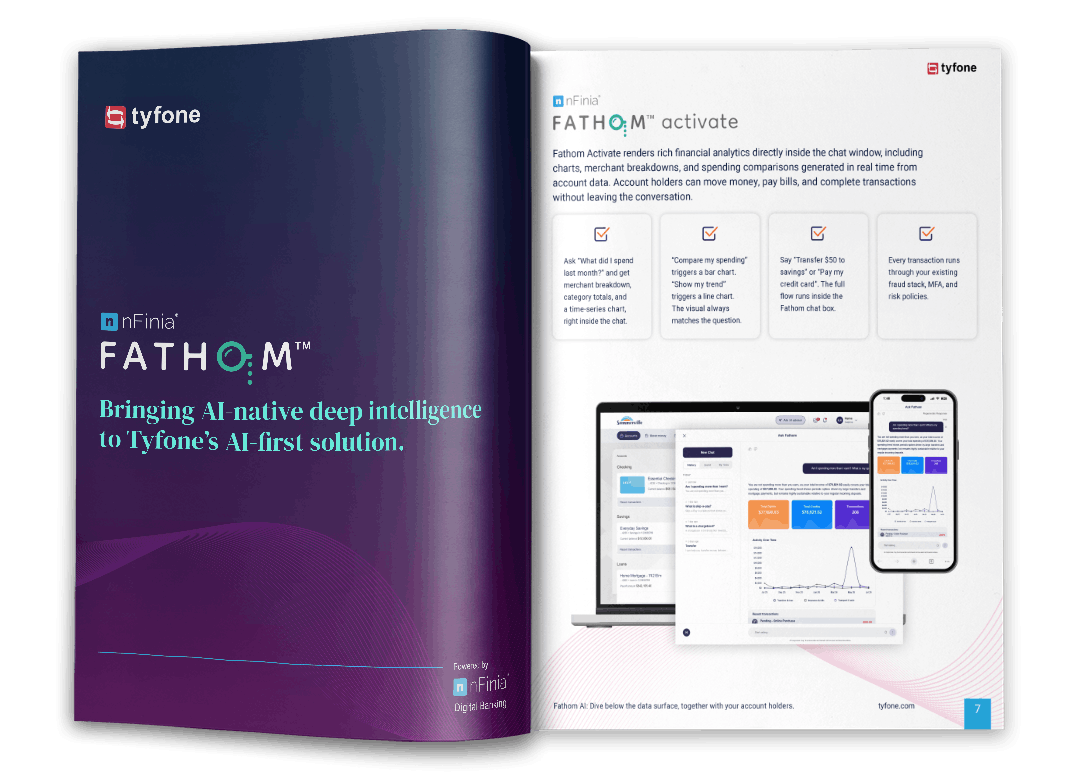
Bringing AI-native deep intelligence to Tyfone’s AI-first solution.
Most credit unions and community banks don’t have an AI strategy yet, and account holders aren’t waiting. They’re already comparing every digital experience, banking included, to ChatGPT. Stand still and get left behind.
Fathom is the AI layer woven throughout Tyfone’s digital banking ecosystem, combining account holder financial data, institutional knowledge, and native banking experiences into a single intelligence layer.
Alloya is one of the nation’s largest corporate credit unions and provides liquidity, investment and payment services to credit unions and credit union organizations. It has 1,274 credit union members and describes its model as built around aggregating resources and providing shared financial infrastructure.
The stablecoin itself is being administered by Appex CUSO, which is responsible for token issuance and reserve administration. As a wholly owned CUSO of Alloya, Appex is positioned within the credit union system rather than as an outside fintech provider.
That structure is central to the way Alloya is presenting the project. The organization said its goal is to create digital-payment infrastructure that keeps innovation and economic value within the credit union ecosystem.
The initial 1 million-token issuance is also deliberately limited. The organizations said any future issuance, distribution or commercial use of CUUSD will remain subject to applicable legal, regulatory and supervisory requirements.
The announcement comes as financial institutions explore ways to use blockchain-based technology for payments and the movement of digital value. Alloya’s approach is to begin with institutional users and test the technology before considering broader applications.
The credit union said the pilot will allow it to assess how CUUSD works in practice, including its operational processes, technology and potential uses among participating institutions.
For credit unions, the appeal is not simply the technology itself. Alloya is positioning CUUSD as an extension of the cooperative infrastructure it has provided for decades, but on digital payment networks.
“We also believe this work represents an opportunity to extend the cooperative model into digital payment networks,” Adams said.
Alloya credited Dr. Lamont Black and Wide Open Ventures, along with XKOVA, for strategic and technical contributions to the project.
The organization provided no timetable for moving beyond the pilot. Any expansion would depend on the results of the testing as well as legal, regulatory and supervisory requirements.
For now, CUUSD remains a tightly controlled experiment: 1 million tokens, a limited group of institutional participants and no consumer access.
But the launch gives Alloya, and the broader credit union system it serves, a direct foothold in an emerging corner of digital payments.
“We have built infrastructure designed to connect financial cooperatives around the world and create new opportunities for them to share resources, transfer value efficiently and participate in the next generation of digital financial services.”
Todd Adams
CEO
Alloya Corporate Federal Credit Union
Ken McCarthy is manager of marketing communications at Tyfone, where he monitors the credit union industry and contributes to conversations shaping its future. He previously covered credit unions and community banking for American Banker and S&P Global Market Intelligence. He holds a journalism degree from Point Park University and has more than 15 years of experience covering financial services. He is also the author of three literary fiction novels.