
DCUC seeks clearer Crypto rules after Senate setback.
The defense credit union group is asking the NCUA to explain what institutions can do under existing law after the Senate failed to advance the Clarity Act.
The Defense Credit Union Council is urging the National Credit Union Administration to give credit unions clearer guidance on digital-asset activities after the Senate last week blocked a procedural vote on legislation intended to establish a federal framework for digital commodities.
The Senate voted 49-50 on Sept. 15 against invoking cloture on a motion to proceed to the Digital Asset Market Clarity Act, falling short of the three-fifths vote required to advance the measure.
In a letter to NCUA Chairman John Crews, DCUC asked the agency to consolidate its existing digital-asset guidance into a practical roadmap for credit unions. The group said institutions need to know what activities they can undertake now, when a subsidiary or outside provider is required, when regulators must approve an activity and what boards and examiners will expect.
“Credit unions need a clear understanding of what they can do today, what conditions apply, and where additional authority is needed,” said Anthony Hernandez, DCUC’s president and chief executive, a retired U.S. Air Force colonel.
Hernandez said the NCUA had already established a foundation through earlier digital-asset guidance and implementation of the GENIUS Act, but that the pieces should now be brought together into a framework credit unions can use.
DCUC’s request comes as the industry works through a patchwork of existing rules and emerging policy around digital assets. The group pointed to NCUA guidance issued in 2021 that addressed qualifying relationships with third-party digital-asset providers, as well as 2022 guidance stating that distributed-ledger technology is not prohibited when used for otherwise permissible activities and in compliance with applicable law.
The trade group wants the agency to go further with activity-specific guidance covering third-party services, payment and settlement functions, payment stablecoins, tokenized shares, custody-related services and other uses of distributed-ledger technology.
FREE PAMPHLET
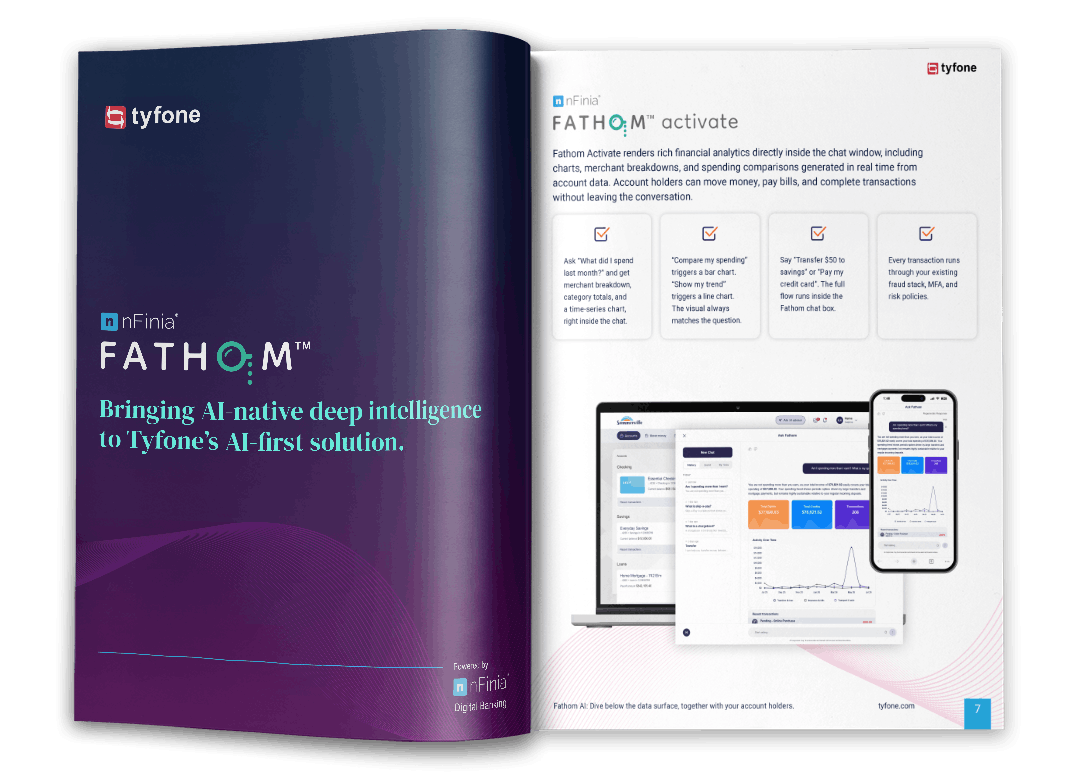
Bringing AI-native deep intelligence to Tyfone’s AI-first solution.
Most credit unions and community banks don’t have an AI strategy yet, and account holders aren’t waiting. They’re already comparing every digital experience, banking included, to ChatGPT. Stand still and get left behind.
Fathom is the AI layer woven throughout Tyfone’s digital banking ecosystem, combining account holder financial data, institutional knowledge, and native banking experiences into a single intelligence layer.
The question is increasingly practical for credit unions, which must determine not simply whether a technology exists but how an institution can use it within its existing regulatory structure.
DCUC asked the NCUA to address five basic questions: whether a credit union can offer a service directly; whether it must use a permitted subsidiary, credit union service organization or independent provider; whether prior approval is required; what risks the board must address; and what examiners will expect to see.
Jason Stverak, DCUC’s chief advocacy officer, said the group wants the agency to distinguish clearly between legal requirements and supervisory guidance.
“Our request starts with creating the legislative opportunity,” Stverak said. “We are asking congressional leaders to work toward a financial services section, and we hope the resulting agreement includes these three priorities.”
That legislative effort is separate from the group’s latest request to the NCUA. DCUC said its immediate goal is greater clarity under existing authority, while recognizing that some issues may ultimately require new rules, congressional action or coordination among agencies.
The organization also wants the NCUA to complete implementation of the GENIUS Act with standards it said should reflect the cooperative structure of credit unions and allow them to participate alongside similarly situated regulated institutions.
The group said boards and examiners should have consistent expectations around governance, cybersecurity, third-party oversight, consumer protection, reconciliation and orderly exit from digital-asset activities.
Because those activities can involve multiple regulators, DCUC also urged the NCUA to coordinate with the Treasury Department, Financial Crimes Enforcement Network, Securities and Exchange Commission, Commodity Futures Trading Commission and other agencies.
The request has a particular focus on military communities. DCUC wants policymakers to consider issues involving military addresses, remote identity verification and deployment-related changes while maintaining sanctions and anti-money-laundering requirements.
For credit unions serving military personnel, those questions can be complicated by members who move frequently, serve overseas or require remote access to financial services.
DCUC has asked for an in-person meeting with Crews and NCUA staff to discuss which issues can be resolved under existing authority, where further guidance or rulemaking may be appropriate and which matters require action by Congress or coordination among agencies.
The Senate vote has left the broader Clarity Act effort stalled for now. The official Senate record shows the Sept. 15 cloture motion on the bill was rejected, while Senate daily records show that four Republicans — Susan Collins, Josh Hawley, Jerry Moran and Thom Tillis — voted against the motion. Tillis voted no in order to preserve the ability to seek reconsideration.
For DCUC, the immediate concern is less about the fate of one piece of legislation than about what credit unions can do while lawmakers and regulators continue to work out the rules.
“NCUA has already established important building blocks through its digital-asset guidance and implementation of the GENIUS Act. We believe the next step is bringing those pieces together into a practical framework credit unions can use.”
Anthony Hernandez
President and CEO
Defense Credit Union Council
Ken McCarthy is manager of marketing communications at Tyfone, where he monitors the credit union industry and contributes to conversations shaping its future. He previously covered credit unions and community banking for American Banker and S&P Global Market Intelligence. He holds a journalism degree from Point Park University and has more than 15 years of experience covering financial services. He is also the author of three literary fiction novels.