
The branch isn’t the problem. The paperwork is.
The real competitive line for credit unions and community banks isn’t digital versus manual, it’s friction versus flow.
A consumer decides to switch financial institutions on a Tuesday night, scrolling their phone after the kids are asleep. They compare a couple of checking accounts, land on one they like, and tap “Open Account.”
If that tap leads to a fillable PDF, a request to visit a branch during business hours, or a “someone will contact you within 3-5 business days” message, the decision is already made, just not in that institution’s favor.
This is the moment many credit unions and community banks lose prospective account holders, often before they even realize it. Not because their rates are worse or their brand is weaker. They lose because the front door is bolted shut outside of business hours and because “digital account opening” at a lot of community institutions still means a scanned form and a tedious process.
The debate over digital versus manual account opening has been settled for years in theory. Almost every credit union and community bank will tell you they’re “investing in digital transformation.” But in practice, a surprising number of these institutions are running a hybrid system that gives them the worst of both worlds: the cost structure of manual processing with the member and customer expectations of a fully digital experience.
Understanding why that gap persists, and what it actually costs a smaller institution without a megabank’s budget, is the real conversation credit unions and community banks need to have.
The Hidden Cost of “We’ll Get to Digital Eventually”
It’s easy to frame manual account opening as merely inconvenient. The bigger issue is that it’s expensive in ways that don’t show up cleanly on a single line of the budget.
Every manual application requires staff time: greeting the applicant, keying in data, manually checking a government ID, walking through disclosures page by page, and routing the file for review.
Multiply that by the volume of new accounts a growing institution needs, and the cost isn’t just salary, it’s the opportunity cost of skilled staff doing data entry instead of building relationships or advising members and customers on products that actually grow the balance sheet.
That opportunity cost lands harder on a credit union or community bank than it does on a megabank: a regional bank can absorb inefficiency across thousands of employees, but a community institution running account opening through two or three branch staff feels every minute of manual data entry directly in its ability to serve everyone else walking through the door.
Then there’s the abandonment problem. Account opening, more than almost any other banking interaction, is a moment of low patience and high optionality. A prospective member or customer comparing a credit union against a national bank and a digital-only fintech will not drive to a branch to finish what a competitor lets them complete from their couch in four minutes.
Every additional step, every requirement to appear in person, every “please print, sign, and mail” instruction is a point where the applicant can simply close the tab and open an account somewhere else.
Institutions rarely measure this loss precisely, because it never shows up as a declined application, it shows up as an application that was never finished, and a deposit that went to a competitor instead.
Manual processes also compound error and compliance risk in ways that feel counterintuitive. A human retyping data from a driver’s license into a core system is a data entry error waiting to happen. A paper file waiting in a queue for a compliance review is a stack of sensitive personal information sitting in an unlocked tray. The manual process that feels safer because a person is “checking things by hand” often introduces more inconsistency, not less.
Story continued below…
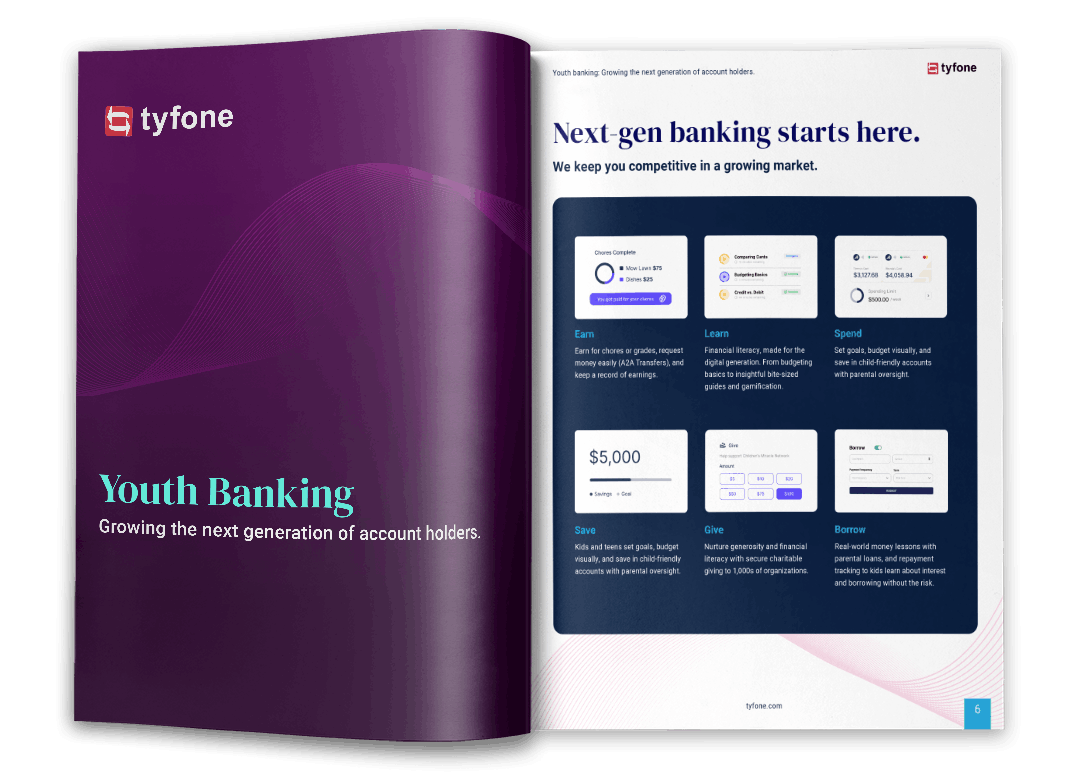
FREE PAMPHLET
Youth banking: Growing the next generation of account holders.
Financial habits are formed early, but most financial tools are designed for adults. As a result, families often rely on cash, shared cards, or disconnected apps to teach money management, making it difficult to balance independence with oversight.
At the same time, younger generations expect intuitive digital experiences, creating a gap between how they interact with money and how financial services are delivered. Financial institutions need age-appropriate solutions that engage younger account holders while supporting parents and caregivers.
By the numbers: what the industry’s own data shows
This isn’t just a hunch. Keynova Group’s Q2 2026 Online Banker Scorecard, which benchmarks the digital account opening experience across the 17 largest U.S. retail banks, including Bank of America, Chase, and Wells Fargo, puts hard numbers behind exactly the friction points described above.
None of the institutions in this study are credit unions or community banks, they’re the country’s largest, best-funded retail banks with dedicated digital experience teams. That’s exactly why the numbers matter for smaller institutions: this is the baseline megabanks manage to hit, and it still isn’t very good.
- Three-quarters of the banks evaluated now offer a step-by-step progress indicator during checking account opening, a best practice Keynova ties directly to higher submission and enrollment rates.
- Live help is now offered during checking account applications at more than half of the banks studied, but only about one-third make live chat available to prospects who are still comparing deposit accounts and CDs before they apply, a gap Keynova flags as a missed chance to catch hesitation before it turns into abandonment.
- Just 41% of banks offer omnichannel messaging that lets a customer-service conversation carry over across devices and channels, and only half allow a checking application started online to be picked up and finished later on a different device.
- Only 50% of banks let customers set privacy preferences inside authenticated online banking, and just 30% let customers control the type and frequency of marketing messages they receive when opening an account, despite this being one of the more solvable trust gaps in the entire flow.
In other words: even among the largest, best-resourced retail banks in the country, with full UX teams and years of Scorecard benchmarking pressure, the basic mechanics of reducing account-opening friction, clear progress indicators, live support at the moment of hesitation, and the ability to resume an application on a different device, are still only partially built out, as The Financial Brand’s analysis of the same scorecard data points out.
For a credit union or community bank without a dedicated digital experience team, the gap is almost certainly wider. That’s the bad news. The good news is that this particular competition isn’t about out-spending Chase or Bank of America, it’s about picking the right platform to close a gap that even they haven’t fully closed, which is a far more winnable fight for an institution with a fraction of the budget.
What “digital” actually has to mean.
Here’s where the conversation usually goes sideways: a lot of credit unions and community banks believe they’ve already solved this because they have an online application form.
But a web form that collects information and routes it to a human for the exact same manual review isn’t digital account opening, it’s a manual process with a nicer waiting room.
Genuine digital account opening means the entire lifecycle happens without a required human touchpoint, while still allowing one when it’s actually needed. That includes automated identity verification using document scanning and biometric liveness checks instead of a teller eyeballing a driver’s license. It means OFAC, KYC, and fraud screening running in the background in seconds, not sitting in a compliance officer’s queue for a day, a real relief for a community institution where that “compliance officer” is often one person also handling three other jobs.
It means e-signature on disclosures, instant underwriting and decisioning instead of a multi-day wait, and same-session funding through ACH, card, or external account transfer. And critically, it means a smooth, automatic handoff into digital banking enrollment, so the account that was just opened is immediately usable, not something the member or customer has to call in to activate a week later.
The credit unions and community banks winning deposit growth right now aren’t necessarily the ones with the flashiest apps or the biggest IT budgets. They’re the ones that quietly removed every unnecessary human checkpoint from the account opening journey and kept only the ones that actually add value, like a manual review flag for a genuinely high-risk application.
Automation isn’t about removing humans from banking. It’s about only involving a human when a human is actually the right tool for that specific step, which matters even more when your headcount is small enough that every hour counts.
The security argument runs backward.
There’s a persistent, well-intentioned objection to all of this: surely a person checking an ID in person, with their own eyes, is more secure than an algorithm. It’s an understandable instinct, but it doesn’t hold up against how identity fraud actually works today.
A busy branch employee, verifying dozens of IDs a day, is asked to catch a well-made fake license by eye, under time pressure, without specialized training in document forensics. Modern digital verification checks a scanned ID against forensic markers for tampering, cross-references the data against authoritative government and carrier databases, and requires a live selfie check to confirm the applicant isn’t using someone else’s photo or a static image.
It screens the applicant against sanctions and watchlists, adverse media, and politically exposed person databases in the same pass, checks that would take a human reviewer significant time to perform manually, if they’re performed at all.
None of this eliminates the need for judgment. It reallocates it. Automated systems handle the high-volume, pattern-matching work that computers are objectively better at, and flag the genuinely ambiguous cases for a trained compliance analyst to review with full context and supporting data already assembled.
That’s a stronger security posture than a single teller making a fast visual judgment call, not a weaker one. Financial institutions that view digital convenience and security as competing priorities are often the most vulnerable to today’s evolving fraud threats, including synthetic identity fraud and sophisticated document manipulation that even the most diligent employee cannot reliably detect through manual review alone.
The growth case nobody puts on a slide.
Most conversations about account opening frame the upgrade as a customer experience initiative. It is that. But it’s also, more quietly, a growth and efficiency initiative that shows up in deposit numbers and staffing costs, not just satisfaction scores, and for a credit union or community bank, deposit growth carries more weight than it does at a megabank.
A regional or national bank can lean on capital markets, wholesale funding, and scale to grow its balance sheet. A community institution’s ability to lend into its community is much more directly tied to the core deposits it can bring in the door, which makes every abandoned application a more consequential loss.
Faster, lower-friction account opening directly increases completion rates, which means more of the applications an institution already generates through marketing actually convert into funded accounts instead of abandoned sessions. It expands the addressable hours of the day an institution can acquire a member or customer, from roughly nine-to-five, five days a week, to all day, every day, hours a community institution’s marketing budget is already paying for whether or not the account opening flow is built to capture them.
It creates a natural moment for cross-sell, the instant an applicant is mid-flow and engaged is the best moment to offer a savings account, a credit card, or a relevant product, not a follow-up call three weeks later that may never happen. And it frees frontline and back-office staff from repetitive data entry and manual review of routine, low-risk applications, letting them spend that time on the complex cases and the relationship-building conversations that are the actual competitive advantage a community institution has over a megabank.
None of this requires abandoning the branch. If anything, the branch and the relationships built there are one of the few things a credit union or community bank can offer that a national bank or fintech genuinely can’t replicate. The goal is making the branch one excellent channel among several, instead of the load-bearing wall the entire account opening process leans on.
Where this leaves credit unions and community banks.
The institutions that will win the next wave of deposit growth are the ones that stop treating “digital transformation” as a slogan and start treating account opening specifically as the highest-leverage place to remove friction.
It’s the first interaction a new member or customer has with an institution, it’s where the most abandonment happens, and it’s where the cost of manual processing compounds fastest as volume grows relative to a smaller staff. Getting it right pays off in every direction at once: more funded accounts, lower cost per account, stronger fraud protection, and a first impression that actually matches the community-focused brand promise the marketing team is making, without needing a megabank’s technology budget to deliver it.
How Tyfone is helping institutions close that gap.
This is precisely the problem Tyfone built Digital Account Opening to solve, and it’s built specifically with credit unions and community banks in mind, not as a scaled-down version of a megabank product.
It’s a single, unified workflow for opening consumer and business deposit accounts, as well as consumer and business credit cards, across online, mobile, in-branch, and admin-initiated channels, so no channel is stuck running the slow version of the process.
Under the hood, it brings together automated identity verification, OFAC and KYC/KYB screening, biometric and document verification, and an instant automated underwriting and decisioning engine that can move an application from submission to approval in under a minute.
Funding is flexible by design, supporting ACH, card, internal and external transfers, and in-branch options, with the ability to let applicants skip funding and finish it later to reduce drop-off. And once an account is approved, enrollment into digital banking, e-statements, and debit cards happens automatically, instead of leaving the new member or customer to figure out the next step on their own.
For the credit unions and community banks we work with, the result has been up to 90% faster account opening time, with instant underwriting and approval decisions in under a minute, not by replacing every human step or the branch relationships that make community institutions different, but by removing the ones that never needed to be manual in the first place.
If your credit union or community bank is still asking new members and customers to finish at a branch that they started online, reach out to Tyfone today.