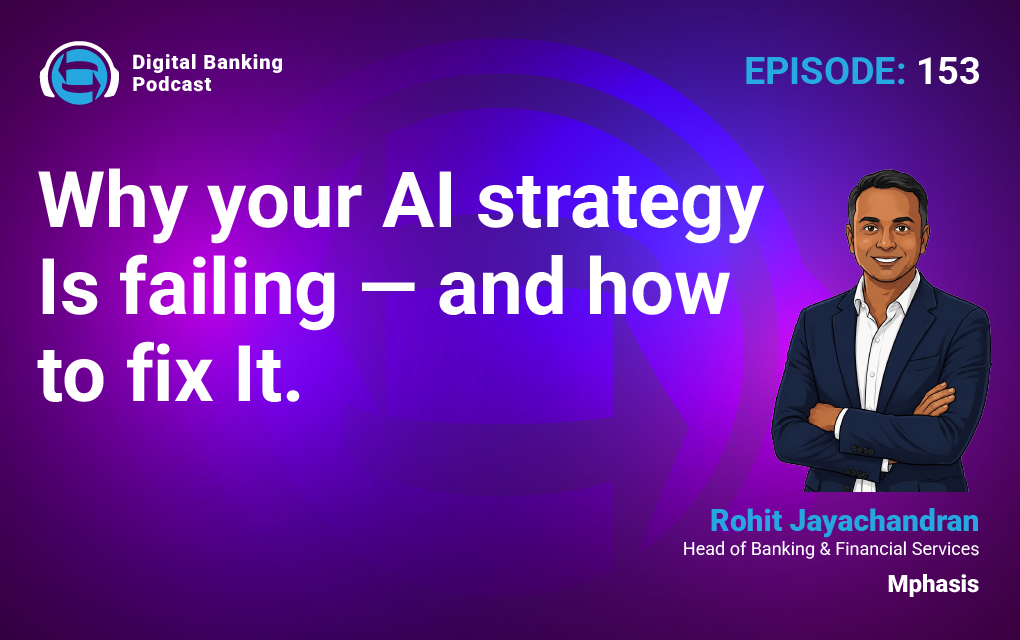
Why your AI strategy Is failing — and how to fix It, with Rohit Jayachandran.
“The best customer service is no service at all.”
EPISODE:
153
with guest:

Rohit Jayachandran
Head of Banking & Financial Services
Mphasis
Episode Summary
In the latest episode of the Digital Banking Podcast, host Josh DeTar of Tyfone welcomed Rohit Jayachandran, Head of Banking & Financial Services at Mphasis, for a wide-ranging conversation about the intersection of technology, culture, and human decision-making in financial services.
Jayachandran walked through 25 years of banking technology evolution — from the dot-com era through mobile, digital, cloud, and now AI — and made a pointed argument that most financial institutions were approaching AI the wrong way. He offered a two-track framework: for critical revenue, cost, and risk functions, apply top-down reimagination; for everything else, give employees the tools and let them drive 15–20% productivity gains grounded in the right guardrails.
The conversation moved into cultural readiness for AI adoption, the importance of a growth mindset, and why community financial institutions had a genuine opportunity to break historical entry barriers around scale and complexity. DeTar and Jayachandran also drew unexpected parallels between Formula 1 telemetry and banking data strategy, and closed with a shared conviction that the future of work would be more fulfilling — not less — for those willing to adopt the tools.
Key Insights
Don’t automate the existing process — reimagine it.
The single most consistent mistake Jayachandran sees banks making with AI is automating their current workflows in their current form. If lending underwriters spend most of their day collecting data and only a fraction making decisions, applying AI to accelerate data collection is only half the win — the real transformation happens when you reimagine the entire process to enable more, better, human-in-the-loop decisions. For financial institutions weighing where to invest, this reframes AI from an efficiency play into a strategic one.
The two-track AI strategy: top-down for critical, bottom-up for everything else.
Jayachandran offered one of the most practical AI governance frameworks in recent memory: segment your organization’s functions into two buckets. For the highest-stakes processes — leading revenue drivers, cost centers, and risk functions — drive top-down transformation with executive ownership, clear outcome measurement, and reimagined workflows. For everything else, give employees the tools with proper guardrails and let them harvest 15–20% productivity gains organically. This approach solves the tension between over-controlled AI programs that stall and under-governed POC sprawl that introduces risk and hallucinations.
Culture and growth mindset are the real AI prerequisites.
Technology adoption doesn’t fail because of technology — it fails because of culture. Jayachandran drew a direct line between how parents raise children (celebrate the process, not the outcome) and how enterprises need to build psychological safety around experimentation with AI. If employees fear making mistakes, they won’t test the boundaries where real productivity lives. For banking leaders, this means investing as much in cultural readiness and permission structures as in the tools themselves.
AI is leveling the playing field for community FIs.
One of the most consequential points for community banks and credit unions: AI is dismantling the historical entry barriers of scale and complexity that gave the largest institutions an unfair advantage. Jayachandran was explicit that the capital expenditure gap is narrowing, and what will differentiate institutions going forward is not budget size but adoption speed. A $1.5B credit union that engineers context well around its critical customer journeys can now compete on digital experience in ways that were impossible five years ago.