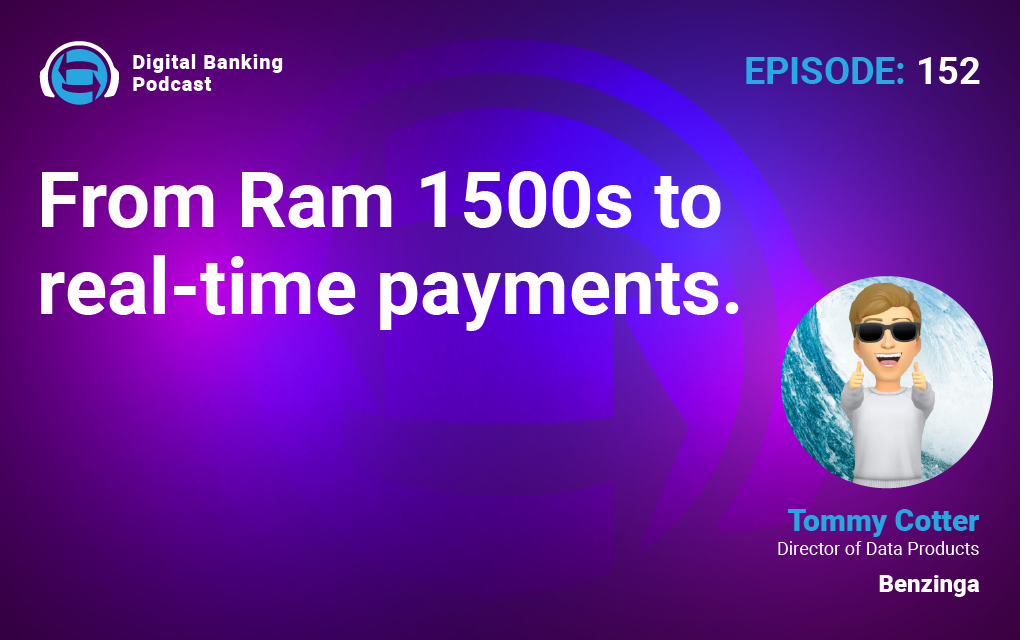
From Ram 1500s to real-time payments with Tommy Cotter.
“You always want to be in a room where you’re being challenged.”
EPISODE:
152
with guest:

Tommy Cotter
Director of Data Products
Benzinga
Episode Summary
In the latest episode of the Digital Banking Podcast, host Josh DeTar welcomed Tommy Cotter, Director of Data Products at Benzinga. Cotter spent his early career optimizing Ram 1500 production at Fiat Chrysler, where a single second of downtime could cost a truck. In this episode, he joined DeTar to talk about what that mindset looked like applied to financial services and why most digital transformation still amounted to putting a broken process on an iPad.
They got into the build vs. buy debate in an AI-accelerated world, what Plaid’s MCP connection meant for community FIs, and why hyper-personalization had nothing to do with uploading a photo of your dog.
Cotter also introduced two ideas that sharpened the whole conversation: John Gruber’s auteur theory — every product reflects the taste of the person calling the shots — and Ivan Vendrov’s “tyranny of the marginal user,” a warning about building for your lowest-engagement user at the expense of the ones who actually stay.
Key Insights
Every Product Reflects the Taste of the Auteur
One of the most provocative ideas in the conversation was Tommy’s invocation of John Gruber’s “auteur theory” applied to product and process design: a product ultimately rises (or sinks) to the level of taste of the person calling the shots. For community financial institutions, this is a leadership accountability moment. If digital experiences feel dated, if onboarding takes 18 minutes, if the mobile app feels like a 2014 artifact — that’s not a vendor problem alone. It reflects the standards of whoever is at the top of the org chart for that initiative. The implication for CDOs, CIOs, and CEOs is direct: the bar your team clears is the bar you set, and “good enough” leadership produces good-enough products in an industry where the competition is decidedly not settling for good enough.
Digital Transformation Is a New Lease — Don’t Just Cut the Top Off the Turkey
Tommy and Josh kept returning to a simple but uncomfortable truth: too many community FIs have approached digital transformation by taking a branch-era process and putting it on an iPad. Citing Jim Marous’s recent challenge to financial institutions to time their own new account opening flows, they argued that real transformation requires crumpling up the existing process and asking: “If I were a brand-new institution today, with only a digital channel and a mandate to be a customer acquisition magnet, what would this look like?” The window for that rebuild is the migration itself. Treating a platform switch as a like-for-like replication is a generational missed opportunity.
The Tyranny of the Marginal User
Tommy introduced Ivan Vendrov’s concept of “the tyranny of the marginal user” — the trap of designing every product decision around the lowest-engagement, shortest-attention-span user. When institutions over-index on appeasing the marginal user, the power users (who actually drive lifetime value) hit a ceiling with no on-ramp to deeper functionality. In an AI-enabled world where modular, hyper-personalized experiences are increasingly possible, the winning platforms will be the ones that meet users where they are and give them a path to where they’re going. For community FIs, this reframes feature paralysis: stop trying to checkmark every box your competitor offers, and start building depth for the members who matter most.
Plaid’s MCP Should Scare Community Financial Institutions
The episode’s most consequential strategic warning came when Josh and Tommy unpacked what Plaid’s recently exposed Model Context Protocol (MCP) connection means for community banking. Consumers can now plug their full financial picture into ChatGPT or Claude and ask, “Can I afford this?” or “Who should I borrow from?” The financial institution is disintermediated from the relationship — and the LLM’s recommendation is unlikely to surface a small community credit union or bank. With LLM-driven GEO (Generative Engine Optimization) becoming nearly impossible to influence at a global level for smaller players, community FIs need to think now about how they remain the trusted, in-context source of financial guidance for their members. The institutions that articulate a clear, differentiated value proposition — one a chatbot’s limited context window cannot replicate — will be the ones that survive the shift.
About The Guest

Tommy Cotter started his career optimizing the Ram 1500 assembly line at Fiat Chrysler — a mile-long, 900-robot operation running 800 trucks per shift. After a pandemic-era pivot into fintech, he now leads data product strategy at Benzinga, bringing the same bottleneck-elimination discipline from the factory floor to financial services.