
A 5-PART WHITEPAPER SERIES
Part 2: The relationship inversion.
Why your concierge advantage is slipping away.
Part Two of five, written for the boards and CEOs of community banks and credit unions. Outsiders are consolidating your consumers’ data, the world’s largest AI companies are making themselves the new front door to your consumers’ finances, and a new breed of digital entities is disintermediating payments and money itself. This series shows what these forces can take, what they cannot, and what to do about it.
By Dr. Siva Narendra, CEO & Co-Founder, Tyfone

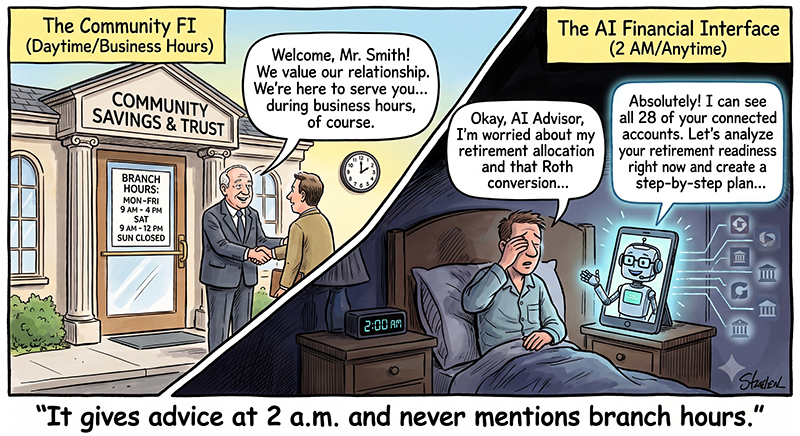
Image generated by Gemini
Executive summary.
Community banks and credit unions have long believed their main advantage is the relationship: the human touch, the concierge service, the banker who knows the account holder by name. This paper argues that the advantage is flipping. Not because AI has become a warmer listener, but because the consumer’s primary financial relationship is moving to an AI interface that now sits between them and every institution they use. In that arrangement, the institution is quietly demoted from trusted advisor to data supplier. The trust numbers show the shift is still early and incomplete, which is exactly why the time to respond is now rather than later.
What “relationship” actually meant.
Be honest about the starting point. For a small minority of high-value consumers, community institutions delivered a genuine concierge relationship: a named contact, real advice, a human who answered. For the mass-market majority, “relationship” meant a branch, a call center, and a general sense of local trust. It did not mean personalized financial guidance. Most consumers never received advice from their institution at all. They received service.
This distinction matters because it locates the real threat. The danger is not that AI will outperform the concierge experience your best consumers receive. It is that AI now delivers concierge-grade attention to the large majority of consumers who never received it from you, the ones you served with a phone tree and a brochure.
From summary to counsel, firsthand.
In Part One I described connecting my own accounts to an AI tool through Plaid, 28 accounts across eight institutions, with the transaction sync completing in roughly 30 minutes in the background. What happened in the hour that followed is the subject of this paper. That hour of back-and-forth was genuinely meaningful, and it did not stop at organizing what the tool could see. It produced a summary of how my assets are allocated, an analysis of my retirement readiness, and a step-by-step plan for converting traditional IRA balances to a Roth during lower-income years ahead of retirement, with the reasoning laid out rather than asserted. The conversation ended with a password-protected PDF, secured with a long random password, that I could share with my family.
None of this was advice any of my institutions had ever offered me. Unprompted, a free consumer tool delivered the kind of planning a mass-market consumer has never received from a community bank or credit union, and packaged it for the consumer’s own next step. In other words, the value shifts from holding the data to making sense of it.
Story continued below…
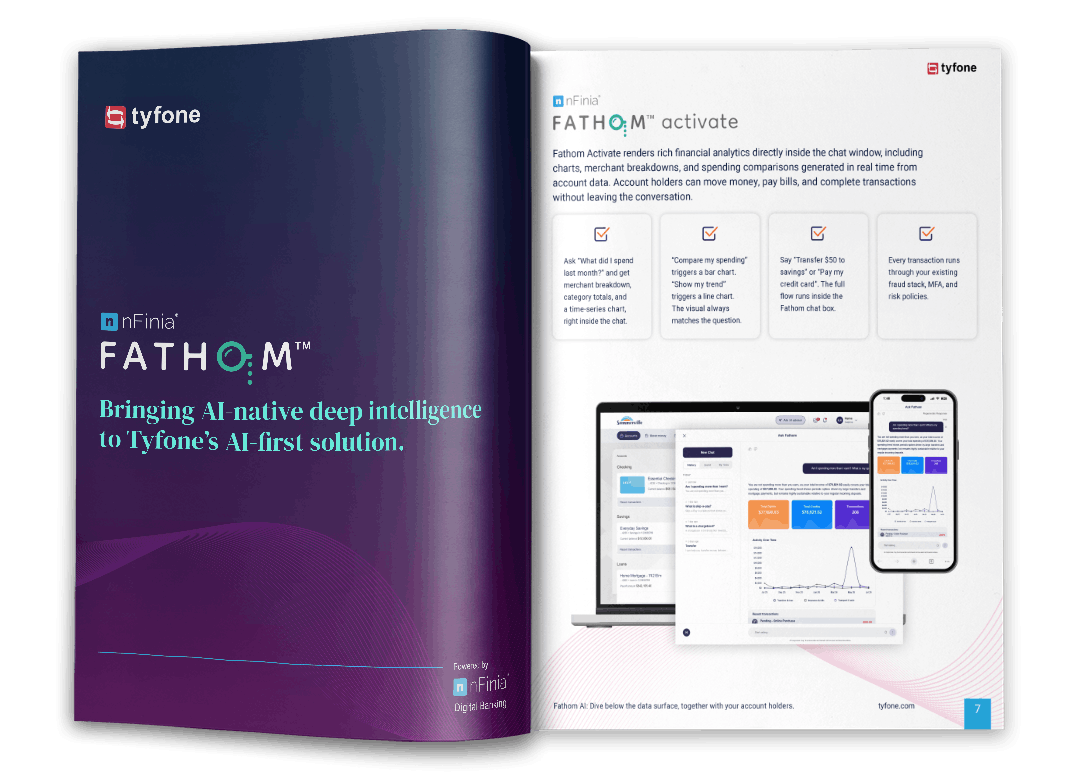
FREE PAMPHLET
Bringing AI-native deep intelligence to Tyfone’s AI-first solution.
Most credit unions and community banks don’t have an AI strategy yet, and account holders aren’t waiting. They’re already comparing every digital experience, banking included, to ChatGPT. Stand still and get left behind.
Fathom is the AI layer woven throughout Tyfone’s digital banking ecosystem, combining account holder financial data, institutional knowledge, and native banking experiences into a single intelligence layer.
The new front door.
The world’s largest AI companies are building the new front door to your consumers’ finances, and the door is conversational. In May 2026, OpenAI launched a personal-finance experience that lets users connect their accounts through Plaid across thousands of institutions and ask questions grounded in their actual money. OpenAI states that more than 200 million people already come to ChatGPT each month with budgeting, investing, and planning questions.
Perplexity has built comparable account-linking. Bank of America’s Erica, a far narrower tool confined to one institution, has handled billions of customer interactions, which on its own proves that consumers will route everyday financial questions through a machine at enormous scale.
When a consumer’s first stop for “what should I do with my money?” is an AI that can see all of their accounts, the institution is no longer where financial decisions begin. It becomes one of many data sources feeding the system that helps the consumer make sense of their financial life. The institution moves from advisor to supplier.
The end state of this trajectory has a useful analogy: telecommunications. AT&T and Verizon do not dictate what you watch on television, they carry the signal while the experience belongs entirely to the platform above them. Financial institutions risk becoming the equivalent: holding the deposits and processing the transactions while the services that matter to customers, the advice, the planning, the interface, are provided not by the institution but by the platform sitting on top of it. The institution keeps the money. The platform keeps the relationship.
“At New Orleans Firemen’s Federal Credit Union, we believe AI and fintech are changing more than how members conduct transactions. They are changing where financial relationships begin. Credit unions can no longer assume that holding a member’s checking account means we have their full financial relationship.”
– Judy DeLucca
President & CEO
New Orleans Firemen’s Federal Credit Union
The trust gap is real, and it is closing.
A board could reasonably push back: consumers do not actually trust AI with their money. Today that is largely correct, and it is the most important nuance in this paper. A 2026 TD Bank survey reported by American Banker found that while 62% of Americans trust AI to provide honest and reliable information, only 18% would trust it to make financial recommendations on its own; 90% still said they trust personal relationships and 85% said they trust their financial institutions. Northwestern Mutual’s 2025 study reached a similar conclusion, with most Americans still preferring human advisors over AI alone.
But read the generational split underneath those averages. In the same TD research, the share of consumers using AI for financial decisions ran dramatically higher among younger demographics than older ones. Separate 2025 and 2026 surveys found that roughly one in five consumers has already made a significant financial decision based mainly on an AI recommendation. The pattern is not “consumers reject AI.” It is “consumers still prefer humans for the most consequential decisions, while the everyday interface moves to AI, fastest among the very customers an institution most needs to keep.” The moat is real, and it is draining.
Why “build your own AI banker” is the wrong reflex.
Faced with this, the tempting move is to bolt a chatbot onto the mobile app and call it a relationship. It will not hold, for the same reason set out in Part One. A single institution’s assistant can only see that institution’s accounts, the same one-slice limitation that commoditized the information layer in the first place.
The consumer’s cross-account AI will always hold the more complete picture, as my own test made plain, and will therefore give the more useful answer.
The relationship cannot be defended by out-chatting the chatbot. It has to be re-anchored on something the AI interface depends on rather than something it replaces.
What this means for your board.
Two uncomfortable conclusions, and one direction.
First, stop equating relationships with channel warmth. The warmth your institution takes pride in was never delivered to most of your consumers, and an AI now delivers its functional equivalent to all of them. Defending nostalgia is not a strategy.
Second, treat the inversion as a positioning problem, not a technology problem. The question is not whether you have an AI assistant. It is whether, when a consumer’s AI helps make a consequential financial decision, your institution is the answer it arrives at or just one of the sources it cites.
Being the answer means being present at the moments that matter most: the high-consequence decisions where consumers are least willing to rely on a machine alone, and where context, trust, and human judgment still matter in ways a distant model cannot replicate.
What that something is, and how to build on it, is the subject of Part Four, after Part Three follows the money itself out of the institution. What to do about all of it waits for Part Five. For now, the conclusion that should concentrate a board’s attention is this: the relationship advantage you have been counting on is real but eroding, and it is eroding fastest among the consumers you most need. It will not be saved by adding a chatbot. It can only be rebuilt on ground the interface layer depends on but cannot occupy.

About the author.
Dr. Siva Narendra is the CEO and Co-Founder of Tyfone, a leading digital banking technology provider serving community banks and credit unions across the United States. Over the past two decades, he has worked at the intersection of digital banking, payments, identity, and financial technology, helping institutions navigate periods of technological disruption while maintaining their competitive independence.
Sources
- OpenAI, “A new personal finance experience in ChatGPT,” May 2026; TechCrunch coverage of the launch.
- TD Bank / Ipsos survey on consumer use of AI in finance, reported by American Banker, 2026.
- Northwestern Mutual, 2025 Planning & Progress Study (conducted by The Harris Poll).
- Consumer survey on AI versus human financial advice (Pollfish), 2026.
- Bank of America, reported Erica interaction volumes, 2025.
- Cornerstone Advisors, 2025 research on mobile-banking satisfaction and the loyalty gap (Ron Shevlin).