
A 5-PART WHITEPAPER SERIES
Part 3: The disintermediation risk.
When transactions leave your institution.
Part Three of five, written for the boards and CEOs of community banks and credit unions. Outsiders are consolidating your consumers’ data, the world’s largest AI companies are making themselves the new front door to your consumers’ finances, and a new breed of digital entities is disintermediating payments and money itself. This series shows what these forces can take, what they cannot, and what to do about it.
By Dr. Siva Narendra, CEO & Co-Founder, Tyfone

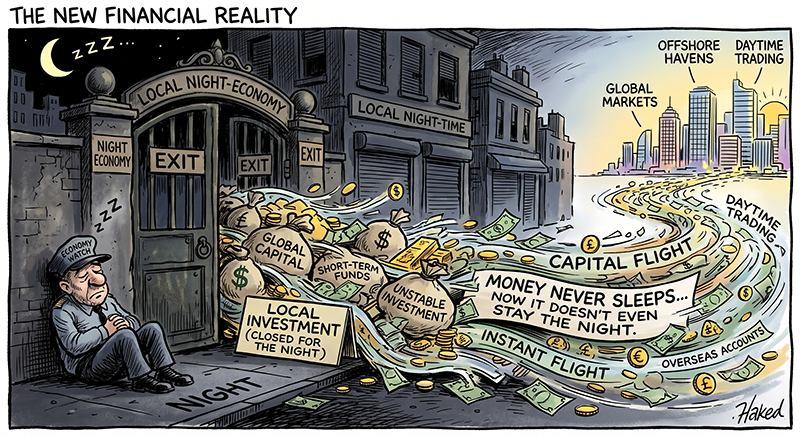
Image generated by Gemini
Executive summary.
Part One showed how your information advantage was commoditized, and Part Two showed the relationship moving to AI interfaces that sit above every institution. This paper follows the money itself. Disintermediation is a fancy word for a simple thing: getting cut out of the middle.
Payments, and the deposits that ride along with them, are leaving chartered institutions for a new breed of digital entities: wallets, point-of-sale software, buy-now-pay-later providers, and now regulated stablecoins. The threat is double and compounding. Every transaction that leaves takes fee income with it, and every balance that settles somewhere else raises the cost of the funding that remains.
For community institutions the squeeze is sharper than for the megabanks, because the very exemption that makes their card fees more valuable also makes each lost transaction more expensive. This paper sets out where the volume has gone, how the payment rails themselves are shifting, and why the defenses the big banks are building are not levers most community institutions can pull.
The transaction layer was always more than plumbing.
For a community bank or credit union, moving money has been a quiet profit engine with two pistons. The first is interchange: the small fee your institution earns every time an account holder swipes a card. The second is the funding side: the low-cost, insured, loyal retail deposits that sit in checking accounts between transactions. Those deposits are the cheapest raw material in banking, funding loans at margins no other source of money can match.
Both pistons depend on the same thing: the transaction beginning and ending inside your institution. Disintermediation is the process by which it stops doing that. The consumer still has money, still pays for things, still saves. Your institution simply stops being where those things happen, and both revenue streams decay at once.
Where the volume already went.
The migration is not a forecast; it is measurable today, on four fronts.
Wallets and social payments: Survey data indicates that roughly two-thirds of consumers now keep standing balances in mobile payment apps, letting an average of a few hundred dollars build up before sweeping anything to a bank or credit union. Across their user bases, PayPal alone holds on the order of $3 billion in stored wallet balances and Cash App well over $1.5 billion, with PayPal processing roughly $700 billion in U.S. payment volume. Every one of those dollars is a balance that is not sitting in a consumer checking account, and a stream of transactions that generates no interchange for the institution that considers that consumer its own.
Buy now, pay later. BNPL volume is projected at roughly $560 billion in 2025, growing at a double-digit rate toward an estimated $900 billion or more by 2030. Some installments are still paid with bank-issued cards, which preserves a sliver of interchange, but the structural effect is to pull spending away from credit cards and the revolving balances behind them. That is interest income leaving the system.
Point-of-sale software. On the merchant side, platforms such as Square and Clover have bundled payments into the software a small business runs on, and now process a combined volume on the order of $600 billion, roughly a fifth of the small-business market. The community institution that once held the merchant’s loan, operating account, and payment processing now frequently holds only the operating account, and not always that.
The broader drift. Industry projections put global fintech revenue on a path toward $1.5 trillion by 2034. The precise figure matters less than the direction: customer-facing financial activity is consolidating onto digital-native platforms whose business models do not include the community institution.
The rails themselves are moving.
The migration above happened on top of the existing card networks. The next phase replaces the networks.
Instant payment systems, FedNow and RTP, let money move directly from one bank account to another in seconds. Combine them with something as simple as a QR code at the register, and a merchant can accept payment straight from a customer’s account, bypassing the card networks entirely.
Merchants have every reason to push this: accepting cards costs them roughly 3% of each sale, approaching 4% for many small businesses, while the new rails cost a fraction of that. This is a threat, but only for institutions that stand still. The same rails open a strategic option for community financial institutions, one this series returns to in Part Five.
Here is the asymmetry a community institution’s board must understand. Under the Durbin Amendment, banks over $10 billion in assets have their debit card fees capped at roughly 21 to 24 cents per transaction. Community institutions under that threshold are exempt and typically earn 44 to 55 cents. That uncapped fee income is so valuable it underwrites the business model of many fintech partnerships.
The cap also hides a second asymmetry. Durbin controls what the card-issuing bank receives; it says nothing about what the merchant actually pays. The processors that serve merchants, many of them owned by the largest banks, typically charge bundled rates and keep the spread. Studies after Durbin took effect found that most merchants saw no drop in their card costs even as issuer fees fell, and small merchants often saw increases. So the megabanks lost issuing revenue to the cap, but their merchant businesses kept earning on the other side of the same transaction. The cap stung them far less than it appears.
The exemption, meanwhile, has been a structural blessing for community institutions, and it is now a structural exposure: when a transaction leaves the card rails entirely, a community institution loses two or more times what a megabank loses on the same swipe, and it has no merchant business on the other side to cushion the blow. The institutions least able to absorb the loss stand to lose the most per transaction.
Story continued below…

FREE PAMPHLET
Bringing AI-native deep intelligence to Tyfone’s AI-first solution.
Most credit unions and community banks don’t have an AI strategy yet, and account holders aren’t waiting. They’re already comparing every digital experience, banking included, to ChatGPT. Stand still and get left behind.
Fathom is the AI layer woven throughout Tyfone’s digital banking ecosystem, combining account holder financial data, institutional knowledge, and native banking experiences into a single intelligence layer.
Stablecoins: the deposit threat gets a rulebook.
Until recently, the deposit side of disintermediation moved at the speed of consumer habit. The GENIUS Act, passed in July 2025, changed the slope. A stablecoin is a digital token engineered to always be worth exactly one dollar. By creating a federal and state framework for approved stablecoin issuers, and requiring every token to be backed one-to-one by safe assets such as Treasuries, the Act gave stablecoins the legitimacy they lacked.
Global issuance already exceeds $300 billion, concentrated overwhelmingly in Tether and Circle, and industry projections for 2030 range from $400 billion to as much as $4 trillion. The width of that range is itself the point: nobody knows how fast adoption will run once merchant payments and cross-border flows pick it up, and planning should not assume the low end.
Two mechanics deserve a board’s attention. First, the yield workaround. The GENIUS Act bars issuers from paying interest directly on stablecoins, but the bar is porous in practice: exchanges can be paid to reward stablecoin holders, and balances can be swept into money market funds or lending platforms. The result is a high-yield alternative to the checking account, aimed precisely at the low-cost retail deposits that fund community lending.
Second, the wholesale deposit trap. Even when a stablecoin issuer deposits its reserves back into the banking system, the money changes nature. Thousands of loyal, insured retail relationships become one massive, uninsured balance owned by a single company, money that can leave in an afternoon. No institution can prudently fund thirty-year loans with money like that. The dollars may stay in the system; their value as loan funding does not. There is a way through this one as well; Part Five names it.
The big-bank defense, again above your weight class.
As with the data tolls in Part One, the largest institutions are mounting a defense, and as with the data tolls, it is mostly their defense to mount. The instrument is the tokenized deposit: a digital version of an ordinary bank deposit that moves on the same kind of rails as a stablecoin, with the same instant, around-the-clock settlement, but stays inside the regulated banking system, keeps the institution’s balance sheet intact, and remains eligible for deposit insurance. The Clearing House plans a domestic tokenized deposit network for early 2027, and platforms such as FIS’s Project Keystone aim to let groups of regional banks issue their own digital money. Some central bank officials expect tokenized deposits ultimately to outpace stablecoins, while the U.S. central bank digital currency conversation has largely stalled.
Tokenized deposits may well blunt the stablecoin threat for the system as a whole. But the networks, the consortium seats, and the infrastructure are being built by and for the largest players first. For most community institutions, this fight, like the data-access fight, is happening overhead. The realistic posture is to track it and be ready to join the rails when they reach down-market, not to mistake the existence of a defense with the possession of one.
The squeeze, stated plainly.
Put the pieces together and the transaction layer presents a compounding bind rather than a single loss.
- Fee income decays as volume moves to wallets, BNPL, point-of-sale platforms, and card-bypassing rails, and the Durbin exemption means each lost transaction costs a community institution roughly twice what it costs a megabank.
- Funding costs rise as wallets, money funds, and yield-bearing stablecoin arrangements pull low-cost retail balances away, forcing institutions to pay up for the deposits that remain and squeezing margins from the other side.
- The remaining deposits degrade in quality as loyal retail balances are replaced, if at all, by corporate money that can leave overnight and cannot prudently fund long-term lending.
Each force alone is manageable. Together they erode fee income, raise funding costs, and shrink lending capacity at the same time, and the institution feels it not as a crisis but as a slow ratchet: a few basis points of margin, a few percent of interchange, year after year.
What this means for your board.
The instinctive responses repeat the mistakes of the information layer. Launching your own wallet to compete with Cash App, or your own BNPL product to compete with the platforms, is once again a contest against the largest players on their terms, with the added disadvantage that payments is a network business, and networks reward whoever is already biggest. Waiting for tokenized deposits to save the funding base means outsourcing your defense to institutions that are not building it for you.
The harder and more useful conclusion is this: the transaction layer is following the information layer into commodity status, and the revenue attached to it should be treated as structurally declining, not temporarily soft. Parts One and Two watched the data and the relationship leave; this paper has followed the money. Part Four names the one business that still holds, the one no platform can intercept and can only take by becoming what you already are. What to do about all of it waits for Part Five.
For now, the discipline this paper asks of a board is to stop counting on the transaction layer to fund the future. The money is already walking. Strategy begins with admitting where it is going, and why it will not be won back on the rails it left on.

About the author.
Dr. Siva Narendra is the CEO and Co-Founder of Tyfone, a leading digital banking technology provider serving community banks and credit unions across the United States. Over the past two decades, he has worked at the intersection of digital banking, payments, identity, and financial technology, helping institutions navigate periods of technological disruption while maintaining their competitive independence.
Sources
- Survey and industry data on consumer mobile-wallet balance behavior and stored balances at PayPal and Cash App; PayPal U.S. payment volume estimates, 2025-2026.
- BNPL market sizing and growth projections (2025 volume; CAGR toward 2030), industry estimates.
- Square and Clover gross payment volume and SMB market share estimates, 2025.
- Durbin Amendment debit interchange caps and the community-institution exemption; published per-transaction interchange ranges.
- Federal Reserve (FedNow) and The Clearing House (RTP) instant-payment rails; merchant card-acceptance cost ranges.
- GENIUS Act (Guiding and Establishing National Innovation for U.S. Stablecoins), July 2025; stablecoin issuance totals and 2030 projections; Tether and Circle market share.
- The Clearing House tokenized deposit network announcement (2027 target); FIS Project Keystone; Federal Reserve Governor Christopher Waller, public remarks on CBDCs.
- Global fintech revenue projections toward 2034, industry estimates.