
Cost squeeze in Northeast Ohio pushes credit union to expand relief programs.
In a Tyfone interview, 7 17 Credit Union CEO John Demmler describes how inflation is reshaping borrowing and driving demand for flexible financial solutions.
As rising fuel prices and the cost of everyday goods continue to strain household budgets, credit unions in economically sensitive regions are seeing how even modest increases can ripple through local communities. At 7 17 Credit Union, a nearly $2 billion-asset institution based in Warren, Ohio, the effects are especially pronounced.
In a recent interview with Tyfone, CEO John Demmler described the financial pressures facing members across Northeast Ohio, where incomes tend to be lower than national averages.
“Fluctuations in gas prices affect our members here in NE Ohio substantially more than in other parts of the country,” Demmler told Tyfone. He noted that with median household incomes around $55,000—and closer to $35,000 in urban areas such as Warren and nearby Youngstown, Ohio—even small increases in fuel costs can quickly add up.
“A 50 cent increase in the per gallon cost of gas affects household budgets by about $40 – $50 per month,” he said. “While this does not seem like much to individuals in other parts of the country, if your household income is only $35,000 and your gas cost just went up $600 more per year, that is a tremendously difficult increase to manage.”
The strain extends beyond fuel. Demmler said higher costs are forcing families to cut back on essentials and discretionary spending alike, reducing money available for groceries, entertainment and other needs. “This squeezes family budgets for groceries or for entertainment quite a bit, pushing that economic impact of less spend elsewhere in the local economy such as restaurants, music venues,” he said. In more severe cases, some members abandon loan payments altogether.
Story continued below…
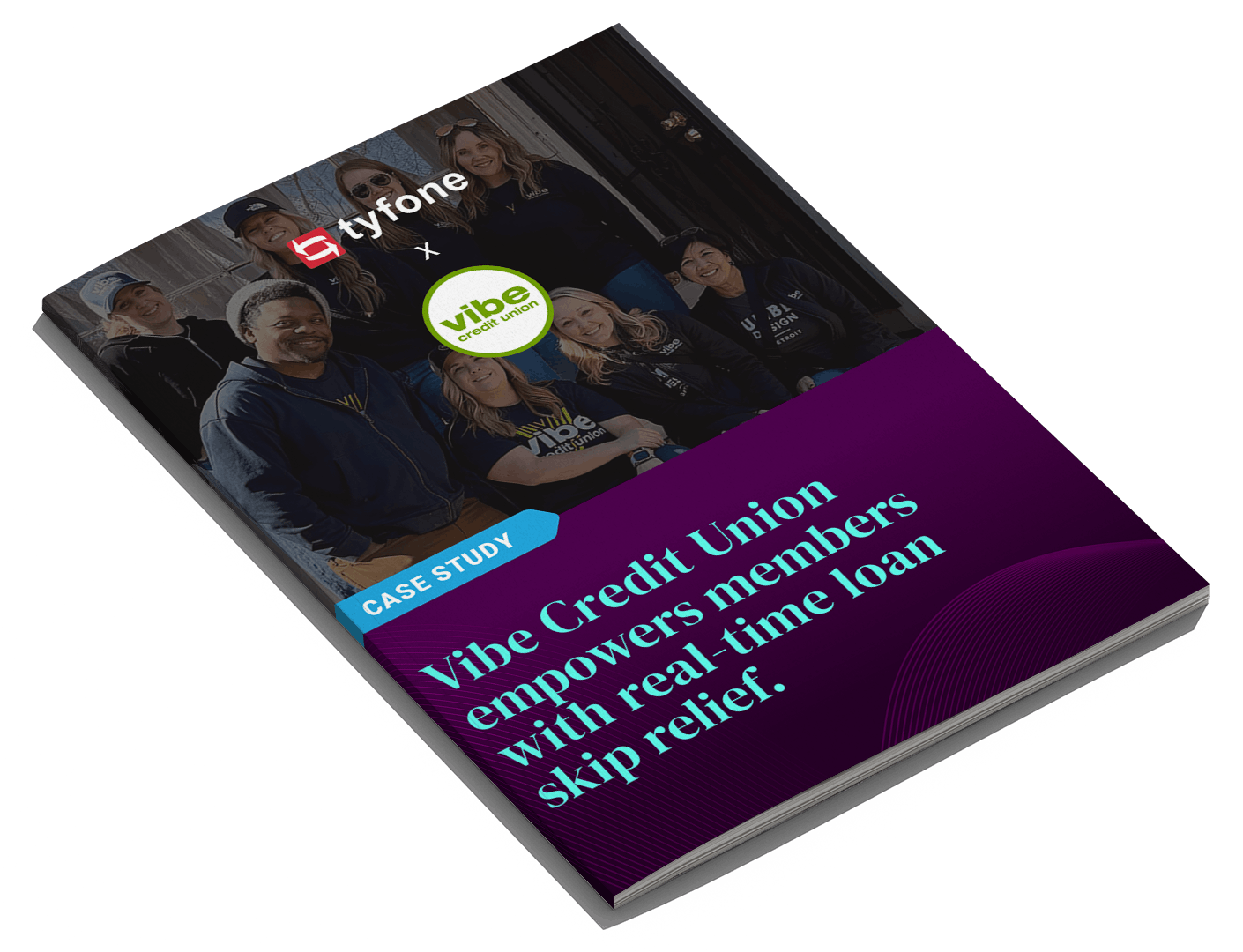
FREE CASE STUDY
Vibe Credit Union empowers members with real-time loan skip relief.
To meet growing demand for faster, more convenient digital options, Vibe partnered with Tyfone to implement a Skip-A-Pay solution. Members can skip eligible loans online, while staff can assist those who prefer to call or visit branches using the same system. The result is a self-service loan skip program that supports members year-round, improves internal efficiency, and has generated over $100,000 in annual revenue without impacting credit scores.
Read our exclusive case study and learn how they elevated their digital banking and loan servicing experience.
Those pressures are shaping how members borrow and manage debt. The credit union has seen a sharp increase in refinancing activity, particularly for auto loans, as members look to lower monthly payments.
“We have seen a very large increase in members refinancing their auto loans with us in the past few years, with direct refinance volume up 13% in March (year over year) while our indirect (Purchase) volume is up only 4% per year,” Demmler said.
The shift reflects a broader trend toward restructuring debt rather than taking on new loans. The credit union’s “Beat Your Rate” campaign has played a key role, offering to reduce members’ current auto loan rates by at least 2.00%, with a floor of 3.99%.
“With average car prices, this saves about $30 a month, which we thought would go a long way to offsetting some of that impact of the rise in fuel costs,” he said.
At the same time, members are turning to lower-cost credit options to manage high-interest debt. Demmler said the credit union has seen strong demand for its Affinity Credit Card program, which offers a lifetime balance transfer rate of 7.17% with no transfer fee, helping members consolidate debt that might otherwise carry interest rates of 15% to 30%.
In response to these economic challenges, 7 17 Credit Union has launched a broad initiative known as “Ohio Strong,” aimed at improving financial stability for members and their communities.
“The premise of the campaign is that we believe that when families are financially strong, our communities will be stronger, and when we have stronger communities we have a strong state,” Demmler said.
The initiative includes a range of products designed to reduce costs for borrowers. Among them are mortgage refinancing options and a “No Fee Mortgages” program that eliminates traditional charges such as processing, underwriting and appraisal fees. According to Demmler, this approach can save members an average of $3,500 on a typical $130,000 home.
In select urban markets, including Akron, Ohio and Canton, Ohio, the credit union also offers reduced mortgage rates, lowering standard rates by a full percentage point.
The institution has also introduced a youth savings program offering a 7.17% annual percentage yield on the first $1,000 saved, aimed at encouraging financial habits among younger members.
Even with these initiatives, Demmler emphasized that flexibility remains central to the credit union’s approach. Through its Member Solutions department, the institution works directly with members to provide relief when needed.
“Whether that is offering skip-a-pays or offering a broader solution for restructuring their debts to allow them to potentially continue to pay all of their obligations, but still free up hundreds of dollars per month,” he said.
“Generally if the member is willing to pay, we can make it work.”
– John Demmler
President & CEO
7 17 Credit Union
Ken McCarthy is manager of marketing communications at Tyfone, where he monitors the credit union industry and contributes to conversations shaping its future. He previously covered credit unions and community banking for American Banker and S&P Global Market Intelligence. He holds a journalism degree from Point Park University and has more than 15 years of experience covering financial services. He is also the author of three literary fiction novels.