
Your best consumers are waiting to be noticed.

Every morning, millions of Americans open an app that reminds them their loyalty has value. They see it in their coffee shop rewards, grocery apps and credit card points stacking up. In most parts of consumer life, sticking around gets noticed. In banking, where relationships are supposed to matter more, it often doesn’t.
We live in an economy that has gotten very good at saying thank you for staying, but this is not always true in banking. That leaves institutions missing a real opportunity to strengthen retention by valuing the people who are already there.
What we’re hearing.
At Rivel, we conduct focus groups with credit union members and banking prospects across the country to go beyond what surveys tell us. These are real conversations, face-to-face – and we’ve spent a lot of time lately listening to how people feel about their financial relationships. What we hear most often is not outrage, but a lack of recognition.
In those conversations, we’ve been asking a simple question: what would make people stay with their primary bank or credit union? Again and again, even among people who say they are generally satisfied, the same idea comes up—they want some sign that their loyalty matters.
“I’ve been with my institution for almost fifteen years,” one member told us. “They’re offering cash bonuses to anyone who opens a new account online right now. Why does a stranger matter more than someone who’s been here with multiple accounts like I have?”
We heard versions of that across ages, incomes and areas of the country.
The acquisition trap.
Banking has focused on growth, mostly, through an acquisition-first model—introductory rates, new account bonuses, and marketing campaigns aimed at pulling customers away from competitors. There was a time when switching institutions, or even opening new accounts, took enough effort that people generally avoided it unless they had to.
Digital account opening, aggressive fintech alternatives and frictionless money movement have made switching easier than it’s ever been. Customers don’t need a breaking point to leave. They just need a reason to think something better exists. This matters more now because loyalty is no longer protected by the inertia of “always have been a member.”
What our research shows is that the building frustration among long-tenured members and customers is rarely loud. It’s often subtle. It’s moving a few key accounts elsewhere, while keeping direct deposits where it’s always been. Consumers are feeling overlooked and perhaps even taken for granted.
People rarely react dramatically when it comes to banking. They just become more receptive to the next offer that comes along. That can mean a competitor’s rate offer, a new branch that’s a little more convenient, a standout youth account feature for their growing family or simply another institution that makes them feel more known when it comes time to open a CD, finance a car or talk about a mortgage.
Some of this is driven by what consumers experience everywhere else. Retailers, streaming services and subscription platforms have spent years reinforcing the idea that consistent engagement should be rewarded—that the longer you stay, the more you get.
Banking feels static by comparison. When someone notices that the institution managing their financial life is less attentive to their loyalty than the app tracking their recent lunch orders, it leaves people questioning why there isn’t more for them.
Story continued below…
FREE PAMPHLET
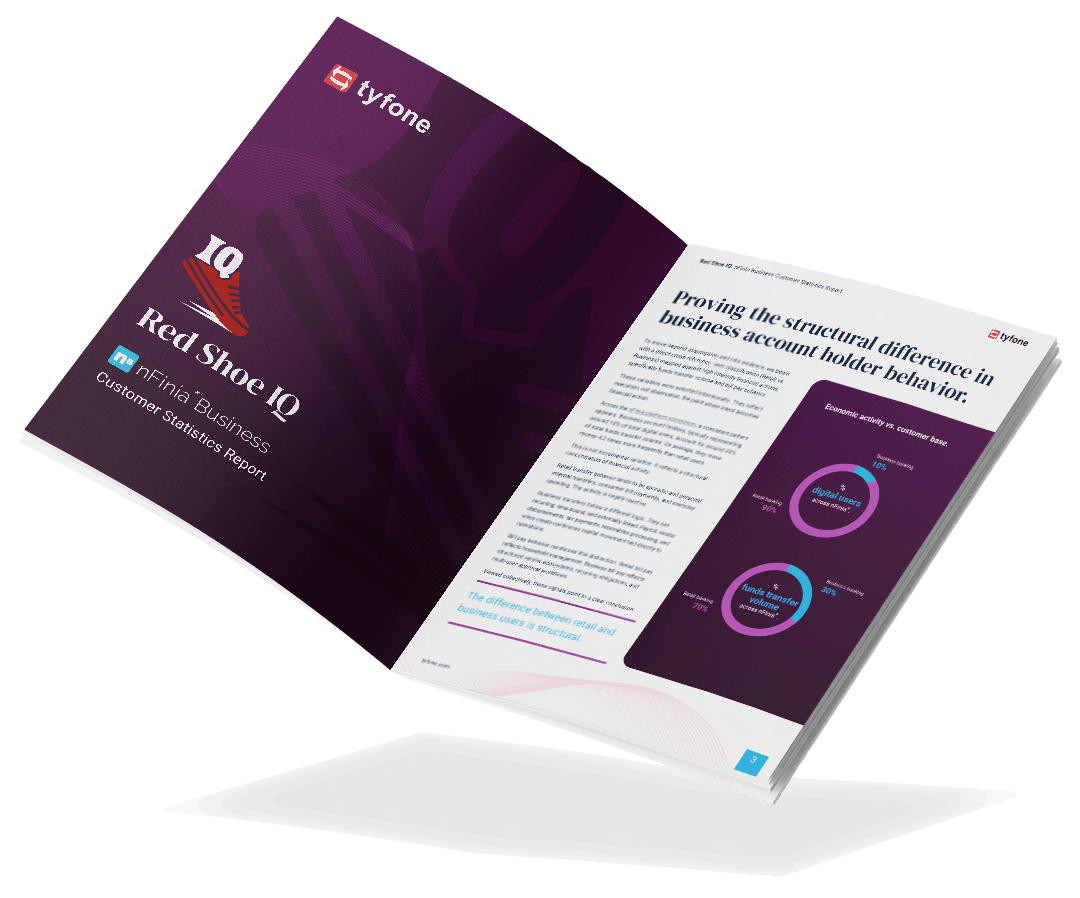
Red Shoe IQ: nFinia Business customer statistics report.
For years, financial institutions assumed retail and business users were simply variations of the same digital persona. But a full year of behavioral data tells a different story. Insights from Tyfone Red Shoe IQ reveal that business users don’t just use digital banking more, they use it differently.
Download the full report to see what the data means for your digital strategy.
What consumers are actually asking for.
The good news is that closing this gap doesn’t require a massive investment or a complex rewards structure. The ideas that came up most consistently in both our focus group research and trade-off analyses were practical, specific and well within reach for most institutions.
- Milestone acknowledgments: Meaningful recognition of membership anniversaries, whether through a personal note, an unlocked benefit or an annual review of services that says clearly: we know you’ve been here, and it matters.
- Tenure-based rate adjustments: Incremental improvements to deposit rates or modest breaks on loan rates for members who have maintained relationships over five, ten, or fifteen years.
- Fee relief tied to relationship depth: Automatic waivers on routine fees like wire transfers or official checks for longstanding members, going beyond balance-only thresholds.
- Priority access at key moments: Dedicated service tiers that give long-tenured members faster access to advisors during major life events such as home purchases or retirement planning.
None of these ideas are especially radical, but they matter because they tell members and customers their loyalty is seen. And for most institutions, the systems needed to do this are already in place. What’s often missing is the decision to make it a priority, especially when compared to acquisition.
For credit unions, that matters even more. Their value proposition is already built around relationships and member focus, but those strengths only carry weight when members can point to something tangible that reflects them.
The math works.
The objection that rewarding existing consumers compresses margins misses the bigger picture. Replacing stable, long-term deposit relationships through expensive acquisition campaigns costs far more than retaining them. According to recent research, it’s as much as 5 times more expensive to acquire new business. Unlike new purchase intentions—with a focus on short-term gain—loyalty emerges from customers’ continuous assessments of experience. Specifically, do these added benefits such as service convenience, reasonable fees and overall advantages of staying put consistently exceed the costs incurred relative to competing banks?
Long-tenured members also tend to be a financial institution’s most stable, least rate-sensitive depositors. Treating them interchangeably with new account holders is a shortsighted way to manage a balance sheet.
Banking relationships deepen over time, or at least they should. What are you providing that they can’t get elsewhere? It’s not always a cash reward. The institutions that make loyalty feel tangible will be in a stronger position to keep it.
For many consumers, this comes down to a basic question: does my loyalty count here or not? More institutions should be answering that more clearly.
Corey Wrinn oversees all sales, marketing, research, and operational functions within the Rivel Banking Research team which conducts primary research on U.S. banking customers. Ultimately, the research analysis informs financial institutions on their market position, identifies areas for growth and opportunity, and monitors their overall impact on their customers and community. It is the world’s largest syndicated banking survey, supplemented with custom research, and Corey can be seen and heard sharing these banking insights across local media and at in-person events throughout the year.
About Rivel Banking Research
Rivel provides exclusive primary research and analysis on your local banking consumers and businesses, regularly through focus groups, surveys, interviews, and custom solutions. For more information on Rivel Banking Research’s benchmarking, market opportunity highlights, and on-hand brand perception insights for your institution, contact: Corey Wrinn, Managing Director, Rivel Banking Research at cwrinn@rivel.com.
Disclaimer
The views, opinions, and perspectives expressed in articles and other content published on this website are those of the respective authors and do NOT necessarily reflect the views or official policies of Tyfone and affiliates. While we strive to provide a platform for open dialogue and a range of perspectives, we do NOT endorse or subscribe to any specific viewpoints presented by individual contributors. Readers are encouraged to consider these viewpoints as personal opinions and conduct their own research when forming conclusions. We welcome a rich exchange of ideas and invite op-ed contributions that foster thoughtful discussion.