
The deposit problem isn’t really about deposits.

Sit through enough strategic planning sessions, and you will start to believe the entire banking industry boils down to a single question: How do we grow deposits? It’s a fair question. In many ways, it’s the question our industry has been asking for decades. But I am no longer convinced it’s the right one.
We spend countless hours debating rates, liquidity, digital acquisition, artificial intelligence, and the next campaign designed to bring in another account. Yet, while we spend our days talking about deposits, our customers spend theirs worrying about making payroll on Friday, buying a safer vehicle, sending a child to college, protecting everything they have worked for, or wondering whether retirement is finally within reach. We call them deposits. They call it their livelihood.
Most people have not stopped believing in the American Dream. They have simply begun wondering whether it is still possible for them. The economy looks different today than it did when CD promotions could save your quarter. Nearly two-thirds (62%) of Americans now see homeownership as out of reach in 2026. Meanwhile, a recent report from the World Economic Forum found that 30% of Gen Z began investing in university or early adulthood, compared to 15% of Millennials, 9% of Gen X and 6% of Baby Boomers.
In other words, too many hardworking Americans cannot afford to buy a home and are hedging their golden years on a few cents rounded up from their Starbucks latte with investment platforms like Robinhood and Acorns.
Existing and future customers are spending, borrowing, and investing with whatever platform meets them where their lives already are. Considering the typical American household keeps just $8,000 in combined transaction accounts, the question in front of every financial institution should not be ‘how do we grow deposits?’. In this new economy, the real question is how we become indispensable.
Think Bigger. Sixty Percent Bigger.
The phrase ‘primary financial institution,’ or PFI, has been part of our vocabulary for years. Typically, PFI is defined by some combination of direct deposit, bill pay, and other activated services. The anchor, though, remains direct deposit, the primary source of income for most individuals. We have all read the white papers and the influencer blogs, written by people who have never managed a P&L, arguing that PFI no longer matters. Let us get real. Financial institutions that do not win the source of income stay in the friend zone.
Recent studies show that 89 percent of Americans use direct deposit. Yet 60 percent have never switched where it goes. While data suggests rates and incentives can motivate a switch, here’s the gut check: Relying on that strategy limits your FI to competing for the 40 percent even open to switching. This may help explain why, at many banks and credit unions, only about 30–40% of retail customers have recurring direct deposits attached to their accounts. Once a paycheck lands somewhere, inertia takes over, and inertia is powerful.
Here is how indispensable FIs compete for that 60 percent too.
Stop Renting Deposits. Start Solving Problems.
A promotional rate may attract money, but it rarely earns loyalty. If a member joins your institution for a better rate, they will often leave you for a better rate. Too many community FIs get stuck playing ‘rate roulette’, the game being to outpace attrition by adding more partial members then they lose each month.
Most customers do not wake up hoping to find a bank with a slightly better yield. They wake up with problems that need solving. The institution that consistently solves those problems becomes far more valuable than the one offering a few extra basis points.
Pro Tip: We must put our data to work for the customer. We need to build relevant products faster and look past our own four walls for the adjacencies that actually make a customer’s life easier. For example, consider the 62 percent of Americans who believe owning a home is out of reach. Data shows many of these individuals pay record high rents and earn sufficient income. Mine that data to identify the real barrier, then build an underwriting model and product designed for today’s economy rather than one built twenty years ago. That is how you finally move a paycheck. Hint: Down payment and mortgage insurance requirements play a major role.
Story continued below…
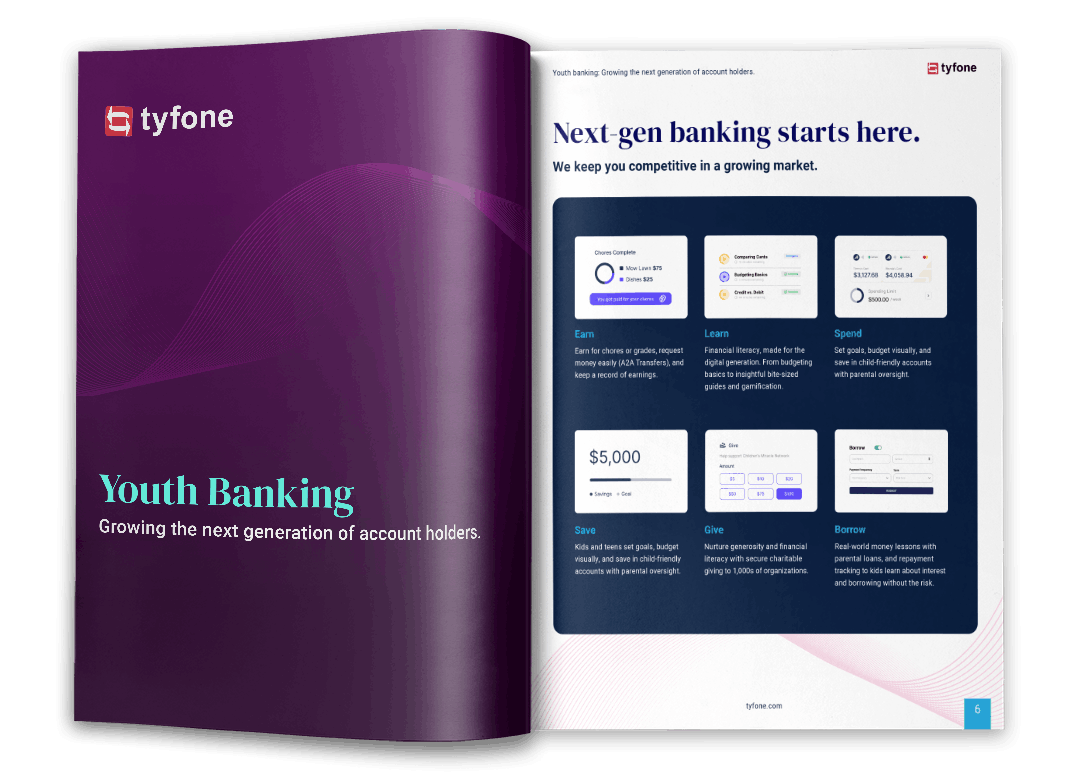
FREE PAMPHLET
Youth banking: Growing the next generation of account holders.
Financial habits are formed early, but most financial tools are designed for adults. As a result, families often rely on cash, shared cards, or disconnected apps to teach money management, making it difficult to balance independence with oversight.
At the same time, younger generations expect intuitive digital experiences, creating a gap between how they interact with money and how financial services are delivered. Financial institutions need age-appropriate solutions that engage younger account holders while supporting parents and caregivers.
Accelerate on Affluent Segments.
According to a recent study by Cerulli Associates, nearly $124 trillion in assets is set to change hands over the next 20 years, primarily to Millennials and Gen X. Modern affluence looks different. For example, 84% of millennials said it was important that their investments align with their values, but 53% said it was hard to do. Whether it’s people helping people or investing local dollars back into the neighborhoods that trust us most, community banks and credit unions were built for this moment.
Pro Tip: Behind every business owner is a consumer. Running parallel with the great wealth transfer is the great ownership transfer. By 2035, six million small businesses will change hands as boomers retire. Every one of those owners needs a deposit account, a place to invest, and access to consumer lending. Leverage data fluency and AI to understand this segment, starting with your existing client base. Build one seamless experience for the business and for the owner’s personal wealth. Make it unreasonably competitive. Make it frictionless. Make it bespoke. Craft something that breaks down silos by bringing every line of business together as one dedicated team of trusted advisors. Hint: This can be mastered by understanding your cost to acquire and factoring in lifetime value. Get this right, and profitability follows, because it’s anchored in deposit growth.
Branches Are Not Dead. We Just Undersold Them.
For years, banks trained branch staff to be traffic directors, pointing customers toward the app and the ATM. In doing so, we quietly taught them the branch was the inconvenient option. Today a common reason anyone drives to a branch is to fix a problem after six failed attempts with an AI phone menu on their lunch break.
The branch of the future is where business owners find advisors, young families build financial confidence, and neighbors gather to solve meaningful problems.
Pro Tip: Reposition the branch as a community hub, not a last resort. Remove the outdated lineup of teller, banker, and manager. Replace it with best in class, cross trained, highly credentialed teams that use data to spot opportunities and proactively meet with clients to build a real path to financial freedom. Invest in digital banking to solve more problems, not just photograph checks and push offers. I can get a DoorDash refund in fifteen seconds. No customer should need an end of day SLA to resolve an overdraft or payment dispute. Hint: The branch is the lighthouse. Digital is the compass. You need both to navigate what comes next.
Finally, own the next conversation by meeting customers where their lives are today and anticipating their best version of tomorrow. Community banking has never been about products alone. It has always been about our neighbors. Our greatest competitive advantage is knowing the people behind the balance sheet. The institutions that win will not simply be the most efficient. They will be the most indispensable. Growing deposits was never the goal. It was always the outcome.
Philip Sutliff is the founder of Main Street & Co., a boutique consulting firm serving community banks and credit unions. After building his career inside large national banks, he developed a playbook for building and rebuilding business banking divisions that has gained national recognition. He works with executive teams and boards to turn overlooked groups into scalable growth engines that drive real deposit and loan growth. Sutliff is an adjunct professor of economics and is widely recognized as a thought leader and disrupter in the industry.
Disclaimer
The views, opinions, and perspectives expressed in articles and other content published on this website are those of the respective authors and do NOT necessarily reflect the views or official policies of Tyfone and affiliates. While we strive to provide a platform for open dialogue and a range of perspectives, we do NOT endorse or subscribe to any specific viewpoints presented by individual contributors. Readers are encouraged to consider these viewpoints as personal opinions and conduct their own research when forming conclusions. We welcome a rich exchange of ideas and invite op-ed contributions that foster thoughtful discussion.