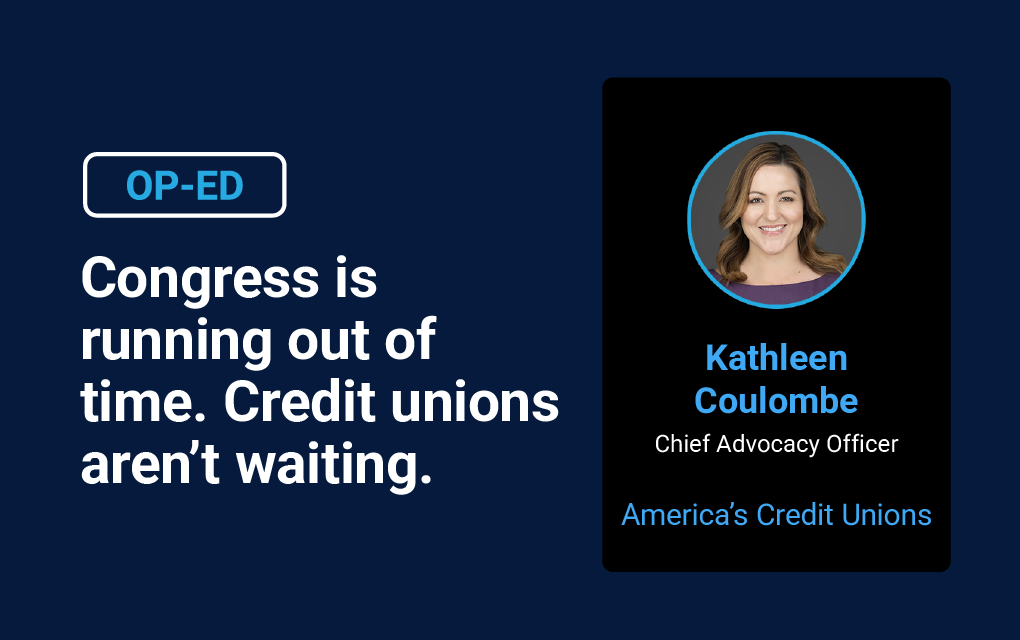

Congress is running out of time. Credit unions aren’t waiting.

September marks the unofficial end of summer and the start of a new season. Kids are heading back to school, pumpkin spice lattes are back and Congress is entering a critical final stretch of the 119th Congress.
For credit unions, though, September isn’t about starting fresh. It’s about building on the work and momentum we’ve created all year. Across the country and in Washington, credit unions have been showing up: serving their 146 million members, telling their stories, and making the case for policies that protect their ability to help people achieve greater financial freedom.
That work has laid a strong foundation. Now, as lawmakers turn their attention to the final months of this Congress, we have an opportunity, and a responsibility, to build on it.
Our collective advocacy has already delivered meaningful results this Congress. We’ve kept harmful interchange proposals at bay by demonstrating the real-world consequences they would have for credit unions and the consumers and communities they serve, while successfully protecting the credit union tax status through multiple iterations of reconciliation legislation.
We’ve successfully reminded lawmakers of the importance of credit union modernization and regulatory parity, culminating in passage of the bipartisan Credit Union Board Modernization Act (CUBMA).
CUBMA becoming law was the result of years of strategic advocacy and a strong presence on Capitol Hill, making the case that reducing unnecessary regulatory burdens and modernizing outdated requirements ultimately benefits the Americans credit unions serve.
It was a significant victory for the credit union movement, but we’re not done and we’re not waiting years for the next one.
These wins demonstrate what’s possible when the credit union movement speaks with a strong, unified voice, but they also underscore the importance of maintaining that momentum through the final stretch.
After credit unions and Leagues spent the August recess meeting with lawmakers in their districts and states, this month the credit union industry converged on Capitol Hill to strategize and sharpen skills to protect and advance credit union priorities at the federal level. This year’s Congressional Caucus event gave advocates opportunities for hands-on experience and direct access to fellow advocates and influence experts to be ready to engage Congress with clarity and purpose.
Story continued below…

FREE PAMPHLET
Bringing AI-native deep intelligence to Tyfone’s AI-first solution.
Most credit unions and community banks don’t have an AI strategy yet, and account holders aren’t waiting. They’re already comparing every digital experience, banking included, to ChatGPT. Stand still and get left behind.
Fathom is the AI layer woven throughout Tyfone’s digital banking ecosystem, combining account holder financial data, institutional knowledge, and native banking experiences into a single intelligence layer.
Calibrating the movement is critical for seeing pro-credit union backed legislation become law and we have already identified key pieces in the works right now.
During the August recess, after months of work from America’s Credit Unions and credit union advocates, Reps. Janelle Bynum and Young Kim introduced the Credit Union Investment Authority Act. This bill would update the antiquated laws that currently limit the investment options for federal credit unions. Along with previously introduced legislation in the House and Senate to provide longer maturities on credit union loans, advocates on the Hill are focused on pushing lawmakers to modernize the Federal Credit Union Act as it is key for credit unions to be able to stay competitive in the financial marketplace.
The collaboration with Congress to drive more modernization and innovation for credit unions does not stop there. CTRs and SARs thresholds are long outdated and have even longer burdened credit unions with excessive reporting on regular, non-criminal activity. Our advocates are articulating these concerns to lawmakers and are working to see relief by pushing legislative and regulatory changes.
Credit union advocacy is year-round because the stakes for more than 146 million Americans are too important to be anything less. Credit unions have proven their strength as trusted financial partners, economic engines in their communities, and a powerful collective voice for the people they serve.
As we enter this critical final stretch of the 119th Congress, we have an opportunity to leverage that strength and the progress we’ve made together. By protecting and empowering credit unions, policymakers can ensure they continue opening doors to financial opportunity, strengthening communities, and helping millions of Americans achieve the financial freedom that makes the American Dream possible.
Kathleen Coulombe is the Chief Advocacy Officer of America’s Credit Unions. She joined the association from the American Council of Life Insurers (ACLI), where she served as Senior Vice President, Federal Relations, leading engagement on a broad range of public policy issues impacting financial security. Previously, she oversaw ACLI’s retirement security portfolio as Vice President and Principal Deputy of Federal Relations. Kathleen holds a Bachelor of Arts in Political Science from the University of Nevada, Las Vegas, and a Master of Public Policy from George Washington University.
Disclaimer
The views, opinions, and perspectives expressed in articles and other content published on this website are those of the respective authors and do NOT necessarily reflect the views or official policies of Tyfone and affiliates. While we strive to provide a platform for open dialogue and a range of perspectives, we do NOT endorse or subscribe to any specific viewpoints presented by individual contributors. Readers are encouraged to consider these viewpoints as personal opinions and conduct their own research when forming conclusions. We welcome a rich exchange of ideas and invite op-ed contributions that foster thoughtful discussion.