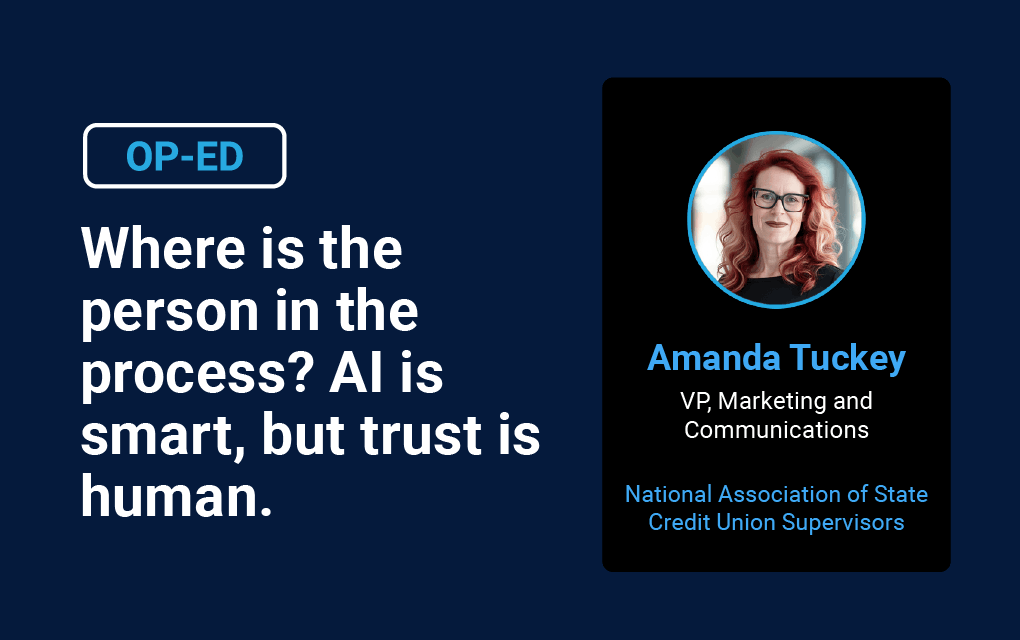

Where is the person in the process? AI is smart, but trust is human.
AI can make credit unions faster, more efficient and more personalized. But it can’t replace the human connection that built the industry in the first place.
This op-ed by NASCUS’ Amanda Tuckey explores the balance between embracing AI and knowing when members still need judgment, empathy and a real person — especially when something goes wrong.
The question isn’t whether credit unions should use AI. It’s where the person fits in.
Written By:

Amanda Tuckey
VP, Marketing and Communications
Personal connection is not incidental to our industry; it’s the foundation of our story and what has sustained us. As we speed towards artificial intelligence, automation, personalization, and the next wave of innovation, it is worth keeping that foundation in view. We spend a great deal of time talking about AI in terms of efficiency, competitiveness, and optimization, and rightly so. But those gains are most meaningful when they strengthen, rather than replace, the relationships that have always set this industry apart.
My recent reminder of that came courtesy of an airline. It started with a delayed flight, followed by three more canceled flights, an 18-hour travel day, renting a car to drive home, and, eventually, my luggage vacationing in a completely different city. Somewhere in the middle of all of this, I found myself doing something I’m sure many of us have done: I was trying to be polite to a computer.
At first, I was patient with the AI agent. Several minutes later — which is an eternity when you are stranded in an airport — I was yelling, “Connect me to a human. Speak to a person.” The AI was unfazed. I, however, was not.
It wasn’t just that something went wrong. Travel goes wrong. Technology breaks. People mess up. What bothered me was that I expected the company to know me better. I had invested years in our relationship, chosen that specific brand over others, and recommended it to my friends and family. But then, when I needed help, it felt like none of that seemed to matter.
I seriously contemplated breaking up with my airline. Instead, like many dissatisfied customers, I did something much harder to measure: I quietly started looking around.
That should concern everyone, because the loud customer isn’t always the one you need to worry about. Sometimes it is the person who quietly stops calling, clicking, or choosing you. We need to get better at noticing what isn’t being said — fewer touchpoints, abandoned applications, repeated requests to “talk to a person,” or a gradual drop in engagement.
AI is incredibly useful. It can recognize patterns, automate repetitive work, personalize communications, and answer questions some may never feel comfortable asking another person. AI has a very high IQ. Unfortunately, it also has low emotional intelligence. It solves problems without understanding why they matter. It reassures you, encourages you, and even tells you your idea is amazing.
Story continued below…
FREE PAMPHLET
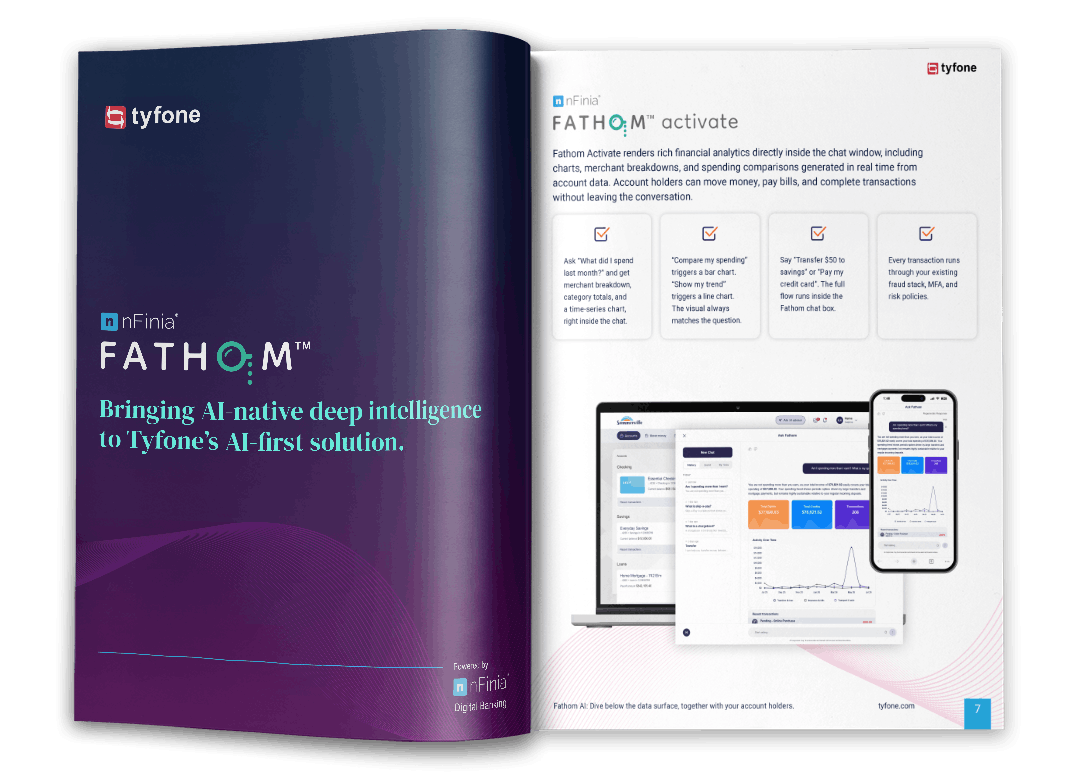
Bringing AI-native deep intelligence to Tyfone’s AI-first solution.
Most credit unions and community banks don’t have an AI strategy yet, and account holders aren’t waiting. They’re already comparing every digital experience, banking included, to ChatGPT. Stand still and get left behind.
Fathom is the AI layer woven throughout Tyfone’s digital banking ecosystem, combining account holder financial data, institutional knowledge, and native banking experiences into a single intelligence layer.
Let’s remember, though: it doesn’t actually know how amazing you are.
That distinction matters, because money is deeply personal. It’s how people pay rent, buy groceries, send a child to college, care for aging parents, and buy their first home. A financial problem doesn’t feel like a data point on a spreadsheet to the person experiencing it.
At the same time, member expectations have changed. People now compare their credit union experience not just with other financial institutions (and if you’re like me, you have more than one), but with the easiest digital interaction they had all week — an app, a delivery service, a five-second checkout, or a platform that somehow knew exactly what they wanted.
Fair? Probably not. Reality? Absolutely.
Our opportunity is to pair what credit unions already do well — trust, relationships, and putting members first — with enough convenience that members don’t have to choose between personal service and a user-friendly experience.
That experience will look different for different people. My 78-year-old father and 19-year-old daughter belong to the same credit union for completely different reasons. One wants instant payments to pay for pizza, while the other wants reassurance that paper checks are still accepted and to calm his anxiety over scams. Our job is to understand those needs, not assume them. And while AI can help, it will never really know those two people.
Outreach can become harder as fraud and misinformation grow more sophisticated. Members are told not to trust the text, the email, the caller, or the link, while also being asked to read our emails, texts, and social posts. When every message says URGENT, eventually nothing feels urgent. The answer isn’t simply more warnings. Trust is built through consistency, transparency, and follow-through.
There is a significant difference between talking at someone and talking to them.
There’s another issue: artificial intelligence can be confidently wrong. Which, to be fair, is also a uniquely human trait. The difference, however, is scale. A person can give one customer bad information; an automated system can give 50,000 customers bad information before lunch. Human oversight isn’t evidence that AI failed. It’s part of responsible implementation, letting technology handle what it does well while people focus on situations where judgment and empathy matter most.
We’ve all heard that “perception is reality,” and there’s a reason the phrase sticks around. My airline probably had reasonable explanations for everything that happened during my trip, and with better communication I may have understood them. But it was still my experience, and that event shaped my outlook.
So yes, we should embrace artificial intelligence. Use it to make faster decisions, identify trends, personalize communications, reduce repetitive work, and remove friction. But as we build this technology, we should keep asking one simple question: Where is the person in this process?
The credit union movement was built by people who saw unmet needs and worked together to solve them. AI can help us do that work faster and smarter, but it cannot replace the human connection that made this industry different in the first place. And if we’re doing this right, it shouldn’t have to.
Amanda Tuckey is a seasoned marketing and communications executive with more than 20 years of experience in the governmental and financial services sectors, including leadership roles with the Michigan Credit Union League. As Vice President of Marketing and Communications at NASCUS, she leverages expertise in strategic marketing, consumer research, stakeholder engagement, and emerging technologies to drive brand awareness, member engagement, and industry impact.
Throughout her career, Amanda has led high-profile, multi-channel initiatives spanning statewide consumer awareness campaigns, international investment programs, public policy communications, and Congressional relationship strategies. She also spearheaded financial sector research and analysis during the COVID-19 pandemic, providing critical insights into market trends and economic impact. Her expertise includes market intelligence, user experience, public policy, data-driven decision-making, and organizational transformation.
Disclaimer
The views, opinions, and perspectives expressed in articles and other content published on this website are those of the respective authors and do NOT necessarily reflect the views or official policies of Tyfone and affiliates. While we strive to provide a platform for open dialogue and a range of perspectives, we do NOT endorse or subscribe to any specific viewpoints presented by individual contributors. Readers are encouraged to consider these viewpoints as personal opinions and conduct their own research when forming conclusions. We welcome a rich exchange of ideas and invite op-ed contributions that foster thoughtful discussion.