
The first impression is a screen.

Rivel Banking Research conducts primary market research and focus groups for financial institutions nationwide, delivering real feedback from consumers and businesses in your market. Through independent research conducted twice annually, we capture the perspectives, preferences, and behaviors of consumers and businesses at the local market level. To learn what your members and prospects are telling us, reach out at cwrinn@rivel.com.
Banks and credit unions spend more time than they’d like to admit every year, deciding which digital channel deserves the next marketing dollar. But channel selection is not the real problem. Consumers discover financial institutions through online search, social media, website ads and streaming. Which ones matter most depends on the audience, but the first encounter increasingly happens on a screen.
What consumers told us.
At Rivel, we recently asked consumers and small business owners across the country how they make banking decisions—who gets their consideration when it comes to opening new accounts? Increasingly, retail consumers are finding new brands and financial options online first. When we recently asked those who had considered a new bank or credit union where they first heard about it online, the answers split across four channels. More importantly, the mix changed sharply by generation.
| Where they first heard online | Overall | Gen Z | Millennial | GEn X | Boomer |
|---|---|---|---|---|---|
| Online search results | 33% | 21% | 27% | 46% | 33% |
| Social media | 28% | 38% | 37% | 29% | 40% |
| Website banner ads or articles | 21% | 17% | 20% | 20% | 13% |
| Video or audio streaming | 17% | 25% | 17% | 6% | 13% |
While online search results lead overall in terms of brand discovery, it’s third for Gen Z and only second for Millennials. Consider a more balanced approach depending on your intended growth area. You do not need to spend equally everywhere but stop using “digital” as if it describes a single media choice. These channels reach different people in different ways, and none reaches a majority of prospective customers all on their own.
Story continued below…
FREE PAMPHLET
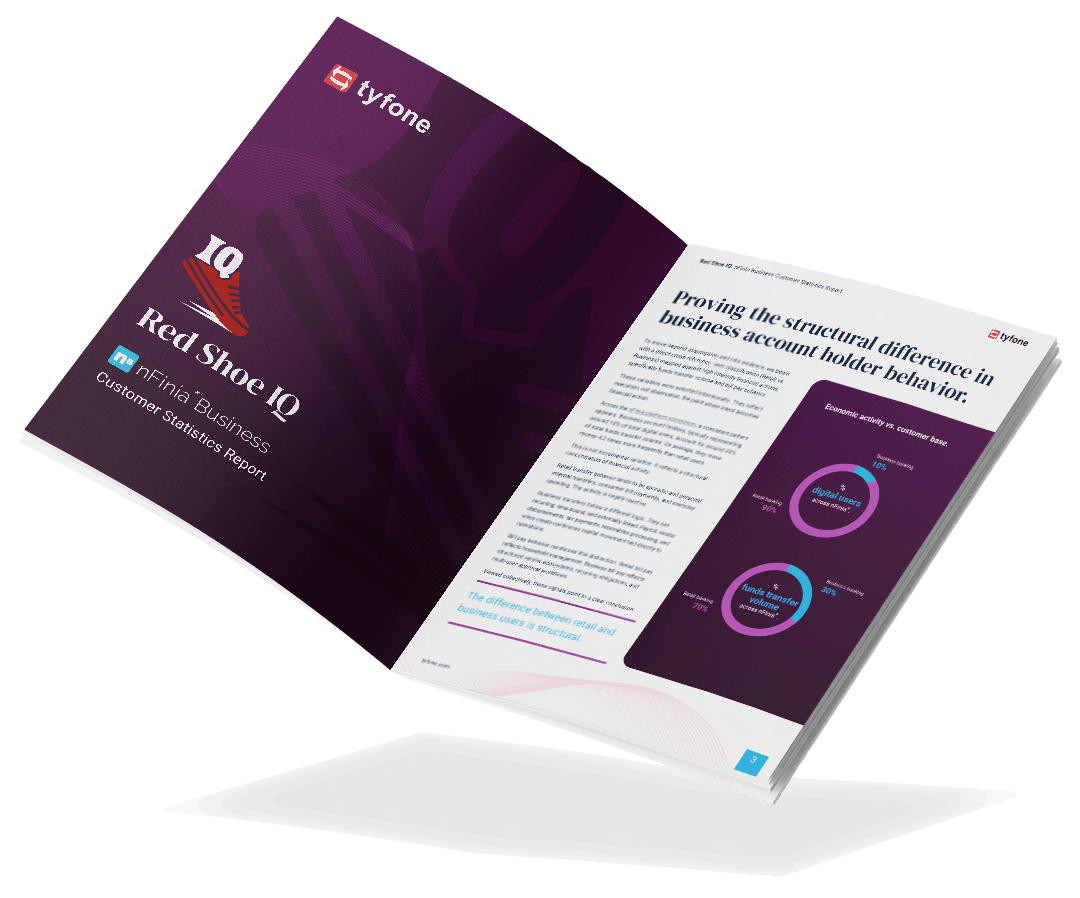
Red Shoe IQ: nFinia Business customer statistics report.
For years, financial institutions assumed retail and business users were simply variations of the same digital persona. But a full year of behavioral data tells a different story. Insights from Tyfone Red Shoe IQ reveal that business users don’t just use digital banking more, they use it differently.
Download the full report to see what the data means for your digital strategy.
Segmentation should drive the channel plan.
Focus on the difference between those potential new consumer age brackets and then act. Wanting to attract a younger consumer with your digital-first banking options and low loan rates? Great—then don’t treat streaming and social as fun side experiments. Start with that investment and build on top of it as you are measuring impressions, but more importantly, actual accounts being opened.
Consider how you are committing real budget to digital marketing consistently and then measure whether more people recognize and consider the institution. For example, if the credit union wants to reach an older audience, search deserves more weight. Ignoring age produces an unfocused channel plan that misaligns with your goals.
Brand marketing is more than products.
Segmentation tells you who to reach and where. It does not tell you what to say. Too many institutions fill that space with rate tables and product lists, then wonder why nobody remembers them. Say something people can actually repeat and remember.
Our national research shows 30% of retail banking consumers are at risk of leaving their primary institution, 20% are shopping for a new checking account and 49% are researching those decisions through traditional or AI search. Put that 49% next to the 33% above who first heard about a new institution through online search results, and the pattern is hard to miss: search is where many people find you, and it is where they go back to decide whether you are worth the switch. These people are not waiting for your next campaign cycle. They are looking now and will land on whoever gives them a reason to stop.
Your goal as an FI in a competitive space is to give them that reason. If you launched an AI chat feature and customers are using it, don’t bury it in a release note. Tell prospects what it means for them: faster answers, fewer dead ends and help at 10 p.m. when the branch is closed. If you built a micro-loan program for lower-income households, tell that story out loud. Explain how it can help, and what it replaces for the family that would otherwise walk into a payday lender. That is a brand message, not a standard product ad, and it travels far better in the channels your segments actually use.
One practical starting point.
When we asked Gen Z which type of financial services content stands out on social media, 47% chose video. Standalone text drew 19%, static images 18%, and infographics 15%.
That does not mean every campaign needs to become a polished television spot. It means video should often be the first version of the message, not the afterthought. Once you know the audience you want to reach and the story you want them to remember, build a short video around that idea. Then adapt it across the channels that matter most: social media, streaming audio or video, display and search. The message should stay consistent, but the length, opening and call to action should change based on how people use each channel.
Don’t work backwards by starting with the channel and then look for something to say. Start with the audience, build the message in a format people notice and then adjust it for the places where that audience is most likely to see it.
Corey Wrinn oversees all sales, marketing, research, and operational functions within the Rivel Banking Research team which conducts primary research on U.S. banking customers. Ultimately, the research analysis informs financial institutions on their market position, identifies areas for growth and opportunity, and monitors their overall impact on their customers and community. It is the world’s largest syndicated banking survey, supplemented with custom research, and Corey can be seen and heard sharing these banking insights across local media and at in-person events throughout the year.
About Rivel Banking Research
Rivel provides exclusive primary research and analysis on your local banking consumers and businesses, regularly through focus groups, surveys, interviews, and custom solutions. For more information on Rivel Banking Research’s benchmarking, market opportunity highlights, and on-hand brand perception insights for your institution, contact: Corey Wrinn, Managing Director, Rivel Banking Research at cwrinn@rivel.com.
Disclaimer
The views, opinions, and perspectives expressed in articles and other content published on this website are those of the respective authors and do NOT necessarily reflect the views or official policies of Tyfone and affiliates. While we strive to provide a platform for open dialogue and a range of perspectives, we do NOT endorse or subscribe to any specific viewpoints presented by individual contributors. Readers are encouraged to consider these viewpoints as personal opinions and conduct their own research when forming conclusions. We welcome a rich exchange of ideas and invite op-ed contributions that foster thoughtful discussion.