
The refi window is getting shorter.

There is something worth noting about how this market now behaves.
Freddie Mac’s 30-year fixed printed 6.76% yesterday, up again from 6.71% the week before and more than 40 basis points above where it sat a year ago. The driver isn’t housing. It’s bond yields responding to inflation that won’t quite settle, energy prices that keep climbing, and a growing suspicion in the market that the Fed’s next move is up, not down.
Consider what the last six weeks have looked like.
In early August, the July jobs report showed the economy losing 23,000 jobs. Rates dropped within hours. The narrative shifted toward a softening labor market and a Fed that would have to stay on hold.
Then last Friday, the August report showed 162,000 jobs added against a consensus of 53,000. And buried in the revisions, July’s loss of 23,000 became a gain of 21,000. The negative print that moved the market in August no longer exists. Short-term yields jumped, and hike odds climbed again.
This morning’s CPI landed at 3.4% year over year, in line with expectations, but core came in a tenth hotter than forecast, with gasoline responsible for more than a third of the monthly increase. It was the last major data point before the FOMC meets next week, and it did not deliver the disinflation, the Chair said he needed to see.
That’s the environment. Rates aren’t trending anymore; they’re reacting. To every data release, every Fed comment, every revision to a number we thought was settled a month ago. The Committee held at 3.50% to 3.75% in July on a 9 to 3 vote, the most divided decision since 2016, and every dissent argued for a hike, not a cut. Next Wednesday brings a new vote and a new dot plot, and markets have spent the past two weeks pricing a hike as more likely than not.
Story continued below…
FREE PAMPHLET
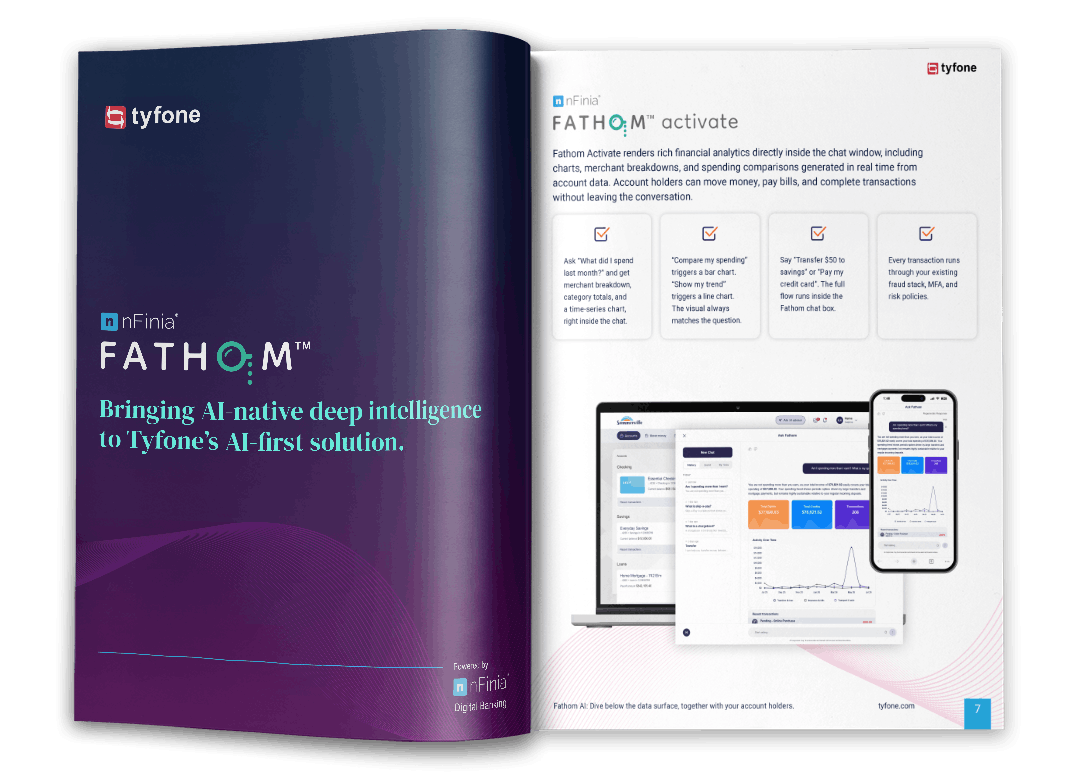
Bringing AI-native deep intelligence to Tyfone’s AI-first solution.
Most credit unions and community banks don’t have an AI strategy yet, and account holders aren’t waiting. They’re already comparing every digital experience, banking included, to ChatGPT. Stand still and get left behind.
Fathom is the AI layer woven throughout Tyfone’s digital banking ecosystem, combining account holder financial data, institutional knowledge, and native banking experiences into a single intelligence layer.
The refinance numbers tell the other half of the story. Back in February, when the 30-year briefly touched 6.01%, refi applications more than doubled year over year. Households were clearly watching. This week, the refinance index is down 25% from a year ago, running at its slowest pace since spring of last year. Same households. Same mortgages. The window opened, and then it closed, and the whole cycle took a few months.
What strikes me is less about any single rate level and more about duration. The windows are getting shorter. A refi environment used to feel like a season, something you could plan around, staff for, and talk to members about with some confidence. Now it looks like a stretch of days between data releases, open and closed before most households, and honestly most institutions, have fully registered that it happened.
I don’t think our industry has internalized what that shift means. It changes how we forecast, when a quarterly outlook can be overturned by a Friday morning and then overturned again by a revision to that same Friday morning. It changes how we staff, when demand arrives in bursts instead of waves. And it changes how we talk to members who ask where rates are headed, because the true answer is that the direction depends on what gets published next week, and that isn’t the answer anyone wants to hear.
I’m not sure I’ve fully internalized it either.
Curious how others are thinking about it.
The $1.8 billion-asset University of Kentucky Federal Credit Union has eight branches and 121,000 members. It hired Ryan Ross as its new CEO in October, 2024, to replace Dan Kittleson, who took the CEO role on an interim basis.
Disclaimer
The views, opinions, and perspectives expressed in articles and other content published on this website are those of the respective authors and do NOT necessarily reflect the views or official policies of Tyfone and affiliates. While we strive to provide a platform for open dialogue and a range of perspectives, we do NOT endorse or subscribe to any specific viewpoints presented by individual contributors. Readers are encouraged to consider these viewpoints as personal opinions and conduct their own research when forming conclusions. We welcome a rich exchange of ideas and invite op-ed contributions that foster thoughtful discussion.