
Credit unions already have the advantage. Fintech can help us use it.

Credit unions have spent more than 100 years building something extraordinarily valuable: trust.
We are member-owned. We have no outside shareholders demanding a return. We operate with a federal income-tax advantage that today creates roughly 15–20% of pre-tax earnings capacity versus a taxable competitor. We have local relationships, extraordinary access to insured deposits, and a cooperative system built around sharing and collaboration.
If you designed a retail financial institution from scratch with those advantages, you would expect it to be incredibly difficult to compete against.
Yet after more than a century, credit unions still represent a relatively small share of American financial services.
That should bother us.
The problem is not the cooperative model. The question is whether we are converting its advantages into enough visible member value and enough growth.
That starts with strategy.
Too many institutions begin their technology discussion with products: What platform should we buy? What features do we need? What is everybody else doing?
The CEO needs to start somewhere else:
What institution are we trying to build?
Where are we going to compete?
Why should members choose us?
And how fast do we intend to grow?
Growth is not the strategy. It is evidence that the strategy is working.
At Bethpage, doubling approximately every five years forced us to rethink almost everything—pricing, service, talent, technology, distribution, capital and culture. The 2X goal mattered because the existing institution could not simply work a little harder and get there.
It forced us to think differently.
That same pressure matters now because digital banking has become the largest branch for most credit unions—and increasingly it is the brand.
This is where fintech partnership can become a genuine credit-union competitive advantage.
Whether you are a $250 million credit union or a $250 billion credit union, you cannot — and should not — assume that the best strategy is to build every capability yourself.
Credit unions have another route to scale.
Collaboration.
Combine the credit union’s balance sheet, member relationship, local knowledge and strategic leadership with fintech technology, specialized talent, APIs, shared infrastructure and the learning occurring across hundreds of institutions, and suddenly scale does not belong only to the largest banks.
That is the opportunity.
Tyfone’s newly announced nFinia Reimagined and Fathom make the point tangible.
Story continued below…
FREE PAMPHLET
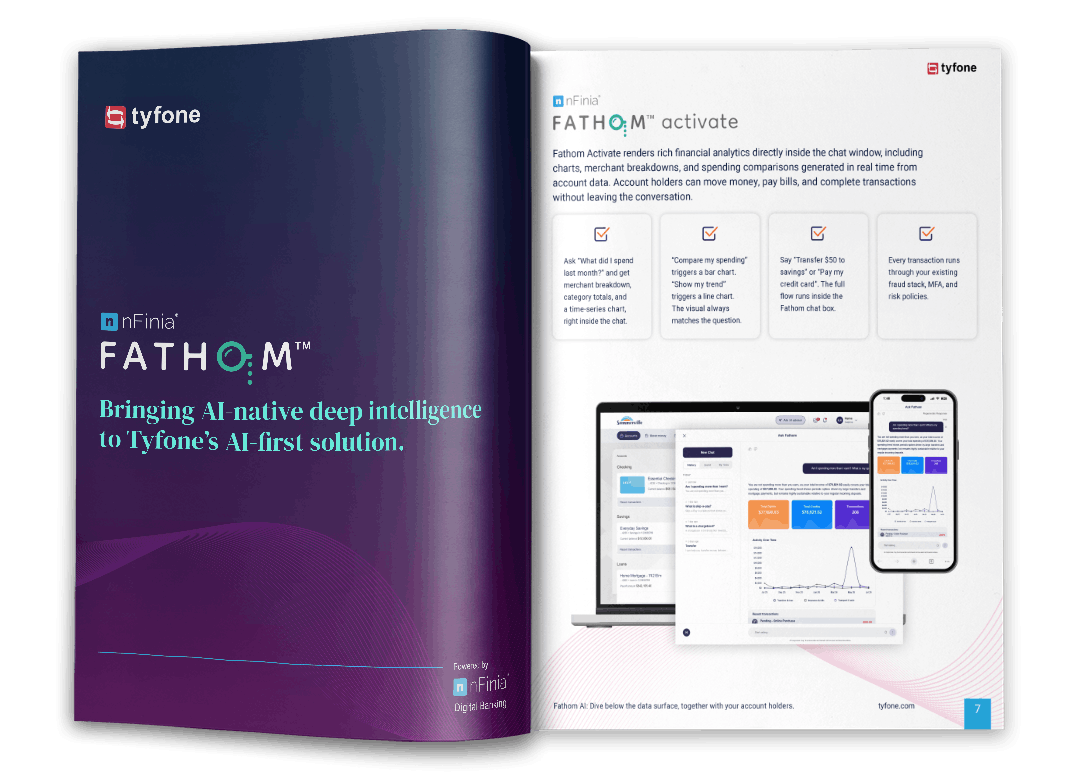
Bringing AI-native deep intelligence to Tyfone’s AI-first solution.
Most credit unions and community banks don’t have an AI strategy yet, and account holders aren’t waiting. They’re already comparing every digital experience, banking included, to ChatGPT. Stand still and get left behind.
Fathom is the AI layer woven throughout Tyfone’s digital banking ecosystem, combining account holder financial data, institutional knowledge, and native banking experiences into a single intelligence layer.
Tyfone reports that 55% of Americans used AI for a financial task during the past year, compared with only 10% the year before.
Think about what that means.
The financial conversation is already moving into AI. The question is whether that conversation occurs with the member’s credit union — or somewhere else.
Fathom is designed as a deep-intelligence AI layer within digital banking, grounded in actual account data and capable of keeping the financial institution inside that conversation.
That is far more interesting strategically than simply adding another feature.
The opportunity is to use AI and fintech partnerships to create a fundamentally better credit union.
- Lower structural cost.
- Better pricing.
- Low fees.
- Kind service.
- Extraordinary convenience.
- Better advice.
- Faster decisions.
- More personalized relationships.
And then use those advantages to grow.
But there is an important catch.
A fintech cannot provide the credit union’s strategy.
The best technology partner should bring ideas, outside knowledge, speed and capabilities the credit union does not possess internally. It should challenge assumptions and help management understand what is becoming possible.
But technology cannot replace judgment.
A credit union still has to decide where it wants to compete, what member value means, where it will invest, what it will stop doing and what institution it intends to become.
In fact, the quality of a strategic partnership is partly determined by the quality of the client.
If management has no clear strategy, no urgency and no willingness to change, even the best fintech eventually becomes another vendor.
The much more exciting possibility is different.
Imagine taking the economic advantages credit unions have accumulated over 100 years — the cooperative structure, tax advantage, trusted relationships and member ownership — and combining them with technology and fintech scale that previous generations of credit union leaders could never have imagined.
Then ask the question we should have been asking all along:
How much better could we make banking for members — and how fast could we grow if we actually did it?
That is the opportunity in front of us.
Before joining PARC Street Partners, Kirk Kordeleski was a partner at OM FinancialGroup for four years. Prior to that, he was CEO of $13.5 billion-asset Bethpage FCU in New York for 15 years.
Disclaimer
The views, opinions, and perspectives expressed in articles and other content published on this website are those of the respective authors and do NOT necessarily reflect the views or official policies of Tyfone and affiliates. While we strive to provide a platform for open dialogue and a range of perspectives, we do NOT endorse or subscribe to any specific viewpoints presented by individual contributors. Readers are encouraged to consider these viewpoints as personal opinions and conduct their own research when forming conclusions. We welcome a rich exchange of ideas and invite op-ed contributions that foster thoughtful discussion.