
Urgency before crisis: Why credit unions need a new growth narrative.

I recently found myself revisiting John Kotter’s classic Harvard Business Review article, Leading Change: Why Transformation Efforts Fail. More than 30 years after it was published, one observation remains remarkably relevant:
The first responsibility of leadership is not strategy, structure, or execution. It is creating a sense of urgency.
That sounds simple enough. But for many credit unions, it may be the most difficult leadership challenge we face.
Why?
Because 2025 was, by most measures, a good year. Capital levels remain strong. Asset quality is healthy. Most institutions are financially sound. Boards and executives have every reason to feel proud of what they have built. Yet history suggests that success can become its own obstacle.
Clayton Christensen’s groundbreaking work, The Innovator’s Dilemma, demonstrated that successful organizations often struggle to embrace transformational change precisely because they are successful. They focus on serving existing customers, optimizing existing business models, and improving existing products. Those decisions are logical. They are also the reason many industry leaders eventually lose ground to new competitors.
Today’s financial services landscape is changing rapidly.
JPMorgan Chase is investing billions in technology. SoFi, Chime, and digital-first competitors are redefining convenience and member experience. Artificial intelligence is beginning to reshape lending, service, marketing, fraud prevention, and operations. New technologies are lowering costs, increasing personalization, and accelerating decision-making.
The future will not look like the past.
And while credit unions continue to perform well, the broader movement remains largely stuck at approximately 8% to 9% market share. Deposit growth has slowed. Loan demand has softened. Competitive pressures are increasing.
The challenge is not identifying the trends.
The challenge is creating urgency before those trends become a crisis.
Story continued below…
FREE PAMPHLET
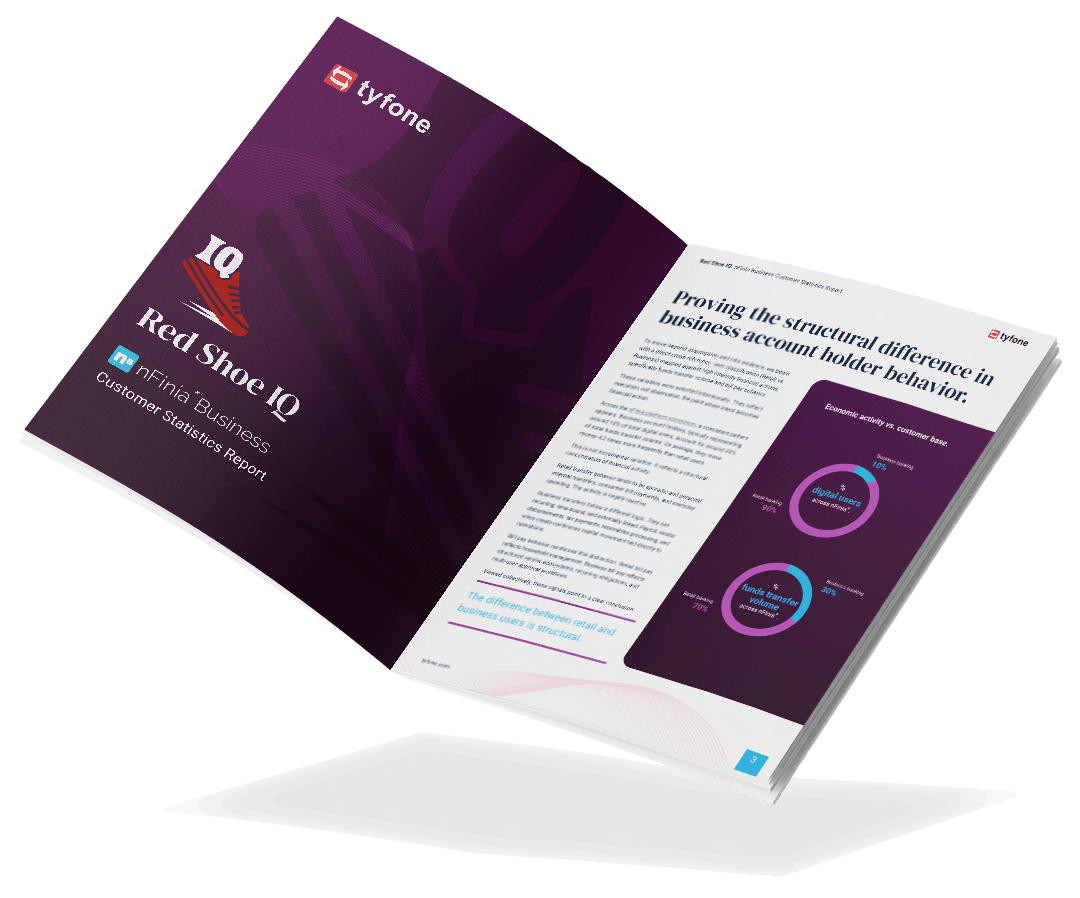
Red Shoe IQ: nFinia Business customer statistics report.
For years, financial institutions assumed retail and business users were simply variations of the same digital persona. But a full year of behavioral data tells a different story. Insights from Tyfone Red Shoe IQ reveal that business users don’t just use digital banking more, they use it differently.
Download the full report to see what the data means for your digital strategy.
During my 22 years at Bethpage and 15 years as CEO, we doubled revenue roughly every five years. Looking back, growth was never the goal. Growth was the result of creating more value for more members every year. Growth created resources. Resources created talent, technology, innovation, and scale. Scale created even more member value.
That experience shaped my belief that organizations rarely change because they understand the need to change.
They change because leaders help them feel urgency around the future. That belief is one of the reasons several credit union leaders recently launched the 20 by 35 movement.
The idea is straightforward: what if credit unions doubled their relevance over the next decade and increased their collective market share from roughly 9% today to 20% by 2035? The number itself is not the point.
The point is creating a strategic intent bold enough to challenge assumptions, inspire innovation, attract talent, and focus leadership attention on what is possible.
Twenty percent market share would mean serving millions more consumers. It would mean greater investment in technology, stronger member value propositions, larger community impact, and a more influential cooperative movement.
Most importantly, it creates the constructive urgency that Kotter described decades ago. Not urgency driven by fear.
Not urgency driven by crisis.
Urgency driven by possibility.
Credit unions have never had more opportunity than they do today. New technologies, expanding fields of membership, evolving consumer expectations, and innovative business models are creating possibilities that previous generations of leaders could scarcely imagine.
The question is not whether change is coming.
The question is whether we will act while the opportunity is still in front of us.
The institutions that thrive over the next decade will not be the ones forced to change by crisis.
They will be the ones that chose to change before the crisis ever arrived.
Before joining PARC Street Partners, Kirk Kordeleski was a partner at OM FinancialGroup for four years. Prior to that, he was CEO of $13.5 billion-asset Bethpage FCU in New York for 15 years.
Disclaimer
The views, opinions, and perspectives expressed in articles and other content published on this website are those of the respective authors and do NOT necessarily reflect the views or official policies of Tyfone and affiliates. While we strive to provide a platform for open dialogue and a range of perspectives, we do NOT endorse or subscribe to any specific viewpoints presented by individual contributors. Readers are encouraged to consider these viewpoints as personal opinions and conduct their own research when forming conclusions. We welcome a rich exchange of ideas and invite op-ed contributions that foster thoughtful discussion.