
A 5-PART WHITEPAPER SERIES
Part 5: Building the toolkit.
The platform play that lets you move fast.
Part Five of five, written for the boards and CEOs of community banks and credit unions. Outsiders are consolidating your consumers’ data, the world’s largest AI companies are making themselves the new front door to your consumers’ finances, and a new breed of digital entities is disintermediating payments and money itself. This series shows what these forces can take, what they cannot, and what to do about it.
By Dr. Siva Narendra, CEO & Co-Founder, Tyfone

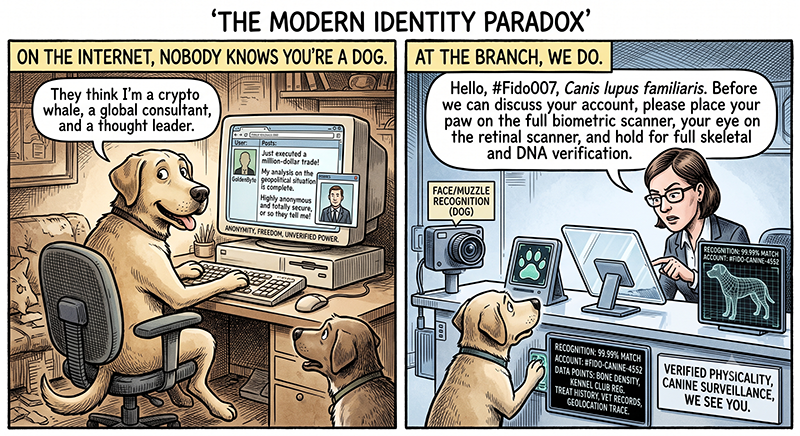
Image generated by Gemini
Executive summary.
Four papers diagnosed; this one prescribes. Part One showed your information advantage commoditized. Part Two showed the relationship moving to AI front doors. Part Three followed the money onto rails that bypass you. Part Four found the ground that holds: lending, real but under attack from three directions. This paper keeps the series’ promise: what to do about all of it.
The plan has five moves.
- Defend lending with flexible workflows inside the institution and a borrowing experience outside it that is as convenient as the attackers’ and more secure.
- Turn your physical presence into the trust layer of digital identity, because everything digital runs on trust and trust is the asset you hold.
- Deliver the personalization the AI front doors deliver, before their convenience displaces your trust.
- Use the new payment rails as a weapon instead of waiting for them as a threat.
- Participate in stablecoins as a lender, not an issuer.
None of these capabilities can be built one vendor and one integration at a time at the pace the threats in Part Four demand. That is why this paper ends where the series has been pointing all along: the toolkit must exist as a platform.
Start where the ground holds: the lending experience.
Part Four ended with a warning shaped like a fork: the structural walls decide who can carry the loan, but the experience decides who wins the borrower. The first move, therefore, is to close the experience gap in lending, and it has two sides.
Inside the institution, the requirement is flexible workflows. No two community institutions underwrite alike, and that is a feature: your lending policy is where your private knowledge of the borrower becomes an asset. But policy expressed through rigid, hard-coded systems becomes a delay, and delay is precisely what the frictionless attackers exploit. The institution needs origination workflows it can shape and reshape itself, for retail and commercial lending alike, without an engineering project every time policy changes.
Outside the institution, the requirement is a borrowing experience that is genuinely convenient and visibly secure. The mortgage lesson from Part Four is unambiguous: borrowers did not leave community institutions because the loans were worse; they left because applying was. Loan origination convenience and security are not refinements; they are the battlefield itself.
And the experience does not end at closing. The most underbuilt corner of lending is what happens when a borrower hits trouble. Collections are where relationships are destroyed; prevention is where they are cemented. Highly flexible, fully automated loan skips (letting a qualified borrower move a payment, instantly, around the clock, without shame and without a phone call) turn the worst moment in the lending relationship into a demonstration of the relationship. Done well, products like this are more than retention tools. They are differentiators hard enough to build that they become moats of their own.
Everything digital runs on one fuel.
Before the next three moves, name the thread that connects them. Every layer this series watched leave (data, advice, payments, money) left through digital channels, and every digital channel runs on the same fuel: trust. The AI front doors have convenience and are working on trust. You have trust and are working on convenience. The next best moves are about deploying that trust advantage before it erodes.
“I particularly agree with the trust component. If members lack trust in you, it becomes challenging for them to follow your recommendations and refer you to other members. However, we must continue to safeguard our data and consider all aspects related to cybersecurity.”
– John Holt
President & CEO
Nutmeg State Financial Credit Union
Personalization, before convenience displaces trust.
I’ve mentioned before that the money-management tools institutions built into their apps failed to hold attention. The reason is simple: they weren’t personal. They showed one institution’s slice of a consumer’s life, dressed in pie charts. But a consumer’s financial life spans eight institutions, and your app can only see one of them.
Personal financial management was never truly personal.
The AI front doors fixed that, which is exactly why Part Two of this series was alarming. My own test (every account, every transaction, synced in half an hour, followed by an hour of genuinely useful planning) showed what personalization looks like when the tool can see everything. It is convenient in a way no institution app has ever been.
What it does not yet have is the thing you have: trust. The surveys in Part Two said it plainly: only 18% of Americans would trust AI to make financial recommendations on its own, while 85% trust their financial institutions.
That gap is the window, and it is the same window every previous part identified: real but draining. The move is to close the personalization gap from the trusted side before the front doors close the trust gap from the convenient side.
In practical terms: bring generative AI personalization inside the institution’s own digital banking, and use the consolidators (the same aggregation rails Part One described) to see the account holder’s whole financial life with their permission. The aggregators are infrastructure; they will carry your view of the account holder as readily as they carry OpenAI’s.
The difference is that when the complete, personalized, conversational experience comes from you, it arrives wrapped in the trust the AI companies are still trying to earn. Personalization plus trust beats personalization alone. But only if the personalization actually ships.
Turning the payment rails from threat to weapon.
Part Three of this series described instant payments as a threat and promised a strategic option. Here it is.
Recall the second asymmetry from that paper: the Durbin cap applies to what the card-issuing bank receives, but not to what the merchant actually pays. The processors serving merchants, many owned by the largest banks, capture that spread.
That spread is the opening. When your institution offers merchants payment acceptance over instant rails (a QR code at the register, with account-to-account payments in seconds), the acquirer markup is disintermediated, this time in your favor and the merchant’s. The merchant pays a fraction of card acceptance costs, and you hold the deposit account the money settles into.
And the megabanks’ own pricing instincts hand you the recruiting pitch. If a large institution charges merchants fees to receive instant payments, every such fee is an argument for the merchant to move the relationship to an institution that does not. The small-business operating account, the very relationship Part Four showed Square capturing through its point-of-sale data, comes back into play. The rails that looked like the threat in Part Three become, used first and priced fairly, the instrument for winning the merchant relationship back.
Stablecoins: lend, do not issue.
Part Three ended its stablecoin section with a promise as well. The answer begins with what not to do. A community institution should not issue its own stablecoin. The arithmetic is unforgiving: every retail dollar converted into a fully reserved token is a dollar that must sit in safe reserve assets, which means it is a dollar that can no longer fund a loan.
Issuing converts the cheap, loyal deposits Part Three taught you to protect into sterile reserves, and shrinks the very lending capacity Part Four taught you to defend. For a community balance sheet, issuing a stablecoin is self-disintermediation with extra steps.
Participation, though, is a different matter. If successful stablecoin ecosystems emerge, with real buyers and sellers transacting in tokens, those participants will still need what commerce has always needed: credit.
The institution’s role is the one Part Four already proved defensible: be the lender. Lend to buyers in those ecosystems, in the currency they actually use, backed by underwriting strength no platform can replicate.
And programmable money sharpens the opportunity. When the money itself can carry rules (release on delivery, repay from settlement, draw down as needed), lending can become efficient at sizes that were never economic before. Stablecoin microlending, automated end to end, is a product category waiting for lenders with the charter to do it safely, and that is you, not them.
The toolkit as concentric circles.
There is a simple way to see how these capabilities fit together: as concentric circles. At the center are the basics, the essential digital banking capabilities an institution must get right. The next circle is digital payments, digital lending, and digital security: the capabilities that move money, deepen the relationship, and protect it. The outer circle is AI, not as another feature added to the stack, but as an amplifier across everything inside it.
That distinction matters. The opportunity is not business plus AI. It is AI multiplied by the business: AI × digital banking, AI × payments, AI × lending, and AI × security. The stronger the capabilities underneath it, the more powerful the amplifier becomes. And because every circle depends on the others, the toolkit cannot be assembled as a collection of disconnected projects. It has to work as a platform.
Story continued below…
FREE PAMPHLET
Bringing AI-native deep intelligence to Tyfone’s AI-first solution.
Most credit unions and community banks don’t have an AI strategy yet, and account holders aren’t waiting. They’re already comparing every digital experience, banking included, to ChatGPT. Stand still and get left behind.
Fathom is the AI layer woven throughout Tyfone’s digital banking ecosystem, combining account holder financial data, institutional knowledge, and native banking experiences into a single intelligence layer.
Personalization, before convenience displaces trust.
I’ve mentioned before that the money-management tools institutions built into their apps failed to hold attention. The reason is simple: they weren’t personal. They showed one institution’s slice of a consumer’s life, dressed in pie charts. But a consumer’s financial life spans eight institutions, and your app can only see one of them.
Personal financial management was never truly personal.
The AI front doors fixed that, which is exactly why Part Two of this series was alarming. My own test (every account, every transaction, synced in half an hour, followed by an hour of genuinely useful planning) showed what personalization looks like when the tool can see everything. It is convenient in a way no institution app has ever been.
What it does not yet have is the thing you have: trust. The surveys in Part Two said it plainly: only 18% of Americans would trust AI to make financial recommendations on its own, while 85% trust their financial institutions.
That gap is the window, and it is the same window every previous part identified: real but draining. The move is to close the personalization gap from the trusted side before the front doors close the trust gap from the convenient side.
In practical terms: bring generative AI personalization inside the institution’s own digital banking, and use the consolidators (the same aggregation rails Part One described) to see the account holder’s whole financial life with their permission. The aggregators are infrastructure; they will carry your view of the account holder as readily as they carry OpenAI’s.
The difference is that when the complete, personalized, conversational experience comes from you, it arrives wrapped in the trust the AI companies are still trying to earn. Personalization plus trust beats personalization alone. But only if the personalization actually ships.
Turning the payment rails from threat to weapon.
Part Three of this series described instant payments as a threat and promised a strategic option. Here it is.
Recall the second asymmetry from that paper: the Durbin cap applies to what the card-issuing bank receives, but not to what the merchant actually pays. The processors serving merchants, many owned by the largest banks, capture that spread.
That spread is the opening. When your institution offers merchants payment acceptance over instant rails (a QR code at the register, with account-to-account payments in seconds), the acquirer markup is disintermediated, this time in your favor and the merchant’s. The merchant pays a fraction of card acceptance costs, and you hold the deposit account the money settles into.
And the megabanks’ own pricing instincts hand you the recruiting pitch. If a large institution charges merchants fees to receive instant payments, every such fee is an argument for the merchant to move the relationship to an institution that does not. The small-business operating account, the very relationship Part Four showed Square capturing through its point-of-sale data, comes back into play. The rails that looked like the threat in Part Three become, used first and priced fairly, the instrument for winning the merchant relationship back.
Stablecoins: lend, do not issue.
Part Three ended its stablecoin section with a promise as well. The answer begins with what not to do. A community institution should not issue its own stablecoin. The arithmetic is unforgiving: every retail dollar converted into a fully reserved token is a dollar that must sit in safe reserve assets, which means it is a dollar that can no longer fund a loan.
Issuing converts the cheap, loyal deposits Part Three taught you to protect into sterile reserves, and shrinks the very lending capacity Part Four taught you to defend. For a community balance sheet, issuing a stablecoin is self-disintermediation with extra steps.
Participation, though, is a different matter. If successful stablecoin ecosystems emerge, with real buyers and sellers transacting in tokens, those participants will still need what commerce has always needed: credit.
The institution’s role is the one Part Four already proved defensible: be the lender. Lend to buyers in those ecosystems, in the currency they actually use, backed by underwriting strength no platform can replicate.
And programmable money sharpens the opportunity. When the money itself can carry rules (release on delivery, repay from settlement, draw down as needed), lending can become efficient at sizes that were never economic before. Stablecoin microlending, automated end to end, is a product category waiting for lenders with the charter to do it safely, and that is you, not them.
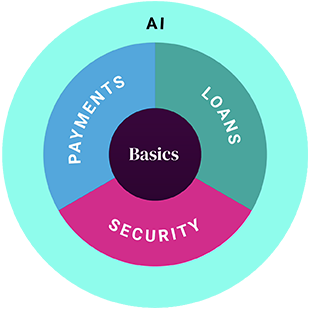
The toolkit as concentric circles.
There is a simple way to see how these capabilities fit together: as concentric circles. At the center are the basics, the essential digital banking capabilities an institution must get right. The next circle is digital payments, digital lending, and digital security: the capabilities that move money, deepen the relationship, and protect it. The outer circle is AI, not as another feature added to the stack, but as an amplifier across everything inside it.
That distinction matters. The opportunity is not business plus AI. It is AI multiplied by the business: AI × digital banking, AI × payments, AI × lending, and AI × security. The stronger the capabilities underneath it, the more powerful the amplifier becomes. And because every circle depends on the others, the toolkit cannot be assembled as a collection of disconnected projects. It has to work as a platform.
“The financial services industry is moving from a product-centered model to an ecosystem-centered model. At 7 17 Credit Union, we’re embracing that reality through investments in digital banking, mobile technology, enterprise analytics, and fintech integration across lending, payments, and investing.”
– John Demmler
President & CEO
7 17 Credit Union
The platform play.
Count the moves: reshapeable lending workflows, a borrowing experience that wins on convenience and security, automated skip-a-pay that prevents collections, branch-anchored digital identity, GenAI personalization over aggregated data, merchant payments on the instant rails, stablecoin lending. Now recall the constraint Part Four left open: community-scale institutions do not employ the engineering armies the platforms do, and the breaches are not waiting.
This is why the answer is a platform play rather than a project list. Built one vendor, one integration, one steering committee at a time, the toolkit above is a decade of work, and Part Four’s honest map says the decade is not available.
Delivered as one platform, where digital banking, account opening, the full lending arc from origination through payments, skip-a-pay, and collections prevention, the payment rails, and the AI experience share one foundation and one security model, the same toolkit becomes something a 200-million-dollar institution can wield as quickly as a 25-billion-dollar one. Speed is the strategy. The platform is how community institutions buy speed without surrendering control, because the alternative to moving fast is not moving slowly. It is watching each of the five layers in this series finish leaving.
How this toolkit exists today.
Everything this paper prescribes, Tyfone has built with and for community financial institutions, because we wrote this series from inside the work.
Tyfone’s Digital Origination Platform delivers retail and commercial origination with the flexible workflows Section I describes, in production at institutions from $200 million to $25 billion in assets. Its fully automated loan skips run around the clock, every day of the year, and over a recent twelve-month period prevented collections by processing more than 300,000 skips across roughly 50 community institutions; its loan payment solution gives borrowers a true real-time payment experience, and stablecoin lending of the kind Section VI describes is on its roadmap.
The Payfinia CUSO is driving the instant-payment ecosystem benefits of Section V, putting the rails and the merchant opportunity in community hands.
And nFinia digital banking anchors the trust argument of Sections II through IV: it is the first digital banking platform to deploy patented decentralized cryptographic device authentication against account-takeover fraud, and the first to deliver all three channels (web, app, and a generative AI experience) governed by a sophisticated rules engine and comprehensive AI guardrails, including dual authentication, data control, account masking, PII masking, observability, and retrieval-augmented generation. The series you have just read is not a prediction we are waiting on. It is the market we built for.

About the author.
Dr. Siva Narendra is the CEO and Co-Founder of Tyfone, a leading digital banking technology provider serving community banks and credit unions across the United States. Over the past two decades, he has worked at the intersection of digital banking, payments, identity, and financial technology, helping institutions navigate periods of technological disruption while maintaining their competitive independence.
Sources
- Parts One through Four of this series and the sources cited therein.
- Federal Reserve (FedNow) and The Clearing House (RTP) instant-payment rails; Durbin Amendment interchange framework and post-implementation merchant cost studies.
- GENIUS Act (2025) stablecoin reserve requirements; industry analysis of reserve-backed issuance and balance-sheet effects.
- TD Bank / Ipsos and Northwestern Mutual consumer trust research, 2025-2026.
- Tyfone, and Payfinia CUSO product and performance information, 2025-2026.