INDUSTRY NEWS
PFCU uses automation to find more lending opportunities.
The Michigan credit union has centralized underwriting and automated decisions to speed up service while giving loan originators more time to identify members’ borrowing needs.
At PFCU in Portland, Michigan, faster lending is about more than moving applications through the system. By centralizing underwriting and automating some decisions, the $873 million credit union is trying to free employees to do something less easily handled by software: help members identify borrowing needs they may not have considered.
“We want to help members whenever possible,” Michele Makley, PFCU’s president and chief executive, told Tyfone.
That approach shapes how the credit union uses automated underwriting. Rather than automatically rejecting applications that fall outside its lending parameters, PFCU sends them to an underwriter for individual review. The system is designed to speed up decisions that fit established criteria while leaving room for human judgment when a borrower’s circumstances call for it.
PFCU has 57,165 members and held $564 million in loans and leases as of June 30, according to National Credit Union Administration call report data. It earned $5 million in the first half of 2026, up from $2.2 million in the same period a year earlier.
Makley said the credit union has reorganized lending by centralizing underwriting, automated decisioning, lending and processing. Each area can concentrate on its own responsibilities, supported by employees with the specialized skills needed for the work.
The structure, she said, has created efficiencies while helping PFCU deliver the speed and convenience members expect without giving up personalized service.
The challenge is finding the right pace for automation. Makley said PFCU expanded automated underwriting gradually, increasing its use as the credit union gained confidence in the decisions. It continues to monitor the system to make sure it performs as intended, she said, while automated decisioning has also strengthened fraud detection.
Human review remains essential, particularly when an application falls outside established parameters. Makley said PFCU does not automatically deny loans, allowing underwriters to examine cases that require a closer look.
Story continued below…
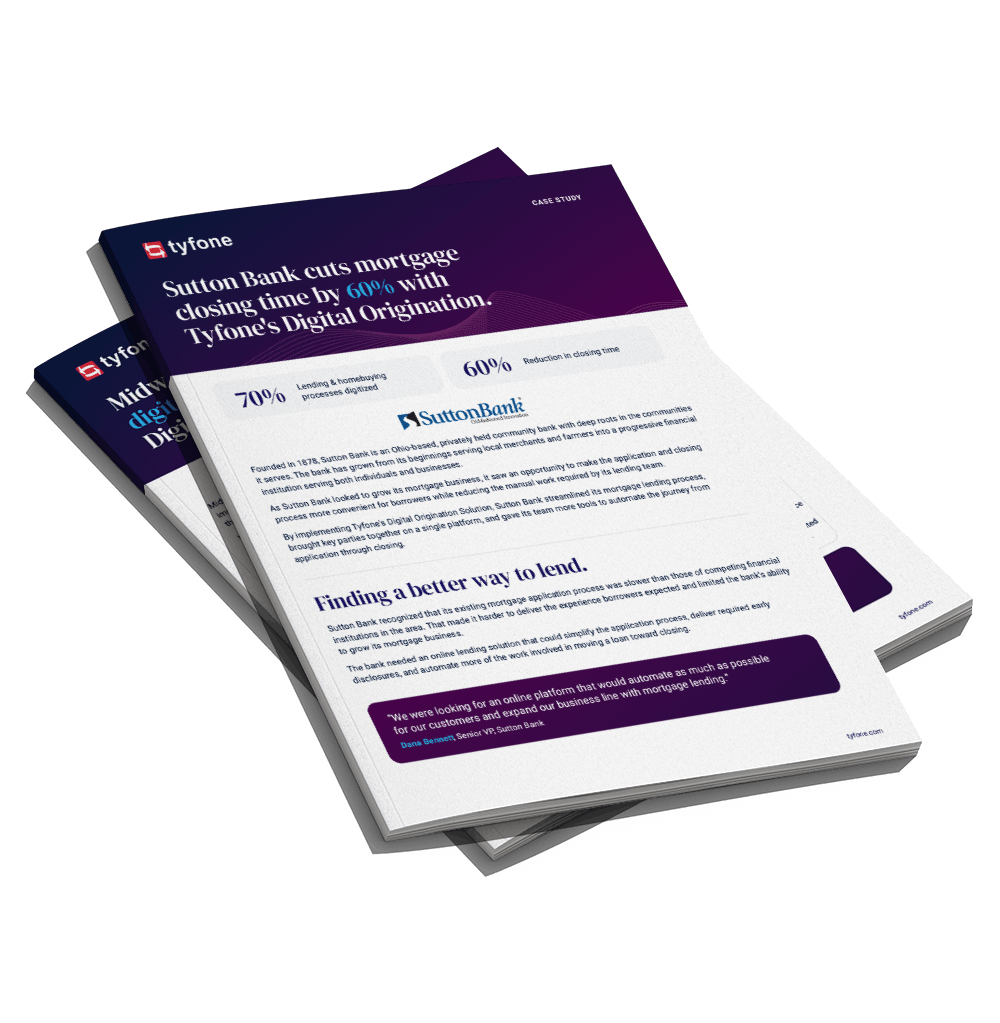
FREE CASE STUDIES
Borrowers expect speed. Your lending process should deliver.
Borrowers want answers fast. No waiting. No paperwork. No unnecessary back-and-forth. Manual processes and disconnected systems make lending harder, slowing decisions, adding work for staff, and creating friction at every step.
Tyfone makes lending faster and simpler with a flexible, white-label experience built around your policies. From application to funding, give borrowers a seamless experience across digital and in-branch channels.
That flexibility reflects a broader tension in digital lending: Credit unions want to make borrowing easier, but faster decisions must still fit their risk tolerance. Makley said PFCU continually refines its processes and adjusts its decisioning to balance serving members with maintaining appropriate lending standards.
She also cautioned against changing too much too quickly. After introducing a change, PFCU allows enough time to measure the results before making another adjustment. The goal is to understand whether a change is working rather than repeatedly altering the process before its effects are clear.
Technology integration is another priority. A digital lending process can promise convenience but fall short if the systems behind it do not work together. Makley said PFCU wants a seamless member experience and an efficient workflow, and it can usually determine quickly which vendors already have established relationships with the credit union.
When possible, PFCU prefers to work with existing vendors, Makley said. That approach can limit exposure to additional third parties and reduce the sharing of member data.
For PFCU, the payoff from a simpler application process is not limited to getting more loans approved. Makley said ease of use is essential to encouraging members to complete applications. The resulting efficiencies can also give consumer loan originators more time to discuss other lending options and review members’ credit reports for additional borrowing needs.
That creates an opportunity to generate business beyond the applications that arrive on their own.
“This allows us to increase our loan volume beyond what is just coming at us,” Makley said.
The strategy makes digital lending both an operational tool and a way to deepen member relationships. Automation can handle qualifying applications more efficiently, while employees use the time saved to identify opportunities and help members understand their options.
For PFCU, the measure of progress is not simply how quickly a loan receives a decision. It is whether a more efficient process helps the credit union serve members, maintain sound lending standards and find lending opportunities that might otherwise go unnoticed.
“We continually refine our process to improve the member experience.”
– Michele Makley
President & CEO
PFCU
Ken McCarthy is manager of marketing communications at Tyfone, where he monitors the credit union industry and contributes to conversations shaping its future. He previously covered credit unions and community banking for American Banker and S&P Global Market Intelligence. He holds a journalism degree from Point Park University and has more than 15 years of experience covering financial services. He is also the author of three literary fiction novels.